Home Blog Page 102

David Griffin’s ‘For You’ and the World-Premiere Recording of the Broughton Sonata

0

A teacher of mine long ago had a terrible nickname for fourth horn players in the orchestra. He called them the “garbage-men of the horn section.” While I wasn’t exactly sure what he meant, I knew that he intended it as some kind of insult. It stuck with me.

As I became a professional, I learned better of course. There was a story behind that teacher’s negative comment, and in hindsight he really had no business planting such an idea in my impressionable head.

If there ever were any misgivings about the capabilities of fourth horn players, David Griffin‘s new recording For You smashes this misguided notion and erases all doubt.

The playing here is simply superb.

My personal favorites from For You are the Dukas Villanelle (played with panache and soul), the Pascal sonata  (delightfully performed) and of course, the world-premiere recording of the Bruce Broughton sonata.

I asked David a few questions about his new recording.

* * *

Q:
What prompted you to make this recording?

The primary reason for making it was to record the Broughton Sonata. It’ s a wonderful addition to the horn repertoire and deserves to be better known.

Q:
What equipment do you use and did you make any changes for the recording? If so, why?

I play a Steve Lewis horn built for me in 1986. About two years ago, I starting playing it with a bell flare from an Alexander Descant model 107 which helped to make the response and control in the middle register even better.

For this recording, I switched to my Ron Pinc (Oak Park, IL) single b-flat for the last two pages of the España. My mouthpiece is a Scott Laskey 725G.

Q:
What does the title ‘For You’ mean?

When I first starting playing solo recitals again a few years ago after about 10 years of not playing them, the approach I had was definitely one of trying to see what I could do. I am gradually moving towards to goal of presenting recitals “for you”.

Music is a gift for the listener and the performer should be as generous as possible in terms of expression, variety, and individuality. Hopefully, my CD conveys this.

Also, I thought it would be funny to present my CD to friends and relatives and say, “This is ‘For You’. That’ll be $15.”

Q:
The Broughton sonata is a world premiere recording. How did you manage to arrange that?

Bruce Broughton conducted the CSO Brass Ensemble a few years ago in a performance of his Fanfares, Marches, Hymns & Finale. Bruce brought a lot of energy to rehearsals, set the bar very high, and achieved excellent results from us.

Later, when colleague Dale Clevenger recommended the Broughton Sonata to me, I purchased the music since I had strong positive feeling about the composer.

After performing the sonata a few times, I learned that it had not been recorded.

Q:
Broughton is well-known for his movie scores. What thoughts do you have about the piece?

The Sonata is a fine concert piece, but it is not film music. I like the seemingly endless melodies and frequent color changes, especially the use of the stopped horn in the first movement. There is also a section in the middle movement requiring wide arpeggios to be played on the harmonic series that is evocative of the ancient origins of the instrument.

Many contemporary composers have abandoned melody which makes Broughton’s Sonata stand out even more because he has not joined the erudite crowd that creates music for itself, to be enjoyed by intellectuals and mathematicians.

The piece is challenging in terms of endurance, and for my performances and this recording, I’ve made a few minor cuts and additions, transposed one passage down an octave, and ignored a tempo marking when necessary.

I believe that my alterations have made the piece more approachable for horn players. I don’t hesitate to make changes in scores, even for pieces in the standard repertoire, if it improves the music or my chance of doing it well.

Q:
How do people purchase your new recording “For You?”

http://cdbaby.com/cd/griffindavid

Downloads and sound samples are available there, too!

Contents:

Eugene Bozza: En Foret, op. 40

Bruce Broughton: Sonata for horn and piano

  1. Broad and lyrically expressive
  2. Lyrically expressive: with a sense of timelessness
  3. With a relentless drive

Claude Pascal: Sonata pour Cor et Piano

Randall E. Faust: Call and Response for Solo Horn

Paul Dukas: Villanelle

Camille Saint-Saens: Romance, op.36

Vitaly Buyanovsky: Espana

Karl Pilss: Intermezzo, from Three Pieces

* * *

Since 1995 David has been the fourth hornist in the Chicago Symphony Orchestra. He began his career with the Rochester Philharmonic and followed with positions in the orchestras of Montreal and Houston before joining the Chicago Symphony in 1995.

Review: Meir Rimon, Horn of Plenty

0

Early in the summer we took a road trip and among the CDs I took one of the family favorites was Meir Rimon, Horn of Plenty.

This recording by Meir Rimon (1946-91) was released way back in 1988 on the IBWP label. Rimon, who was Principal Horn of the Isreal Philharmonic, sounds just great on this recording Isreali pop music arranged for solo horn and chamber orchestra, his phrasings are really beautiful as is his sound. When he goes up to the top of his range a wonderful, light quality comes into his sound and I suspect it is where he is up on the high F side, as he was an early adopter of the triple horn. Song titles, to give you the mood of the album, include numbers such as “Perhaps it was Just a Dream,” “Kinneret of Thee I Sing,” Soldiers’ Love Song,” etc. The arrangements are creative and very nicely done as a multi track project in a studio. The horn playing, again, is just great.

If you check iTunes this CD is not listed but his recordings on the Crystal label are still available. If this review has you interested in hearing Meir Rimon, Dances, Moods, and Romances in particular has several tracks in a similar style to those on Horn of Plenty. There are samples of the tracks on iTunes and also in the Crystal Records website. Highly recommended as summer listening.

Technical Materials IV: Materials I am Still Looking For

First a question, did you notice any general category of technical material missing from the materials in the previous posts in this series?

In the first post I mentioned the Reynolds etudes. I studied with Verne Reynolds and I end up using his etudes to a point with advanced students but to be honest, and this may sound like heresy again, what I really wish I could say is I have found is a book that is similar to Reynolds but the etudes are somewhat shorter and easier and could be attempted by younger students. Because that is the material I am still looking for.

In the Horn Central website there are currently [Update: were, site no longer online] 194 horn studies books listed. Certainly nothing listed there has quite reached the level of being a standard that is from the category of contemporary in style and not overly difficult.

A book I have been thinking about trying in lessons next year is this one, The Oliveros Interval Studies by Pauline Oliveros. These were written in 1959 and were published in 2002 by Burdick’s Edition; the listing to purchase may be found on this page. Oliveros is better known for electronic art music so these are a unique part of her output; I am sure not many horn players or teachers know of these etudes.

Musically these etudes do fit in at a place something like the Reynolds etudes (they are both interval based books) but not so long or difficult. They also seem musically interesting based on my impression to this point and it is a nice short book. However, and I hate to be overly critical in reviews such as this, I am a tough customer when it comes to music notation and I do wish they were notated better by the publisher. Still, it is not an expensive edition and is an option to consider trying as it is important to work on materials in a more contemporary style.

Besides the Reynolds the only other books that I have actually used in lessons from this general category are the Schuller Studies for Horn and the Falk Vingt Etudes Atonales (20 Atonal Studies). There are I am sure other books out there of this type that I have not tried; your thoughtful comments on this topic are certainly welcomed below. Or better still, if you are a composer/hornist, get busy, there is a market for something of this type that will track well in lessons week to week in a contemporary style.

Return to part I of series

UPDATE: And I took the plunge and filled a gap, see my new publication, 12 Modern Preparatory Etudes.

An Interpretive Approach to Siegfried’s Horn Call

A good place to start when studying the horn calls from Siegfried or the Rhine Journey is within the character of Siegfried himself. The Ring and its roots in Nordic mythology are a huge interpretive resource. Building this story in your mind — whether it be for an audition, an orchestral performance or in an actual opera production — is a sure-fire way to tap into the Ring’s bigger picture.

Siegfried is a conflicted and complicated hero on a tragic path. His story deserves your undivided attention. Get your thinking cap on.

Mighty Valhalla!**

Epic Epic-ness

The Long Call is without a doubt, epic.

It is an epic piece of writing, featuring a solo horn at a pivotal harmonic moment (F major), in an epic opera, within a epic cycle of operas.

We love it. We dream about it. We win and lose jobs with it.

That being said, opinions on the horn call from Siegfried and how it should be played can spark cult-like obsessions and frothing at the mouth. A tendency too perhaps is to blindly philosophize on Siegfried’s horn with a sledgehammer, before thinking in detail about the story and its subtleties.

To begin interpreting your own inner Siegfried it certainly helps to look at it in terms of mythic proportion.

We can start this discussion with two classic archetypes.

Siegfried, the Lion-heart

Siegfried is in his youthful prime and does not know the meaning of fear. He is full of bravado and energy. He and Nothung (his sword) are akin to Thor and his mighty hammer.

Siegfried is a product of a very sheltered upbringing. He is easily exploited and when provoked, can do radical things that upset the universal balance. This balance is what separates the humans from the gods, heaven from earth.

His combined bravado and naivete lead him deeper and deeper into what becomes the inevitable fall of Vahalla itself.

While playing his Call, he roars proudly at the little birdie in the tree – and in the process wakes up a Dragon. He slays it con mucho gusto and tastes its blood to absorb its magical spirit.

Boy meets girl, lion meets lamb

His horn call characteristics:

  • aggressive and heroic
  • performed like a Shakespearean soliloquy
  • slowly paced and deliberate
  • played more like Mahler, less like Mozart
  • Dionysian

Siegfried, the Lamb

In a sense, Siegfried is a tool.

This is not to say that he is unintelligent or slow, but rather extremely naive and easily influenced. Our hero is the product of a very sheltered (and perhaps twisted) childhood, having had the devious Mime as his father figure. He is a tragic hero with flaws.

His destiny is on a predetermined path. He is the sacrificial lamb – an unwitting tool within the greater power struggle to obtain the all-powerful Ring.

Ultimately, his life is extinguished. His corruption and death become the catalyst for the Nordic apocalypse.

Siegfried is a child of the Forest and in talking to the Bird with his horn, he is being earnest in his attempt to communicate. His first try at bird-talk after all — before the Call — is with an improvised, flute-like instrument made from a stick.

It is his innocence in this case really, that gets him in trouble. He has been tricked and lead to this place to stumble upon the Dragon, to slay it and to obtain the Ring.

Siegfried, in his own mind, slays the Dragon simply because it is a corrupt monster that should be extinguished.

His horn call characteristics:

  • earnest and innocent
  • performed as an attempt at dialogue
  • lightly paced, sometimes even a little impatient
  • played more like Mendelssohn, less like Star Wars
  • Apollonian

Food for thought

Are you getting serious about Siegfried and his horn? Siegfried is much more than a rebellious teenager, and deep ideas like these are something to devote serious thought to.

Think carefully too about adhering solely to one extreme or the other. Siegfried, much like ourselves, is a character on a continuum shaded with tones of gray.

Related articles/summary so far:

* * ...actually, the Wallaha museum in Regensburg, Germany. 🙂 Photo credit: istockphoto.com.

Technical Materials III: Uncommon Materials I Teach From

First, to add one big point in the previous post in this series, I don’t teach with a one-size-fits-all routine that is the same with every student. There is a big picture that we are working with individuals who have differing strengths and weaknesses.

My Doctorate is in brass pedagogy and my dissertation focused on 19th century horn methods. The title was this mouthful: “The Development of Valved Horn Technique in Early Nineteenth-Century Germany: A Survey of Performers and Works Before 1850 With Respect to the use of Crooks, Right-Hand Technique, Transposition, and Valves.” In short I looked at a lot of 19th century publications. This opened my eyes to a number of books out there that while not well known today give a clear window into the pedagogy of master horn teachers of long ago.

What is great about these books in general is these materials were written above all to fill a need in their teaching and that got me thinking about them as I considered what I felt I needed to make my teaching more effective. But on the negative side these old methods are extremely dated and organized in a way that is really hard to use today. They suited the teachers who put them together but don’t suit the modern student very well.

What I did was over time begin to split out the best of these materials and organize them into a technique book. I did not begin to use these until a few years into my teaching in Arizona and only this summer in the final version underway now I put the names of the composers of the exercises back in. Most of my current students probably only have a vague idea who wrote the exercises they have been working on, but the truth is coming out!

UPDATE/SPOILER: I did publish the book this post is talking about working on, it was published as Ultimate Horn Technique. Honestly, I think I tried to do too much! I replaced it with this more concise publication, which is available on Amazon. 

The biggest chunk of music comes from the Meifred method published way back in 1840. This was the first significant method written for the valved horn and I still marvel at what he did as really he was pretty much starting from scratch as to how to present development of finger technique. I have a lot more background on Meifred here. People don’t use this book today for several reasons, among those being he was actually pushing a very unique approach to valve horn technique that combined valves and right hand technique in the bell. (And, of course, it is long out of print). But if you eliminate that part of the equation actually the materials Meifred created for this book are pretty inventive and have a lot of practical use today.

Besides Meifred, the Kling and Gallay methods are also referenced about equally in the technical materials I have developed. Both present some really nice scale patterns and also I use a number of their exercises for transposition study. As an aside, Kling was also very quotable in his method and did not hold back in passages such as this:

The assertion, which has been absurdly made in recent times, that the use of the crooks in connection with the ventil [valve] horn should be discontinued, as being absolutely useless, since everything could be transposed on the F-horn, is not worth serious consideration. Hornists who follow such mischievous advice by attempting to transpose all passages on the F horn will find themselves frequently coming to grief and exposing themselves to the ridicule of the audience. I advise the employment of the G, A, and high B-flat crooks whenever these are indicated by the composer. By their aid, the passages will be rendered with greater ease, more clearly and with truer tone than when they are transposed on the F horn.

In the main technical part of the book the other horn teachers referenced are Dauprat and Schantl. The Dauprat method is huge, and I mainly reference some of his low range exercises for transposition study. From Schantl I have drawn a few melodic etudes that are “lost etudes” compared to those selected by Pottag in his book of preparatory melodies. From Meifred and Kling I also reference other short melodic etudes; the idea is to balance the finger technique with melodic studies to work on turning great phrases.

Horn teachers don’t teach double tonguing much. I have used materials in the Yancich Method because Arban studies on the whole seem a bit high and there is not that much else that I want students to work on from Arban. What I did for double tonguing in the technique book was track in Arban studies for the most part transposed down a bit so they lay better for horn.

Lastly in my collection I reference some tuning studies from the Gumpert and Kling methods. These I use more as sight reading than anything else, which is why I have them in an appendix, but they are I think very valuable and underrated resources.

As I write this post the technique book has been through a couple generations of draft versions and is nearing the layout stage for publication. [UPDATE: The cover of this book is seen here.] It will hopefully be in print at the end of the summer along with a low range collection selected from Bordogni, Gallay, and Pre. These two publications will for me fill a big gap in what is out there and will hopefully be of interest to other teachers who are looking for new, practical materials. However, there is still one general area of technical material that I would love to find some better materials, and that will be the topic for the final post in this series.

Forging the Sword; The End of ‘Siegfried’ Act I

Even with the Long Call aside, playing principal horn in Wagner’s horn-tastic opera Siegfried is nothing short of a Herculean task. To help reinforce and illustrate that notion, today’s article features a few samples from Siegfried, Act I/Scene III.

Scene III begins with the hero Siegfried becoming persuaded then determined to reconstruct Nothung, a mythical blade that has been shattered into several pieces. His evil mentor Mime lacks the skill to restore the blade himself. It can only be fixed by someone who knows no fear.

Motivic noodles

Of course, we already know that Siegfried is the prime candidate to fix the sword. Early in this scene there is a long dialogue between the dim-witted Siegfried and the manipulative Mime.

Perhaps suggesting the energetic pace of the dialogue, the harmony gets very active. The horn call motif gets tossed about in a number of keys.

This development continues for several pages.

Later, one encounters (what was for me at least) one of the most confounding passages in the entire Wagner Ring Cycle.

The gauntlet

This excerpt is in E horn, at a tempo of about 110-120 bpm. The orchestral context can further compound the difficulty level.

These passages are a excellent illustration, of why it is important to practice your Siegfried call in a variety of keys and patterns.

Motif soup

As the scene advances towards Siegfried himself forging the magic sword, a number of motifs from previous operas are thrown in and mashed together. A few can be seen here:

Finale

The act ends with an exuberant Siegfried holding the repaired sword high in the air. This is the same sword that will be used to kill the magic dragon in Act II.

The tempo at the prestissimo is in one, at about 100-110 bpm. This too is one of the trickier passages in the entire Ring cycle – it is at the end of a long act, it is loud and it requires some tight fingering control.

Thus ends Act I of Wagner’s opera Siegfried.

This by the way, is all music for the principal horn to digest way before the Long Call which is still two more scenes away!

Please see our terms and conditions for information on sharing and fair use.

Technical Materials II: Standard Materials I Teach From

As mentioned in my previous post, in terms of materials I started out as I was taught but over the years began to experiment with other materials.

In the initial comments to the first post Pares Scales came up right away as a favorite out there. I have had a couple students come into my studio who had used this with prior teachers and I certainly could tell a difference as their finger technique was much more worked out. The materials are formulaic to be sure but they do work you through the keys well toward the goal of being able to toss off scales in any key. I experimented some with the Schantl book as an alternate but for me Pares works out better in lessons. I will probably keep using it for some students (I think it is especially good with students committed to a music education program, as the same book is available for every instrument and they can make use of it in lessons on other instruments later) but in the last couple years I have been developing my own technique book.

Another favorite and old standard is Kopprasch. It is really hard to beat it for working out articulations in particular; there is a way that number 10 for example needs to sound. But on the negative side, and this may sound like heresy, some of the etudes are actually a bit long for introducing and working on transpositions. What I would like are some slightly shorter etudes of a similar style that I can use for more focused transposition study, and that is another element of what I have been working into my technique book.

Another book I can’t get away from is Maxime-Alphonse. I love the musical element and the variety in the content. The only negative really is that it is expensive, and I try to pick carefully which volume to buy and try to use it well.

None of my teachers worked with me on Gallay. I like the unmeasured preludes and make some use of them but in particular now make use of the Op. 57 studies for second horn. I like how “orchestral” and characteristic they are for horn; in the last few years I have started using these with most every student who is up to the level to be able to play them.

The final area where I make use of some standard materials is in the low range. I like the Neuling etudes a lot but have concluded over the years that many students find them A) too long and B) too hard. I experimented with some other materials down an octave and finally found an edition of the Bordogni etudes down a fourth (the standard bass clef version not being low enough). I was not that happy however with that edition overall and have worked out a version of my own that I have been using with students recently. But one great point for me of the Neuling is that they are in and out of old notation bass clef, and a slightly easier set of similar etudes would complement the Bordogni. I feel that I have found this in the De Pre low horn etudes, which I have recently been making use of in lessons. As they are out of copyright I have also been working on my own edition of these.

Warm-Up materials are also technical materials, and I should mention that I do recommend the horn version of The Brass Gym and use these materials often but not so much as actual lesson material.

As noted above, I have some materials under development, which include some that I have newly developed, and I am still looking for more contemporary materials that hit the right place technically. More on those topics as the series continues.

Technical Materials I: What I Studied From

Horn teachers tend to teach out of materials that they used as students with their own students up to the point that they find that they can’t cover what they need to as effectively as they would wish.

In late high school the first materials I really used in lessons were the Max Pottag, Preparatory Melodies to Solo Work for French Horn (Belwin—these etudes are by Schantl) and G. Kopprasch 60 Selected Studies for French Horn, book 1 (Carl Fischer). This was supplemented soon with Maxime-Alphonse Two Hundred New Melodic and Gradual Studies, volume 1 (Alphonse Leduc). In college a teacher the summer between my freshman and sophomore years added in Gabriel Pares, Pares Scales (Rubank), which I credit as a key to sorting out elements of my technique. The book is repetitive and could extend better into the low range but is very affordable.

I kept tracking forward through these materials generally, and at the end of my undergraduate studies another teacher added in Hermann Neuling, 30 Spezial-Etuden fur tiefes Horn (Pro Musica Verlag), materials I also particularly credit with being very effective at the time. There were excursions into other materials including a few of the Verne Reynolds 48 Etudes (G. Schirmer) and more exotic materials but actually this compact list certainly includes a good 95% of what I actually studied in lessons of this type technical and etude material until the end of my Doctoral studies, balanced of course with study of excerpts and solos starting in high school.

I started out as a teacher largely using these materials and experimented with other materials that students already owned from their prior teachers. Balance is a key element.

Over time I began to regularly request some different materials than my teachers used with me, and I developed some of my own. More on that as the series continues.

Continue reading in series

Slaying the Dragon; Before & After the Siegfried Horn Call

For the French horn player, there is lots of fun playing to do in the opera Siegfried from Wagner’s Ring Cycle. This composition, in my opinion, should always rank high in any hypothetical list of top classical compositions for French horn.

Of course for starters, there is the famous Long Call in Act II of Siegfried.

In some situations a fresh horn soloist might be engaged to perform the Long Call. In my experience though – – which I imagine is fairly typical – – the circumstances dictated that the principal horn play in the pit, then sneak out to play the Long Call backstage, then sneak back to continue playing the rest of the opera.

The call is famous of course, but what may not be so well known is what occurs before and after. The end of Act II, Scene II has some surprises – especially for the stand-in principal in the pit.

Tweets from the murmuring forest

Starting on page 40 of the Horn I part, a solo horn makes a quick appearance as the Bird of the Forest – perhaps representing Siegfried’s desire to communicate with this timid forest creature.

This is performed in the pit and afterward, the solo horn the leaves the pit for the backstage solo. Meanwhile, the acting principal – – an assistant or associate – – has some solo moments to perform.

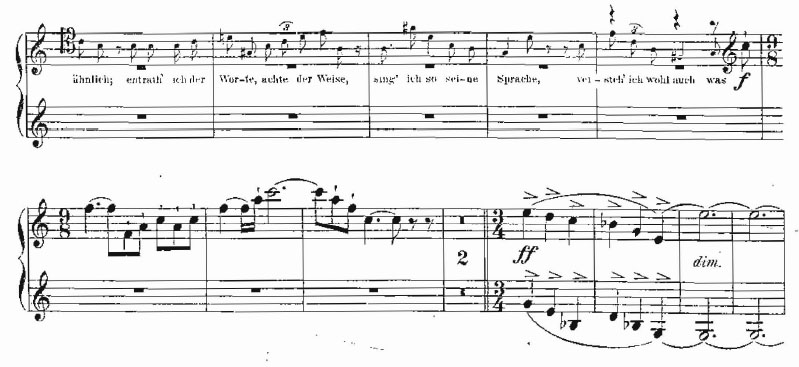
First, as Siegfried becomes increasingly impatient with the Bird, his blood gets boiling a little. An impulsive burst of energy – a fanfare – appears very suddenly.

This is something to be aware of. It is in E horn, and it is loud and prominent. It also occurs after a long playing break so some planning might be needed to keep it on ice.

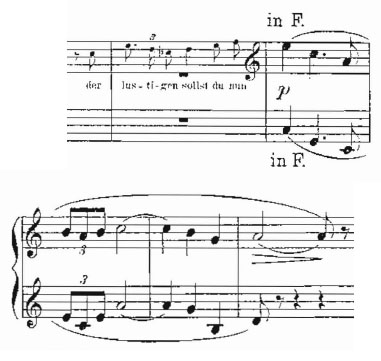
As things calm down, our hero starts to get the silly idea that he can communicate with the Bird using his horn. A nice horn duet occurs at this transitional moment.

The big moment

* [ INSERT YOUR LONG CALL HERE ]

Here then is the big moment – where the Long Call is played. Yes that is right, he is trying to talk to a bird using his horn! If you haven’t figured it out yet, Siegfried isn’t terribly bright. Could it be because his mother and father were brother and sister?

After the call

The young man’s infernal horn blowing angers Fafner, a magic dragon taking a nap nearby whose stirrings are rendered by growling Wagner tuben and low brass.

A short battle ensues and the acting principal in the pit again has some tricky passages to cover. For the horn section too, which has just heard the solo horn play the call, this moment is a bit like releasing a pack of blood-thirsty hounds hungry for fresh meat.

Siegfried then quickly slays the dragon with his magic sword and takes a little taste of its blood. (Who knows why – inbreeding? Yuck!)

About this time the solo horn returns to the principal spot in the pit, where a few exposed solo passages like this are in store.

In a nutshell

After gathering his minimal wits, Siegfried starts to understand that pesky little Bird in the trees. This, due to some mystical, bird-language-understanding properties in the dragon blood – so we presume.

At this point Wagner updates the voice for the Bird, from a solo clarinet to a solo soprano. This is a nice touch that beautifully supports the drama at a key moment.

There is an important dialogue and shortly thereafter, the scene ends.

The lesson

This is a very broad overview of course but the big point here is that, as with all audition excerpts, it is important to always ask this basic, two-part question:

  • What happens before?
  • And, what happens after?

Any of this is fair game as audition material. It is best to be prepared and find these answers.

The download

See also “Forging the Sword; The End of Siegfried Act I

*Please see our site terms for sharing and copyright information.

Arranging chorales, like painting by numbers

1

For myself as a conservatory undergraduate, four-part chorale writing was slow and sometimes laborious. It was a learning curve fraught with rules and clams.

Later in life I got over this and discovered that studying 4-part chorales did not have to be an academic chore; it could actually be fun, useful and educational.

Even if you yourself do not not feel up to the challenge of arranging a large scoring project – – like the Mozart arrangement I gave away last month – – a short chorale might be a more manageable thing to try out as a “mini-project.”

The basic materials needed to start are simple:

  • a pencil, an eraser and staff paper
  • a chorale resource – such as a hymnal or a music library collection
  • time, thought and energy

For notationally-challenged novices especially, I would assert that the pencil and paper method is the preferred and superior method. For myself still, the hands-on experience of sketching with a pencil is many times better than wiggling a mouse. A computer is not required.

This exercise can help improve (among other things):

  • understanding of four-part writing
  • transposition skills
  • music notation standards and practices
  • score writing, arranging & artistic choices

These are all valuable  – – dare I say required? – – skills for any enterprising musician to have.

Why ‘dive in’ with chorales?

Arranging chorales is a bit like painting by numbers. Put in very plain and simple terms, it is hard to goof up a Bach chorale.

Seriously, the guy is a bona fide genius.

As an example, I have embedded a few transcriptions of my own below (RSS readers may need to click-through). These are arranged for horn quartet and admittedly, there is nothing terrifically profound here. For starters, unlike a brass or woodwind quintet arrangement, there is only one transposition when arranging for four horns.

That being said, some thought was devoted to a few important things:

  • high range – making sure the Horn I doesn’t hover too high
  • low range – making sure that Horn IV range is reasonable and playable
  • breathing/phrasing – do I add fermati and breath marks?
  • dynamics – how creative can I get?

Some chorales for instance, were ruled out immediately based solely on the first two rules.

https://issuu.com/brucehembd/docs/chorales4horns

These choices by the way, are the first baby steps into thinking like a music arranger. Who knows? Maybe a summer project like this will spark the inner composer inside of you!

Don’t forget group benefits

The rewards of chorale arranging aren’t exclusive to the arranger! Used as a warm-up tool in your own chamber group, your chorales can help:

  • improve intonation, group phrasing and pacing – through the group study of 4-part writing, score study and following a leader
  • increase morale – when a member of a group steps up and writes an arrangement, it ferments and invigorates group spirit
  • exercise control – why limit your group’s experiences and potential to available, printed sheet music? Who knows your group better than one of its own members?

These arguments are just a beginning. Arranging even the simplest things – – for what basically amounts to as thought, time and energy – – is something that can boost your immediate circle of spirit and musicianship in a number of ways.

All it takes is a pencil and paper.