Home Blog Page 103

A Blast from the Past: The Altonium

Depending on your age and background the Altonium could be seen as odd, rare, cool, cute, or as an old friend from back in the day.

The Altonium as a middle brass instrument had/has several advantages. I was recently able to borrow this example of one produced fairly late in the game, by Olds. Back in the day (roughly the 1940s to the 70s) most of these were made in E-flat and it was one of the more popular substitutes for the horn in marching band. This particular one being in F is a good thing; on it you can read F horn music with ease (I believe it was shipped out with an E-flat slide also). Another big plus is the ergonomics of this instrument. I can easily imagine holding this horn for hours and hours with no real problems at all, being built on the same pattern as an American, bell front baritone or euphonium. The weight is close to the body and the hand positions required are pretty comfortable.

On the negative side, your forward vision is somewhat blocked and it was built to use an alto/tenor horn mouthpiece sized between that of a trumpet and a trombone mouthpiece with a bigger inner diameter than a standard horn mouthpiece. On it in the photo is a Dennis Wick 5 and actually this instrument plays better than you would think it should with this mouthpiece. The sound is a bit bright but very tolerable.

I believe the first E-flat alto horn I ever saw was as a freshman in high school in 1975, at the University of Kansas band day. At that time some groups such as KU still used large numbers of this type of alto horn in marching band. Obviously the mellophone edged out the Altonium not long after that. They look really old-school but honestly it is a design that could be revisited if ergonomics was a primary goal. For more on E-flat alto and tenor horns in general click here.

UPDATE: While I like to use the term Altonium as often as I can just because it sounds cool, A Facebook commenter noted, accurately, that strictly speaking the Altonium was a King product, specifically their models 1147 and 1148 which were produced into the 1970s. They were a unique design built to use a horn mouthpiece. And I updated the text above, as the the instrument in the photo is by Olds.

Hornmasters: Farkas, Schuller, Berv, and Tuckwell on Fingerings

Chapter four of The Art of French Horn Playing is on the topic of fingerings and tuning as Farkas felt that “these two subjects necessarily belong together, as one cannot tune a brass instrument without first determining what fingering will be used for each note.” However, for this part of the Hornmasters series we will divide the topics for clarity and first focus in on the topic of fingerings.

Fingerings in general

In the USA it is very common today on double horns to to play the Bb horn above written G# on the second line and F horn below, except for the isolated group of low notes from low C# to F also on the Bb horn. However, for Farkas in the book at least, the range in the middle of the staff from G# to C is considered to be optional for F or Bb horn, and above third space C# he would suggest always playing on the Bb horn.

The “optional” part (G# to C in the staff) for F or Bb horn is old school; virtually all players use the Bb horn in this range. I think the idea was to minimize the use of the thumb valve. Back in the day many/most horn designs did not favor the quick action of the thumb.

On the topic of alternate fingerings

Gunther Schuller in Horn Technique is interested that students of the horn have a strong understanding of the basis of fingerings, and especially alternate fingerings.

Most elementary books of horn studies include fingering charts to help the beginning student. In many years of teaching, however, I have noticed that many students fail to understand the reasons for a given fingering and, therefore, the essential structure of the instrument. In order better to understand fingering problems on the horn, it is necessary to examine the relationship between the so-called ‘overtone series’ (or natural notes) and the construction of the modern double horn.

…the intervals of this ascending harmonic series decrease successively in size according to specific proportions determined by the vibrating wavelengths.

Schuller goes on in charts and text to show the relationship of the harmonic series and fingerings to the notes of the horn.

Alternate fingerings and intonation concerns

Next we turn to Barry Tuckwell, who presents an open and practical approach to fingerings in Playing the Horn. While noting that “the more traditional fingerings are excellent for general use, they have many defects due to faulty intonation or turbulence caused by changing the tubing length.” An abundance of alternate fingerings are available on the double horn. Tuckwell gives the example of written E on the bottom line of the staff, where “There are five, or possibly six, different fingerings for this note.” He gives them all: can you figure them out? Tuckwell summarizes that for alternate fingerings

In general it can be assumed that the shorter the length of tubing the more precise the attacks will be. On the other hand, the shorter tube can be more difficult to control tonally in the middle and lower registers. It is not possible to say definitely which notes are flat and which are sharp, as each instrument is different and has its own tuning idiosyncrasies. However, in general the 5th and 10th harmonics are on the flat side and the 9th is very slightly sharp.

The 7th harmonic is about a quarter-tone flatter than the Bb written, and the 11th about a quarter-tone sharper than the F written. The 13th harmonic is a flat A, and the 14th a less flat Bb, the 15th is usually in tune….

The 1st and 2nd valves used together are sharp and the third valve alone is usually flat. The 2nd and 3rd valves used together usually give notes in tune, but 1st and 3rd are always sharp and 1st, 2nd, and 3rd together are very sharp.

Bearing all this in mind, it can be of great advantage in some phrases to group the flat or sharp fingerings together rather than try to cope with a series of alternately flat and sharp notes, each requiring adjustment to differing degree.

Fingerings and legato passages

Finally, Tuckwell notes that alternate fingerings may also be of help in some legato passages. This will depend on your horn but it is a topic that we all could experiment with. Some horns, some pairs of pitches, when you move a valve there is a noticeable “click” in the sound that can often be improved by using different fingerings. This can be especially felt for example on a Geyer style horn, where the E-F interval at the bottom of the staff often feels much better on the Bb horn than on the F horn.

Continue in Hornmasters Series

Looks like a mini-Wagner Tuba: Introducing the Althorn

Recently I have had the opportunity to try this great example of an althorn. This particular one is in F and was made by Miraphone in the 1970s. It is in excellent shape.

Speaking of “shape,” that is pretty much the first thing a horn player today will notice, the shape. It looks like a small Wagner tuba but it is not. This is an oval pattern althorn, which is the type of instrument Hindemith wrote his Althorn sonata for.

I have really enjoyed trying out this instrument. It has several big positives compared to other alto horns I have tried, among the biggest being it is in F. It has an E-flat slide with it, but it clearly was designed to be played in F. Other big positives include the upper range intonation is pretty solid, it has a fourth valve so it can cover a very full range (which I understand to be very uncommon on instruments of this type), and it has a really lovely tone somewhere between a Flugelhorn and a tenor Wagner tuba. No wonder Hindemith wrote for it.

On the negative side, I can’t play it much over about 20 minutes at a time as it is ergonomically challenged, I can’t get either hand in a really comfortable position (may get better with time), and also the low range intonation has problems, mainly the range from G on the second line down to e-flat on the bottom line written, that harmonic being quite flat.

That all said, I really like this instrument. I would love to work out the Hindemith Althorn sonata on it or a twin and also something like Schubert song transcriptions sounds great on this instrument. The tone is unique in a good way and the legato is great as well. For those interested, I used a Dennis Wick 5 mouthpiece in my tests.

This type of instrument was used a bit in marching bands in the United States but was really geared to be used in a German brass or military band and as a type was normally constructed in E-flat. Hoping to track down a video of some in action I was given the lead to check out Ernst Mosch. There are a lot of videos of Ernst Mosch (1925-99) and his band on YouTube; obviously he had a very popular group in its day. The below is a good example.

While he does not use althorns he does use oval pattern tenor horns, easy to hear and see in the above, which look like Wagner tubas but they are not as they are built to use a trombone/euphonium size mouthpiece and are in B-flat. Do check out the video, it is a window into a type of playing I have never experienced in the United States. I should also mention that the trombones have figured out how to play some really tight off-beats and also his conducting style is unique, do check that aspect out as well.

The Birth of the Cool and the horn in the Miles Davis Nonet

0

Miles Davis Birth of the Cool– this 1957 album is considered one of the most influential jazz albums ever. It is a compilation of singles recorded over three sessions in 1940-50, the notable thing for us horn players being that the nonet included horn. This “video” (audio only) is one of several on YouTube of “Move,” recorded in New York City on January 21, 1949. Give it a listen.

The personnel on this cut is Miles Davis – trumpet, Kai Winding – trombone, Junior Collins – French horn, Bill Barber – tuba, Lee Konitz – alto sax, Gerry Mulligan – baritone sax, Al Haig – piano, Joe Schulman – bass, and Max Roach – drums. There is quite a bit online about this album, the Wikipedia article being an OK place to start reading. The cover image in this article is linked from the Wikipedia as well.

As to the horn players in the nonet sessions, three different hornists perform. Besides Junior Collins in the above cut on this album you can hear Sandy Siegelstein and Gunther Schuller perform, Schuller being by far the best known of the three. Amazing recordings, hard to believe they were done over 60 years ago.

Speaking of Miles Davis recordings, I noted with interest that hornist Pip Eastop recently played the trumpet on a concert performance of Kind of Blue, another great Miles Davis recording that is one of my favorite recordings to listen to of all time. His article on this project begins,

On May 20th there’s a concert at St. James’ Church, Piccadilly, London. It’s a live performance, or interpretation, of the album, “Kind of Blue” by Miles Davis. I think it’s going to be a sextet, but what I DO know is that I’m going to be the one playing the trumpet and thus, to some extent, trying to “be” Miles Davis. This is, of course, an impossible task …

But one that has got to be extremely interesting! Most of us are not fluent enough on jazz trumpet to play the lead but a lot of us could do a good job on horn in the nonet arrangements. These arrangements are actually published and available today and are a project I would love to play at some point, to relive these jazz classics from another place and time.

First impressions with the Patterson mellophone leadpipe – Mark Taylor

This leadpipe (made by our sponsor Patterson HornWorks) and its angled-bend is something that I have been very curious about.

Thanks to mello-head Mark Taylor, we have candid 9-minute video of his impressions. He emphasizes in the comments that this is a first impression only.

We can look forward to a more details sometime in the future.

* * *

Getting mellow?

Photograph: Study in contrast, II

0

I have been using this shot as a Facebook profile lately. I love the simplicity.

Click the image for a larger view.

[Part I in this series, tells the story behind this photo.]

Tonguing is a big key to everything, especially accuracy

0

The Public Service Announcement of the weekend is on the topic of tonguing. There is a lot of dogma on tonguing out there to cut through which seems to me at least in part to be driven by false perceptions and what sounds good on paper rather than on reality.

The longer I teach the more I feel firmly that there is no one way to tongue and that approaches to tonguing actually vary widely in the horn playing community. How you tongue will likely be significantly different than they way your friends or colleagues tongue, even if the results sound practically identical. It is an important topic as on the horn tonguing is really a big key to everything, especially accuracy. I have two major suggestions as you sort out tonguing in your teaching and playing.

1. Look at the older printed sources that are pretty independent from the line of thought given by Farkas and try to understand that they have equally valid points of view. Two quotes I like a lot as they open up new ways of thinking about it all are this one from Milan Yancich,

I then demonstrate different kinds of articulation: placing the tongue out very far between the teeth for heavy, marcato or hammered playing; placing it behind the upper teeth for legato playing; putting to tongue to the roof of the mouth to give an even more legato articulation; and finally placing the tip of the tongue against the lower teeth, using the flat of the tongue against the roof of the mouth to produce even another attack. The student then understands that the tongue, very much like the bow on a stringed instrument, can be used for many different types of articulation.

and this one from Anton Horner, which is the closest description I can find in print of the way I actually tongue,

Attack each note with your tongue as though you had a small hair or tiny piece of thread on the end of your tongue and wanted to force it out of your mouth.

Kopp-10-snip2. Be very wary of dogmatic tonguing advice from players of other brass instruments. Realize that the way a teacher of any other brass instrument than the horn says to tongue is probably different than we would employ on the horn, and they also have no concept of how drastically different tonguing is on the horn in different ranges.

The way we need to tongue is in general different than trumpet or trombone but probably closest to that employed on the tuba. In an earlier article (now off the site) I posted,

One aside I want to explore further this summer; I found that I can articulate a tuba. The tongue stroke I use for low horn transfers over pretty well. When I play trombone or trumpet, however, my default tonguing sounds overly harsh, even blatty. There is something about the slower response of the horn and tuba that requires a more active tongue stroke.

A side point being though that on the F horn in the upper range my default tonguing also sounds overly harsh. I suspect that years of double horn playing has led to some subtle choices in this regard, or that perhaps the Bb horn is simply more forgiving. On the F horn in the higher range and on the natural horn I have to very consciously use a more gentle tongue stroke more up on the gums than where I default to.

As to what to practice, nothing really beats Kopprash. For more suggestions as to what to play this post is a good place to start.

As a final thought, I know that the way I tongue is considered wrong by some teachers. Yet, I know I get high level results (check out my solo CDs!) and that quite a number of players approach it as I do. I have puzzled about this for years. In the end, the important thing to remind yourself of is that the result is what matters — if it sounds right it is right. If you are a teacher be aware of the variations of tonguing methods, treating everyone as a unique individual toward achieving the best results possible.

[Updated 2015]

Horns as Stage Props, IV (M*A*S*H*)

9

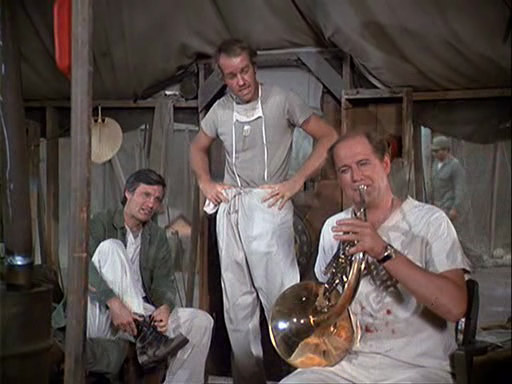
The long-running series M*A*S*H* takes place during the Korean War and features an emergency medical unit that is located near the front battle line. The title of the show stands for Mobile Army Surgical Hospital.

In the episode “The Smell of Music” from the sixth season, the wisecracking doctors Pierce and Honeycutt are finishing a 72-hour shift of non-stop surgery. When they arrive at their community housing tent another surgeon, Charles Emerson Winchester III, has discovered a new way to relax – playing the French horn.

Below is a brief 2-minute segment from the scene. Winchester gives the horn call from Don Juan a try with comic results.

[dewplayer:/wp-content/uploads/2010/06/MashEp15Season6.mp3]
Link to Audio

The conflict takes a turns for the worse, into a prolonged feud between Winchester and his horn, and the other doctors who refuse to bathe until he stops.

Which side will win? The stinky horn player or the stinky doctors?

It comes to a peak moment with “Hawkeye” and Honeycutt banging on drums, buzzing a kazoo and honking a jeep horn versus Winchester blasting away as loudly as he can.

[dewplayer:http://hornmatters.com/wp-content/uploads/2010/06/MashEp15Season6-2.mp3]

The rest of the encampment tires of this battle and takes charge.

First, and much to Winchester’s delight, nurses hose down, soap and scrub the two smelly doctors.

But this is not the end of the camp’s revenge. Nurse Hoolihan takes Winchester’s horn and declares a “third wave.”

Here is more audio from the end of that scene. Winchester’s final comments are priceless.

[dewplayer:/wp-content/uploads/2010/06/MashEp15Season6-3.mp3]
Link to audio

Barbarians! You visigoths! Do you realize you have taken the last vestige of Western civilization left here, and you’ve run it under your pagan wheels?

The star behind the character

The character of Winchester on M*A*S*H* was played by David Ogden Stiers, who is both an actor and musician. He is currently the Associate Conductor of the Newport Symphony.

While I don’t imagine that he actually played the horn tracks used in this episode, he does a great job forming an embouchure and faking fingerings!

*All images and audio in this article are used without permission under the auspices of fair and limited use. These items remain the sole and absolute property of the CBS broadcasting network and their respective subsidiaries.

Are Highly-Rated Horn Professors Overrated?

0

A few days ago I saw a link to an interesting article with the title “Study: highly-rated professors are. . . overrated.” The article was part of the College Inc. series in the Washington Post, and author Daniel de Vise looks at the topic of student evaluations and at a bigger question, that of are good student evaluations indicative of good teaching? His article begins,

How does a university rate the quality of a professor? In K-12 education, you have standardized tests, and those scores have never been more widely used in evaluating the value added by a teacher.

But there’s no equivalent at the college level. College administrators tend to rely on student evaluations. If students say a professor is doing a good job, perhaps that’s enough.

Or maybe not. A new study reaches the opposite conclusion: professors who rate highly among students tend to teach students less. Professors who teach students more tend to get bad ratings from their students — who, presumably, would just as soon get high grades for minimal effort.

As he explains, the results of the study on which this article was based are “counterintuitive” but for the math classes followed show the following:

Professors rated highly by their students tended to yield better results for students in their own classes, but the same students did worse in subsequent classes. The implication: highly rated professors actually taught students less, on average, than less popular profs.

Meanwhile, professors with higher academic rank, teaching experience and educational experience — what you might call “input measures” for performance — showed the reverse trend. Their students tended to do worse in that professor’s course, but better in subsequent courses. Presumably, they were learning more.

The last two sentences of the quotation above are interesting ones. Professors are rewarded for good evaluations in a variety of ways, but for sure when I look back at the big picture of my professors some of them that I would probably not have given a good evalation to when I was their student ultimately I know I learned a lot from.

It is something I see often with incoming students as well. A student will seem to have been very happy with their prior teachers but when you get down to it I sometimes have to wonder what they actually studied and if the teacher was more concerned with them making progress on the horn or with them liking their lessons. Not that being a mean teacher is the solution either, but teaching is not about ego but instead about being effective.

There is no perfect teacher but for those out there that teach check out the full Washington Post article, much there to think over.

French horn park sculpture

1

Found on flickr – “French Horns, Unwound and Entwined

Click for larger view.