Home Blog Page 70

Tips on Auditioning Horns, Part I: Carl Geyer, Paxman 25, Patterson Custom and Finke Americus

0

My main agenda for the Southwest Horn Conference (SWHC) – besides hearing concerts and talking shop – was to play on as many horns as possible. It had been a long while since I had an opportunity to play on so many different instruments, all in one convenient location. I was positively giddy at the prospect.

But before getting started, an agenda for consistent testing was needed in order to determine as fairly as possible what horns played the best. Based on my own personal and subjective set of standards, I wanted to come up with a wish list of what I would deem as “top gear” for this conference.

Keep it simple

Basic scales and arpeggios can tell a lot about a horn.

With even the simplest patterns, one can quickly and fairly judge intonation, response and many other determining factors. Myself, I prefer basics over solos or excerpts for one simple reason: to concentrate less on performing and more on critical evaluation.

Sometimes moving a slide or two may be involved. On my first morning of trials at the SWHC for instance, a door was open and the room was relatively cold; moving slides was a necessity on that occasion.

Bad notes

Next on the agenda is to find out if the horn has any weak spots, and in particular, any bad notes. Geyer-wrap horns, for example, can be fairly notorious for a few particular quirks and here is what I go for right away:

Geyer from Pope Instruments

On older horns too, grabbing the stop-arm rotor and giving it a good shake back-and-forth can reveal if there is wiggle-room in the valve. If the valves are tight, there will be little or no movement.

At the SWHC, this original Geyer with rebuilt valves and a new lead pipe by Ron Pinc was on Ken Pope‘s table. I played on it for a good while and enjoyed listening to others play on it too.

The valves seemed very tight and there were no bad notes to speak of. Characteristic of an original Carl Geyer horn in good shape, the tone felt like warm melted butter and it is well worth the price.

This horn is for sale from Pope Instruments, and another horn on the same table that caught my strong attention was the Paxman 25LGD.

I had never tried a dual bore horn before and thoroughly enjoyed the F-side of this instrument, among many other things. The Paxman 25LGD is a large-bore horn and it had a very open and free feel and response.

‘Wow’ factor

For any make or model of horn, I also like to slowly toggle between the different sides of the instrument to see how they do (or do not) line up. Again, moving a slide or two might be necessary. Be sure to give that a try before giving up altogether and putting a tester horn back down.

Patterson Custom Double

One of my favorite tests for Kruspe wraps in particular is to play a few loud forte-pianos and sfortzandos. I do this to see if the instrument can get some color and sizzle with having to work too hard for it.

If the horn just says ‘wow’ instead of WOW! I put it down and walk away.

One horn that had me saying WOW was the Patterson Custom Double. This was easily one of the best horns at the show. The Patterson Custom Double has the open feel of most Conn horns, but it contains plenty of sizzle and power for when it is needed.

Tone quality flows evenly throughout: the high range did not get shrieky and the low range did not feel stuffy or sound tubby.

Be aware of bias, stay open for surprises

Back in the day, the word fink was a pejorative for someone who is a tattle-tale and rats out their friends. You dirty rotten fink! Pinko commie fink!

This bias, I must sheepishly admit, has always been in my mind whenever I see or hear the brand name Finke  – and so to be fair, I had to put that aside and actually sit down and try one out.

Thankfully I put asunder my rather childish hangup and decided to try out the Finke Americus horn at the Osmun Music table. It was a nice surprise and a very fun horn to play on.

Finke Americus from Osmun Music

The Americus model is described as a large-bore Geyer-wrap design and it is made in nickel-silver. The tone quality and intonation felt even and smooth in all ranges.

Unfortunately, my camera lens had a smudge on it, but there is plenty of information at the Osmun Music site on the Finke Americus.

I felt an immediacy to the response of this horn, one that really intrigued me the more I played on it. The tone glows and radiates like an Engelbert Schmid double horn, but with perhaps more depth and weight.

Ultimately, the big lesson for me with the Finke Americus was that preconceived notions about a horn can lead to missed opportunities. I look forward to trying one of these horns out again.

* * *

In Part II: Custom lead pipes, my favorite Conn horn and the dilemma of the Schmid double horn.

Random Pictures from the 2012 SW Horn Conference, Part II

0

I have attended a number of international horn and brass conferences, but before last weekend I had never actually been to a regional workshop.

The main thing in particular that I enjoyed with the Southwest Conference was the relaxed pacing of events.

It always seems that at the international events, three or four things might be going on at the same time and one is forced to make impossible decisions between one great program or another. At the Southwest Conference, there was plenty of time to play horns and chat with people that I might otherwise not see face-to-face.

More random photos follow. As before, click on any image for a closer look.

* * *

One of the highlights of the conference was the Saturday evening concert that featured a premiere of a new piece by Eric Chasalow and a jaw-dropping performance of the Schumann Konzertstück for Four Horns and Orchestra.

4 music stands await for the final piece.
The orchestra warming up.

Bruno Schneider demonstrated smooth elegance and superb breath control throughout. A few of us noted his embouchure and discussed its similarity to what is known about Dennis Brain’s embouchure.

Bruno Schneider was holstered and ready for action.

* * *

Horn choir rehearsal.

* * *

A different shot of the Sam Pilafian warm-up session. Note the bright red tuba!

* * *

I bought a new mute from Ion Balu and also tried out his horns with the double-walled lead pipes.

Ion Balu.

* * *

Kevin Stiles and  Michael Reipe from Wichita Band Instrument Company.

* * *

Besides trying out lots of horns, I enjoyed listening to others try out horns – especially the models that I specifically liked (or did not like). I also must confess that enjoyed eavesdropping on dealers and customers chatting about equipment and other shop-talk.

Bill Bernatis tries out an Atkinson horn (a nickel-silver Geyer wrap) while Scott Bacon and a rep from Osmun Music chat.

* * *

Here is a picture of one of my favorite instruments from Ken Pope.

Unfortunately my camera lens had a huge smudge on it and so the picture is marred (there are more pictures on the Pope Instrument site). My faulty camera lens aside, this horn played like warm melted butter and in my opinion is well worth the price tag.

A Geyer horn with a Ron Pinc pipe.

* * *

Do you like horn pictures?

Throughout this week I will be posting a series of articles on my favorite instruments from the Southwest Horn Conference, and more specifically, my routine and criteria for trying out horns and determining what I like.

Stay tuned!

Random Pictures from the 2012 SW Horn Conference, Part I

0

Over the weekend, I had pleasure of attending the Southwest Horn Conference. The event was expertly hosted by Rose French at the Center for Performing Arts at Paradise Valley Community College.

Click on any image in this article for a closer look.

The weather in Phoenix was an average from the mid-40’s in the morning, upwards of 70 degrees during lunch.

I missed the first full day of events, and was not able to get there until the Friday evening concert. The parking lot looked more like this when I arrived.

The first thing I noticed was the merchandise table. The conference logo looks great on a variety of materials.

I attended the opening concert in the 250-seat capacity auditorium. The stage actually seems larger than the audience space.

Nancy Joy with marimba.
The following day – a warm-up session lead by Sam Pilafian.
Randall Faust leads a horn choir session.

I then pursued my one-track mission on playing as many horns as I could.

From Scott Bacon’s display.

I had a great time playing horns and talking to new and old friends.

Dennis Houghton and Victor Valenzuela
Milton Kicklighter and Ken Pope looking at an 8D.
Bill Bernatis, Gabe Kovach and Jim Patterson talking shop.
Tom Greer of Moosewood tries out a Kuhn.
Ion Balu and host Rose French.

* * *
(More random pictures later today!)

‘Listening’ with Your Whole Body

Hearing music is not necessarily limited to the ears. Take for example musician, composer and speaker Evelyn Glennie. Ms. Glennie has been profoundly – not completely – deaf since the age of 12.
She asserts that deafness in general is largely misunderstood by the public and she has taught herself to “hear” with parts of her body other than her ears.
In her essay Hearing Essay she talks openly about her condition.

So far we have the hearing of sounds and the feeling of vibrations. There is one other element to the equation, sight. We can also see items move and vibrate. If I see a drum head or cymbal vibrate or even see the leaves of a tree moving in the wind then subconsciously my brain creates a corresponding sound.
A common and ill informed question from interviewers is ‘How can you be a musician when you can’t hear what you are doing?’ The answer is of course that I couldn’t be a musician if I were not able to hear.
Another often asked question is ‘How do you hear what you are playing?’ The logical answer to this is; how does anyone hear?. An electrical signal is generated in the ear and various bits of other information from our other senses all get sent to the brain which then processes the data to create a sound picture.
The various processes involved in hearing a sound are very complex but we all do it subconsciously so we group all these processes together and call it simply listening. The same is true for me. Some of the processes or original information may be different but to hear sound all I do is to listen. I have no more idea of how I hear than you do.
(More.)

Beyond the surface details of her inspiring story, she offers very thoughtful and insightful lessons for us as horn players and musicians to learn from.
In this brilliant lecture from her TED talk from 2003, she illustrates that music transcends the mere auditory, and that it is a whole-body experience.

From the Mailbag:”What Can I Do About Mouthpiece Pressure?”

0

K. asks:

I have been working with my horn teacher over the last few months on changing my embouchure. The problem I had in the past was I used too much upper lip pressure. I have been trying to change it, but no matter how hard or long I work at it (hours, days, weeks, etc) I cannot get anything over a second space A without putting extra pressure on my upper lip.

Any tips or ideas on how to avoid that?

To begin I must mention my own personal bias, that I am skeptical about obsessions with excessive mouthpiece pressure. I would assert that many – if not most – of these concerns are unnecessary.

In my own years of experience as a private teacher, I have only had a small handful of students that in my observation appeared to be using too much pressure. That being said – and without the benefit of seeing in-person what the exact issue is with the questioner above – the tips below are given in very broad and general terms.

The variables

Mouthpiece pressure is relative to a number of factors, including:

  • facial anatomy
  • mouthpiece cup and rim type
  • mouthpiece angle
  • embouchure ratio
  • air stream direction

With so many factors at play there is plenty of wiggle room for variation.

Speaking in absolutes about embouchure  – that there is only one way to form the lips – falls short of reality and it overlooks the vast differences and variations of human anatomy from person-to-person.

Along this line of thought:

…there is nothing cosmically metaphysical or subconscious about learning to play the horn. We are not born with a natural capability to play the horn, one that only needs to be brought to the surface by a caring and attentive guru.

Until animals start buzzing their lips in the jungle, I don’t buy the ‘natural’ approach that some teachers tout as a selling point – along with its abstract, pop-psychology terminology. While it might work for some students with the right mindset and technical accomplishment, this approach to teaching the horn has virtually no established pedagogy to rely on. It is up to the individual teacher in this case to determine the method.

Playing any musical instrument requires technical knowledge, and mental and physical skill. For some that requires breaking things down and analyzing it to see how it works and all fits together. The pursuit of this knowledge isn’t always about solving problems. Sometimes it is the pursuit of an answer – or just raw knowledge.

(More.)

For the purposes of offering guidance on mouthpiece pressure specifically, I will focus briefly on just four details of the embouchure: mouthpiece placement, air stream direction, mouthpiece angle and muscle tension.

High, medium or low placement?

First, it is particularly helpful to understand what your embouchure placement type is and what its tendencies are.

In this pursuit I reference David Wilken’s excellent video on embouchure basics. In this video, Mr. Wilken divides embouchure types into three broad categories based on where the mouthpiece is placed on the lips: high, medium or low.

Many – if not most – horn players fall in between the high and medium placements, with an embouchure ratio ranging roughly between 2/3 upper lip and 1/3 lower, to 3/4 upper lip and 1/4 lower.

Of course there are exceptions, and with the Southwest Horn Conference coming up this weekend, I am particularly interested in checking out Bruno Schneider’s medium-low placement embouchure.

In Mr. Wilken’s video, there is also a close-up example and discussion of a horn player with a low-placement embouchure setting.

Air stream direction

Referencing both Mr. Wilken’s video and Philip Farkas’ A Photo Study of 40 Virtuoso Horn Players’ Embouchures there are two basic types of air stream direction:

  • an upwards air stream or,
  • a downwards air stream.

According to Mr. Wilken’s video, air stream direction is directly connected to mouthpiece placement. Since most horn players use a high or medium placement, the typical air flow for horn players is downwards. For low placement players, the opposite is true – the stream is typically targeted upwards.

(As an aside, the antiquated notion of “blowing the air down the center of the mouthpiece” is somewhat of a fallacy. While it sounds good to utter this phrase out loud for motivational purposes, the truth is that this turn of phrase is technically a myth – one that needs to be busted.)

Meet the mouthpiece

From “Mouthpiece Pressure and other Tall Tales

A teacher of mine once said that heavy mouthpiece pressure was nothing to be concerned about as long as one “meets the mouthpiece.”

In illustrating this he would make two fists with his hands, touch them together at the knuckles and then push them against one another. With his hands, he was illustrating the concept that force and counter-force can balance one another.

With enough muscle tension and support, the lips can handle mouthpiece pressure in most cases.

Mouthpiece angle

Related to air stream direction and mouthpiece placement is the angle of the mouthpiece in relation to the lips. Typically – not always – players with a medium or high mouthpiece setting angle their horns either straight onto the lips, or at a slight angle downwards.

The angle of the mouthpiece then, is directly connected to the amount of pressure on the top lip. In short – the higher the mouthpiece angle, the greater the pressure on the top lip (and vice versa).

Answering the question

So to answer the main question that began this article, making a conscious effort to reduce pressure on the top lip involves lowering the angle of the mouthpiece in relation to the lip surface.

For all the reasons given above, this effort – to lessen pressure on the upper lip – can backfire; it can be antithetical towards that specific embouchure type, mouthpiece placement and air stream.

To wrap it up in one, short sentence, I would honestly not worry too much about mouthpiece pressure.

My advice? Focus your energies on other issues.

That being said, there are always exceptions to the rule and this advice should not be construed as something chiseled in stone.

Hearing Under Siege

Under siege
For about 10 years now, I have been faithfully using custom musician ear plugs whenever a rehearsal dynamic exceeds 90 decibels. I do this in order to protect my hearing.

While it is not ideal – the plugs do take some getting accustomed to – it is a better alternative than foam plugs or hearing loss.

Meanwhile, in Bavaria:

They had rehearsed the piece only once, but already the musicians at the Bavarian Radio Symphony Orchestra were suffering.

Their ears were ringing. Heads throbbed.

Tests showed that the average noise level in the orchestra during the piece, “State of Siege,” by the composer Dror Feiler, was 97.4 decibels, just below the level of a pneumatic drill and a violation of new European noise-at-work limits. Playing more softly or wearing noise-muffling headphones were rejected as unworkable.

So instead of having its world premiere April 4, the piece was dropped. “I had no choice,” said Trygve Nordwall, the orchestra’s manager. “The decision was not made artistically; it was made for the protection of the players.”

(More.)

[Extracted 2021 from a “Random Monday” post, JE]

Horn Secrets: Putting Conventional Wisdom to the Test

A week from today I will present a session at the 2012 Southwest Horn Conference with the title “Horn Secrets: Putting Conventional Wisdom to the Test.” The following was turned in for the program book:

Many elements of a conventional approach to horn playing were put forth by Philip Farkas in his 1956 text The Art of French Horn Playing. But the seldom told story is that many of the best horn players break many of those rules, the Farkas approach being only one end of a spectrum of ways to approach a variety of technical issues. This session will look at that bigger picture through a variety of resources from the past and present, with a particular view toward seeing clearly those points where conventional wisdom and physiological accuracy collide.

You will need to attend the session to get the full view, but the basic plan is to first quote Farkas, who pretty much defines conventional wisdom on a number of topics. With him setting the table so to speak then on each topic attention will turn to three sources that present and illustrate differing approaches, in a way that will challenge thinking but at the same time not be an overwhelming amount of information for the time available. The point being in no way to attack Farkas but to stimulate thinking about a bigger picture of horn pedagogy.

To stay within time constraints there will be only four major topic areas addressed in the session. As I know most Horn Matters readers won’t be able to attend the session (but come if you can!), the following quotes drawn from the PowerPoint and links to more, related information give a good idea of some of the concepts presented and should be of interest to serious students of the horn.

Average tonguing

Philip Farkas, The Art of Brass Playing
One might think of a series of tongued notes as simply a long note which is cut into separate segments by the tongue. When one thinks in this way, the logic of moving the tip of the tongue in a up-and-down direction becomes apparent. So many players have the mistaken idea that the tongue should move back-and-forth—piston-like. …Correct tonguing is an up-and-down motion, but when the tongue is placed between the teeth, the only direction it can move for the attack is backward.

Milan Yancich, A Practical Guide to French Horn Playing
There is a great deal of argument concerning the use of the tongue in brass playing. Having been taught to tongue behind my teeth in my early years on the horn and later to tongue between the teeth, I have concluded from both experiences that there is no one-and-only way to articulate. Tonguing is an individual matter depending on the formation of the teeth and jaw. The tongue, its thickness and length, the size of the oral cavity, the bite of the teeth, all these contribute to articulating with the tongue. I usually instruct my beginning students to tongue slightly between the teeth.

Anton Horner, Primary Studies for the French Horn
Attack each note with your tongue as though you had a small hair or tiny piece of thread on the end of your tongue and wanted to force it out of your mouth.

Dale Clevenger, as reported in Dale Clevenger: Performer and Teacher
Position the tongue at the bottom of the top teeth to articulate. The cleanest articulation is produced when the tongue meets the bottom of the upper teeth. If the beginning of the note is fuzzy or unclear, most likely the tongue is making contact too high back on the back of the upper teeth or even on the roof of the mouth, which may interfere with the flow of air. At the point of sound, the tongue should already be in place at the bottom of the top teeth, and it should move backwards to create an articulation when the air is released.

Staccato tonguing

Philip Farkas, The Art of Brass Playing
…the release of a very short note, coming, as it does, right on the heels of the attack, is most often the point of technical failure. Too often the misguided player attempts to get shortness in his staccato notes by stopping the vibration with the tongue—“tut-tut-tut”. This abrupt stopping of the air-column, and its consequent abrupt stoppage of the tone, produces a most unmusical and unnatural quality. No musical instrument in the world stops its sound suddenly. …any musical note, no matter how short, has a diminuendo at its very end which tapers it down to inaudibility….

Fred Fox, Essentials of Brass Playing
When playing a series of fast sixteenth notes only the tongue is used to start and stop the notes, since now, with the notes following each other so quickly, the hard tongue stop cannot be heard.

Harry Berv, A Creative Approach to the French Horn
The staccato note ends almost as soon as it starts by the abrupt stoppage of air, which is responsible for the so-called “dry” sound.” The tongue acts as a valve in starting and stopping the flow of air; never try to end the note by constricting the throat.

Douglas Hill, Collected Thoughts on Teaching and Learning, Creativity, and Horn Performance.
[In relation to very short articulations Hill recommends practice of staccato eighth notes with]…the most compressed tut possible.

Embouchure

Philip Farkas, The Art of Brass Playing.
So we see that there are several forces at work in forming the embouchure. The drawstring of muscle around the mouth contracts in an attempt to form a very small circle of the mouth, but at the same time the cheek, chin and jaw muscle, in fact the complete network of muscles radiating out from the mouth, are striving to pull the mouth wide open in all directions.

Although these opposing muscles seem to be working at cross purposes, it is exactly this stress or tug-of-war which is needed to supply the tension so necessary to the creation of lip vibration. … the opposing muscles might figuratively say to each other, “You pull less hard and I will, too, but let neither of us win this tug-of-war.”

Perhaps the above discussion will make us realize the futility of the age-old argument among brass players: “Which is the proper embouchure, the smiling one or the puckered one?” A little thought will lead to the conclusion that both systems must be combined.

Gunther Schuller, Horn Technique
…there are four ways in which pitches can be altered by the embouchure: one is by pressure upon the lips from without (the mouthpiece and the horn); the second is by changing the size and shape of the lip opening; the third is by altering the degree of tension in the lip muscles; and the fourth is the angle at which the air is directed into the mouthpiece. The first approach is controlled primarily through slight pressures applied by the left hand, while the latter three are governed by the movement of the jaw, the lower teeth, and the lip muscles themselves.

Farquharson Cousins, On Playing the Horn.
There is, I believe, a rare secret to be found in every first class embouchure. It has no accepted name, so I shall invent one which is also a literal description: ‘the Upward-Resisted-Push’. When the mouthpiece is in position the player pushes it upwards towards the nose, where, provided that the pivots are firm, the muscles between the top of the mouthpiece and the nose will RESIST. Apart for from the advantage of making it difficult to press in excess of muscle support, the Upward-Resisted-Push assists the red (vibrating) part of the top lip inside the mouthpiece to be revealed. Also it helps the tightening of the lip membrane for higher vibrations. When the knack of the Upward-Resisted-Push is acquired a note seems almost to sustain itself and there is a sensation of effortless ‘poise’, perhaps the most satisfying experience in the whole game of horn playing. What has been described is the basis of what I call the ‘Embouchure-Seal’.

Douglas Hill, Collected Thoughts on Teaching and Learning, Creativity, and Horn Performance
To form the embouchure, begin by humming the sound emmm. Feel the position of your jaw. Notice how the teeth are separated, yet the jaw is relaxed. Now simply tuck the corners of the mouth (firm but not flexed) in toward your teeth. This is not a full smile but is just enough of a smile to inhibit the formation of air pockets in the cheeks and top lip while blowing. This firm tucking should also cause the chin muscles to be pointing downward set in a flattened or concave position. Thus, the lower lip will never fill with air, and the chin will remain stable and never bunch upward. Before, during, and after the formation of an embouchure, attempt to feel heaviness in the face, especially around the eyes. Look tired like a basset hound. (Try to imagine that.)

From this relaxed positioning of the facial muscles, it is simply a matter of forming a very slight pucker at the center of the lips, as if the letter “p” is about to be pronounced. With the release of a steady airstream through an oval-shaped aperture, you should be able to produce a vibration. If your teeth form a natural overbite, then your top lip will probably also protrude farther than your bottom lip. Allow your embouchure and aperture to conform to your natural facial formation as much as possible. This point is very important in finding your best embouchure.

Mouthpiece pressure

Philip Farkas, The Art of Brass Playing
Through another of our homely illustrations we can visualize how heavy pressure achieves both the small aperture and the firm flesh. Imagine a nice, fresh, spongy doughnut, sandwiched between two pieces of plate-glass. If these pieces of glass are slowly pressed together, the hole in the doughnut can be observed to gradually get smaller as the doughnut itself is flattened. But, at the same time, this pressure also compresses the “flesh” of the doughnut into something much firmer than its original spongy consistency. In just the same way, mouthpiece pressure diminished the size of the opening of the lips, while simultaneously compressing the soft flesh into something resembling strong, firm muscle. Unfortunately, the poor lips suffer the same abuse as did the crushed doughnut, and, of course, human lips cannot take this punishment indefinitely.

Farquharson Cousins, On Playing the Horn.
Lips are tough, and with training can support almost effortlessly whatever pressures are consistent with their development. There must be no confusion about this. Imagine a wheelbarrow being edged by a mini-car, then the mini-car by a lorry, and the lorry by a locomotive. In each case pressures are brought to bear without much effort on the part of the stronger party. A mouthpiece made of metal could crush any human tissue if allowed to do so, but if the player develops the muscles in his lips, reasonable pressure can not only be harmless but can improve the efficiency of the ‘Embouchure-Seal’, the only condition being, as already emphasized, that pressure is relative to muscle support. The stronger the lip muscles, the greater the pressure that can be exerted, and the firmer the contact between mouthpiece and lip.

Joe Barbenel, John Booth Davies, and Patrick Kenny, “Science proves musical myths wrong,” New Scientist, April 3, 1986
From these experiments, we can make several guarded statements. First, it is simply not true that professional players of the highest calibre use low levels of force on the mouthpiece. We could not differentiate amateur players from professionals in terms of the amount of force they used to perform a given task. Secondly, skilled players were no better than other groups at ranking photographs of players for the amount of force the subjects were using on the mouthpiece. The experts appeared to base their judgments of force on the general appearance of effort rather than on any specific cues. When asked to judge between different players, experts could not reliably tell who used the most force and who used the least.

Randy Gardner, Mastering the Horn’s Low Register
Many people are taught to anchor their mouthpiece into the bottom lip and lighten pressure on the top lip when playing in the high register. This is essential in the upper tessitura to ensure that the top lip remains free to vibrate.

——————–

And there will be a lot more covered, with a look at elements of The Balanced Embouchure, the general topic of why Farkas presented his approach as he did in print, and much more.

By the way, I will also perform! In addition to a half recital shared with Daniel Katzen I will be playing third horn on the Konzertstuck with an all-star group (J.D. Shaw, Laurence Lowe, and Daniel Katzen) and more! If you are in the area and not sure about attending, do attend. Hope to see you there!

Mini-Review: Brass Instruments from the MIM Collection

0

Over the holidays relatives descended in droves upon my homestead, and so to get out of the house we decided to go to the Musical Instrument Museum (MIM) in north Phoenix for a day-trip.

This was my first visit to this museum. I was particularly eager to see if the over-the-shoulder horns and other rarities from the Fiske collection had been added to the public displays.

Brass instruments represent the most comprehensive element of the Fiske Collection and the centerpiece is a set of seven over-the-shoulder brasses by Hall & Quinby of Boston (1872), the only known complete set of these types of Civil War-period instruments. The collection also features examples of most valve types invented during the 19th century and several outstanding examples by European and American makers are represented.

Other highlights include 19th-century clock-spring slide trumpets by Ulyate, London (c. 1830); a slide trumpet made for the famous English player John Distin (c. 1833); a keyed trumpet by Antonio Apparuti, Modena (c. 1835), a rarity as the only example in the United States; an expertly designed disc valve cornet by J. A. Kohler, London (c. 1853); and two double-piston valve B-flat trumpets by Graves & Co., Worcester, Massachusetts (c. 1845).

(More.)

Snapshots from an iPhone

The MIM has two floors: the top floor is organized by region, and the bottom floor by special category. The majority of the brass instruments were in the European galleries upstairs.

With my handy iPhone camera I took a few photos of some brass-related instruments that piqued my interest and that I thought might be of interest to Horn Matters readers.

Be sure to click on any picture to get a larger view.

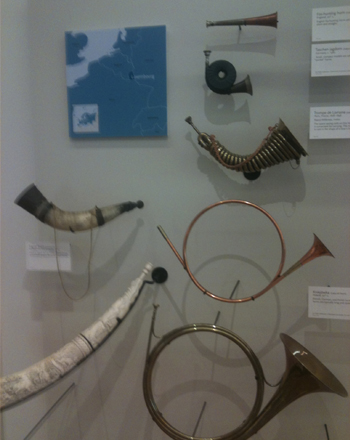
The first snapshot is of an oliphant – an elaborately carved ivory horn. It was displayed in a case with a number of horns from the same region.

Most of the instruments are displayed without glass, so visitors are able to get a really close look at each instrument.

One of the more interesting brass instruments was this tenor horn – made between 1850-1862 by Augustin Heinrich Rott. It was on display in the Czech region of the European gallery. I would have loved to try a few notes out on this one.

* * *

In the main floor gallery titled “Mechanical,” this paper roll trumpet caught my attention.  No air or buzzing is required.

The gallery also has a few paper roll player pianos – which I have seen before – but this was this first time that I had seen the same technology applied to a brass instrument.

* * *

This reed horn requires the user to blow air into the mouthpiece. Each key has a reed that is tuned to different notes. The manufacturer is Couesnon – which happens to be the maker of my hunting horn.

* * *

In the Latin and South American gallery these lightweight, bamboo and leaf-wrapped horns from Bolivia illustrate an interesting example of how indigenous traditions get mixed and morphed into the traditional Catholic liturgy.

In the accompanying audio-visual display two sets of these horns are being performed in a Catholic liturgical setting, assigned to playing the long notes of the cantus firmus.

With a choir, organ and other instruments they added a very unique flavor to the mix. I love how they look like gigantic pan flutes.

* * *

The final picture is from the North American gallery.

This area of the MIM is the least complete at the moment; about one half of the space in this gallery is littered with empty displays under construction.

Fortunately, I was able to take a peek at the complete set of over-the-shoulder horns – soprano, alto, tenor and bass. As mentioned previously, this Hall & Quinby of Boston (1872) collection is the only known complete set of these types of American Civil War-period instruments.

Some of the rarer over-the-shoulder horns can be fairly valuable. In the popular television program Antiques Roadshow a similar soprano saxhorn was appraised at $4,000 – $5,000 USD. One can only imagine what the appraised value might be for a complete set.

The two alto horns in the Hall & Quinby set are pitched in G and E-flat.

* * *

A great side trip from the SW Conference

Overall I was very impressed with the MIM and would highly recommend it to anyone.

For anyone who might be attending the Southwest Horn Conference next week, the MIM is literally around the block from the conference and would make for a nice side trip.

Plan to be there for at least two hours.


Joseph Eger, Around the Horn

An excerpt from Joseph Eger‘s Around the Horn. 


* * *

[Extracted from a “Random Monday” post, 2021, JE. The video is a brief historical introduction to the horn. In the original post Bruce linked to the 2008 Dissertation on Eger by Kathleen S. Pritchett. Follow his link for more, and the below is a good introduction to Eger.]

The November 24, 1957 issue of the New York Times called Joseph Eger “one of
the greatest French horn players alive.” During the 1950s and 1960s, Eger toured the
United States and Britain as a soloist with his own group, even trading tours with the
legendary British hornist, Dennis Brain. He recorded a brilliant solo album, transcribed
or arranged several solos for horn, and premiered compositions now standard in the horn repertoire. He served as Principal Horn of the New York Philharmonic, Los Angeles
Philharmonic, and the National Symphony. Despite his illustrious career as a hornist,
many horn players today do not recognize his name. While Eger was a renowned horn
soloist in the middle of the twentieth century, he all but disappeared as a hornist,
refocused his career, and reemerged as a conductor, social activist, and author. This
dissertation seeks to be the long-overdue comprehensive documentation of Eger’s career as the first American horn soloist and his contributions to the world of horn playing

Scale Goals: High School Horn

Depending on the state you are in, regional honor band auditions at the high school level may have either recently happened or are coming very soon. Besides music that you are required to prepare you will be asked to play scales, and it should at the audition never sound like a surprise. “F# major! AAAK!” should not be your reaction, although from having judged in the past it too often sounds as if that is the case. If a scale is on the list they can ask it!

In working on our regional audition music with high school students recently I noted that they had a sheet of scale requirements for all the instruments. If this was generated by their band director or by AMEA I am not sure, but it does give some clear goals for horn students preparing for our regional auditions. Specifically:

Tempo. “Maximum controlled speed” is requested. My suggestion is at least 1/8 notes at a quarter note = 60. Practice them with a metronome, keep yourself honest.

Articulation. The sheet says “At least one scale is to be played slurred and one tongued,” so be ready to play scales either way. But from the judging angle of this I am more interested in hearing good, medium tonguing.

Range. The document specifies either one or two octaves for each scale. The list is the same for horn and low brass in this regard (even though listed separately) so I am not sure how much thought was given to this topic by the people who generated the document, but their list is as follows, the number after the scale being the number of octaves required “to receive full points.”

Major Scales: C1, F2, Bb2, Eb1, Ab2, Db1, G2, D1, A2, E2, B2, F#2, C#1, Gb2, E to Bb chromatic (2+ octaves)

Note the 2+ octave chromatic scale, that would be something to be specifically ready for as well.

[And yes, Db/C# and F# Gb are the same scales, I don’t know why they are listed twice.]

So if you needed something specific to push you, and a lot of students do, those are the goals suggested on the document I saw related to Arizona regional auditions. In the bigger picture of horn performance the list above is pretty minimal and needs to be mastered by any horn player serious enough to be reading Horn Matters, challenge yourself to reach a higher level. Now get busy!