Home Blog Page 76

Hornmasters: Attacks, a Prelude to Tonguing

Tonguing would seem on the surface to be a fairly uncontroversial topic. We have touched on this topic in this series of quotations from Classic horn methods but now it is time to turn more directly to the topic.

Tonguing is a topic that every teacher has tips to offer. Looking at the big picture of this topic, this is one which Farkas lays down an approach but in reality it is just one approach. Tonguing methods and descriptions of tonguing methods vary widely. As such, this is a topic I have not looked forward to addressing. But address it we must!

What is an “Attack?”

We can produce a wide variety of articulations by tonguing notes. In English we would commonly call the start of any note the attack. In The Art of French Horn Playing Farkas clarifies his view of the concept.

The word “attack” is misleading, as it infers a thrust forward. The tongue dos go forward to a slight degree, but this takes place before the so-called attack and can be done quietly and leisurely, at least at the beginning of a passage. In fast passages, it is the very speed with which the tongue has to get into position for the attack which makes it seem as though the attack were a sudden strike of the tongue. However, by playing at a leisurely tempo we can observe definitely that the actual attack is a pulling away of the tongue which allows the air to flow between the lips.

But by the date of publication of The Art of Brass Playing Farkas seems more comfortable with using the term “attack” in relation to starting notes.

We have only two ways to begin or articulate a note: by slurring to it from a previous note, or by starting it with an “attack” of the tongue. In two respects the tonguing of a note is the more important consideration because: 1.) The first note of a series must be started with the tongue; 2.) reiteration of the same note must be accomplished by tonguing. Even though slurring is a most important fundamental of brass playing, there are only two basic types of slur, smooth and forceful, whereas there are many types of tonguing. Therefore, let us discuss first this more complex articulation.

Enunciating notes?

And Farkas still later, in The Art of Musicianship, “to avoid confusion,” referred to attacked notes as “enunciated,” defining articulation in general to include attacks and slurs. In short, over the course of his publications he varied his way of addressing the topic of what to call the process of starting notes.

The action or process of initiating a given sound

For Harry Berv in A Creative Approach to the French Horn an attack was more than a word to describe an articulation. “Whether vocal or instrumental, attack is the mental awareness and physical action of initiating a given sound.”

Verne Reynolds in The Horn Handbook looks at the attack in a broader sense, that it is the composite process of starting any note. As to the word attack itself, “This seems a needlessly belligerent term, but rather than inventing a more decorous synonym we will continue with attack, since brass players understand that even the most gentle of note beginnings is called an attack.” Later he also makes clear that his use of the term “release” is in relation to the ends of notes, not the beginnings.

Releases are the start or the end of a note?

Douglas Hill would prefer that we avoid the term “attack” in Collected Thoughts on Teaching and Learning, Creativity, and Horn Performance.

You should not overemphasize the importance of the tongue or work it too hard. Simply understand its function as it primarily clarifies the release of the air. Some say that you must attack a note, but the whole idea suggests an image of your tongue as a large and dangerous knife. Think of the tongue more as a door that opens new vistas.

Call them “attacks,” please

Personally, with all due respect to the above Hornmasters (especially Hill), I prefer to call it an attack, as this gives I feel the best mindset, as in going for notes with confidence. I am very hesitant to ever use the term “release” to start a note, as it can be a way of thinking that can lead directly to the dreaded “hesitation attack,” where players become unable to play entrances with perfect timing. And, I would add, conductors think of releases as being the ends of notes, not beginnings, so there is an additional confusion factor as well. I have a bit more related to the topic of releases in this article.

When we return we will explore the topic of average, general tonguing, on which the Hornmasters had much to say, with a bonus article with quotes from Dale Clevenger to start the discussion.

Continue in Hornmasters Series

Silverado, and Why We Play the Horn

One project I gave to the studio last week was for everyone to learn the opening six bars of Silverado. Why I did this was partly because we are working on it in horn choir, but also I was thinking about style and inspiration.

Then, Thursday, the new issue of The Horn Call arrived with a very interesting article by Paul Stevens on the topic of “Why We Play the Horn.” The reason he gives has to do with goose bumps. Stevens wrote,

The pursuit of goose bumps is why we play, why we do long tones, why we suffer through Kling and Kopprasch. We have goose bumps playing or listening to great recordings and in concert halls to great orchestras. They are our fuel, our sustenance. We need those shivers to keep us going.

Reading in a little further, after briefly addressing the topic of film scores, he continues,

I think most of us who play the horn are real suckers for the noble and heroic, which is why, back to concert music, we can’t hear the opening (or closing) of Bruckner 9 without those shivers. If we can play the fourth movement solo in Brahms 1st without them we are seriously out of character and seriously in big trouble.

Are those rare, special moments enough to keep us going? Do we still have strong emotions, especially with the umteenth performance of that ol’ Brahms First, or practicing that list of excerpts hundreds of times? I think so. I remember playing a show I secretly loathed, The Phantom of the Opera, and every time we came to those darn particular spots, bing, there went the goose bumps again! Those heroic spots get you every time.

Stevens has a list of 45 works in the article that give him goose bumps. I won’t tip his hand on the list but it is a great list worth looking over. Every horn player really should come up with their own list, it is a great project to ponder.

While not on his list, the opening of Silverado (by Bruce Broughton) certainly would fit in any “horn goose bumps” list well. I heard Stevens conduct this work last year at the MidSouth Workshop in fact, which was why I bought the same arrangement, as I knew it sounded great (for eight horns with two solo horns by Steven Mahper). The key passage is at the opening of the video below. You can’t help but be inspired to keep playing; this is exactly the type of music that motivates. Enjoy!

A Newly Updated Dennis Brain Discography

0

I recently received a note from Stephen Gamble that Robert Marshall’s substantially revised listing of Dennis Brain’s recordings, originally published in 1996 by Margun Music, is now online.

When I first followed the link I was sort of confused as it claimed to be comprehensive but I could not find many recordings on the list. Then I realized that the text on the page at the link is just an introduction and foreword with an appendix; the actual list is a separate PDF that has to be downloaded from the page itself.

With that out of the way and downloaded, this is an impressive list. As Marshall notes, this is a fourth revision of the list and includes 1,791 recordings, compared to a mere 1632 in the original list. If you want to track down all the recordings of Dennis Brain playing any work it really is all right there.

And for those of you reading this that may be unfamiliar with Dennis Brain (1921-1957), his recordings have inspired generations of hornists. I have a longer article related to Dennis Brain here, and if you have not yet heard him play, be sure to “get Brain” soon.

Who Wrote the Haydn Double Concerto?

This week I had the opportunity to perform the double concerto commonly attributed to Haydn. My performance was with Rose French (with piano), as a preparatory performance for her as she will be performing this work with Bruno Schneider at the 2012 Southwest Horn Conference.

This is a favorite work of mine and was last year the topic of the Doctoral project of ASU DMA graduate Guan-Lin Yeh, “Concerto for Two Horns in E-flat Major Attributed to Joseph Haydn: A New Arrangement for Wind Ensemble.” The abstract is as follows:

A new arrangement of the Concerto for Two Horns in E-flat Major, Hob. VIId/6, attributed by some to Franz Joseph Haydn, is presented here. The arrangement reduces the orchestral portion to ten wind instruments, specifically a double wind quintet, to facilitate performance of the work. A full score and a complete set of parts are included. In support of this new arrangement, a discussion of the early treatment of horns in pairs and the subsequent development of the double horn concerto in the eighteenth century provides historical context for the Concerto for Two Horns in E-flat major. A summary of the controversy concerning the identity of the composer of this concerto is followed by a description of the content and structure of each of its three movements. Some comments on the procedures of the arrangement complete the background information.

Besides the arrangement, Guan-Lin did a great job of working through the context of the work historically and of the question of composer as well.

So who wrote the work? Usually sources say Joseph Haydn, but there is a version published that lists the composer as Michael Haydn. In my opinion though, the evidence really is pretty compelling that this is actually a work of Antonio Rosetti, seen at right. Rosetti wrote a lot of music for the horn, including at least seven double concertos, and stylistically and in terms of form his works are a good match for this double concerto. But the name Haydn does sell more music.

In any case it is a very attractive work that certainly deserves to be performed often, and the DMA project by Guan-Lin Yeh on this double concerto is well worth checking out as well.

UPDATE: Sorry to say, I did get a report from a reader that the arrangement did not work well for them — I thought it worked when we read it here, but be sure to take time and read it with your group to decide how it works for you.

Re-Writing Bach: The Trio from Brandenburg Concerto No. 1

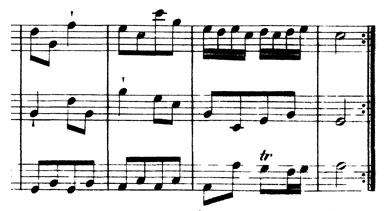
I have been working on the final Trio section from Bach’s Brandenburg Concerto No. 1, not for a specific performance but rather as an exercise for technical improvement in tonguing, the high range and endurance.

While working on this excerpt I remembered a neat performance trick – one that can be very helpful to a first horn player (more on that later).

For the woodshed

Since this passage is written with a blank key signature and no accidentals it is excellent fodder for transposition study. Adding in creative articulation and rhythmic variations offers additional levels of technical challenges.

Click for a larger view.

My own cyclical practice on this excerpt began slowly and without the written repeats. Gradually and over time the repeats were added in while the tempo gained momentum and speed. My worst key is concert D-flat major. The high A-flat on my horn is a little slippery on the octave skips.

Decomposing Bach

Like the bonus notes in Dvorak’s 7th symphony, this is one of those traditions that gets spread by word-of-mouth. I can’t remember where I learned this little performance trick but I imagine that it is common knowledge among many, if not most, seasoned pros.

It provides a small respite for the principal horn, the tiniest amount of breathing space in what is otherwise a workout on the chops. The good news too is that even with a score and a pair of great ears, most conductors will not notice.

The trick I speak of involves a little re-orchestrating of notes between the two horns, in two specific spots:

  • mm. 13 – 14
  • mm. 29 – 30

This is a trick geared for performance situations and of course, it would not pass muster at an audition (unless it is specifically asked for).

Measures 13 and 14

The original passage.

This passage can be taxing on any principal player and on the second repeat especially, the one-octave c2 to c3 jump might start to feel a little taller than usual.

When re-orchestrated:

This re-orchestration offers the first horn player a tiny bit of security and ease, in that:

  • The one-octave c2 to c3 leap is eliminated.
  • The peak high note arrives through a steady succession of ascending quarter notes.

Measure 29 and 30

The original passage.

The same passage re-orchestrated.

Once again a simple re-arranging of existing notes eliminates a potential tipping point for the first horn. All the advantages stated in the first example hold true here as well, and with a little practice no one will be the wiser as to what is going on.

Plan in advance

This is a great trick to know about and for myself it was very helpful in pulling off a successful performance. That being said, strong consideration must be given to the second horn player. This trick – as clever as it is on paper – presents that player with more notes to play than what is printed. It also takes away a few breathing opportunities.

Be sure to discuss this passage well in advance of the first rehearsal. It is a team effort that requires a good spirit to execute effectively.

BB1 at hornexcerpts.org

For more on Bach’s Brandenburg Concerto No. 1 take a look over at Daren Robbin’s Orchestral Horn Excerpts site.

Of particular interest to myself were the audio samples in this excerpt. Many of them are done with period instruments and comparing tunings, tempos and articulations is particularly interesting. In at least one recording it seems apparent that the players utilized the same trick as spelled out in this article.

*All examples are excerpted from the IMSLP web site under the auspices of fair use.

How to Test a Different Leadpipe on your Horn

Among horns I have owned over the years I have tried and changed several leadpipes. A change of leadpipe continues to be a popular upgrade for horns and it is not difficult to try a new one. It was a topic mentioned in my article on Friday, where I noted,

One thing I keep in my office is a vintage Lawson leadpipe bent for an 8D. It gives a good idea of what an upgrade leadpipe can do and often I will have students try it in a similar circumstance, to see if the high range is more stable and produced more easily. Often it is, along with improved articulations in general, etc.

Several makers sell leadpipes as custom, separate sale items. Every leadpipe maker will have their own requirements as to trial periods and deposits but most will send a leadpipe out on trial.

Leadpipes can be bent for any instrument but are typically sold or sent out for trial bent for popular models of horn. So if you have for example a Conn 8D or Yamaha 667 it will be a relatively simple matter to have a leadpipe sent for trial.

This is a leadpipe from a Conn 8D, without the receiver. You can’t test it on a horn in this form, you would need a receiver. This particular leadpipe could not be tested on a horn very well. Makers who sell leadpipes will normally ship them to you with a receiver for testing, one sized for your horn.

With leadpipe and receiver in hand what you need to do is line it up on the horn and plug it in to your main slide, then find a comfortable way to hold it. I like to tuck the leadpipe in the “groove” between the existing leadpipe and the bell tail for a quick test. It depends somewhat on the geometry of the specific instrument. But in this configuration you can get a very good idea of what the changes might be like, of how the horn would play with the new leadpipe.

And what can you expect for changes? Everything can be different; better articulations, tone, high range, intonation, etc. It is something to certainly consider with some horns, to try an upgrade, it can make a huge difference.

An unexplained photo

0

From BuzzFeed, this is #47 in a collection of 50 unexplained photos.

[Extracted from a “Random Monday” post, 2021, JE. This photo comes back around periodically on Facebook, etc., no idea the real story on this other than it is odd.]

Ask Dave: Water Keys 102

0

So, you decided to install a water key or two or three on your horn.

You just take it to your technician and say, “Put on a water key.”  Right?  Not so fast, there, horn player!  You have to actually make some decisions.

First, talk with your tech about where to place the key or keys.  Most players want one on the leadpipe.  The water condenses here first and fastest.  Another popular place on a double horn is to put the water key on the 3rd Bb slide crook.  But don’t forget other trouble areas.  Remember that a water key is for convenience, and nothing else.

Second, you have to decide on the style of water key you want installed.  Each has its own advantages.  There are three major types of water keys commonly found on horns:  lever-style, Amado, and the Joy Key.  There are other types, but they are rarely used on horns so we’ll skip over them, at least for now.

The lever style

The lever-style key is the oldest and most common type.  It consists of a water key nipple soldered on over the hole, and a saddle which holds the lever and the spring which pushes the lever down.  The hole is sealed by a cork.  Advantages include the positive seal, the slim profile which follows the tube length, and the potential operation by attaching a string to the lever, which can be operated by the thumb.  Disadvantages are cost (typically the most expensive key to buy and install) and the occasional need to replace the cork.  Installation is a bit more labor-intensive, as well.

The Amado key

The Amado key consists of a brass casing soldered cross-wise to the tubing which houses a stainless steel piston.  The piston is sprung so that one merely pushes the end of the piston inward to create an opening to release water.  Advantages include lower cost of the part and installation, a seal that is very close to the tubing itself which creates a smoother inner surface.  Disadvantages include the need to regularly oil the piston, a tendency to become leaky over time, and a profile that is not good for the 3rd slides because it can interfere with the other slides or the bell.

The Joy Key

The “new kid on the block” is the Joy Key, invented by Andrew Joy.  It consists of a water key nipple soldered on to the tubing much like the lever key’s, but which is also used to hold a special insert which both seals the tubing and is also porous and allows the key to drip, and therefore drain, constantly and without any user operation.  The insert is made of extremely tiny fused metal balls.  Holding it in place is a screw ring with an O-ring.  Advantages include never having to operate the key and therefore never having any water accumulation.  Disadvantages include the need to replace the insert when it gets clogged.  I have a personal concern about making one’s horn permanently leaky, but I have not yet heard that players who use them feel their horns’ performance is adversely affected.  You have to decide if you want a horn that drips constantly, which it does.

There is one advantage to installing a water key:  you can un-install it.  Every style of key can be replaced by another style more suited to your needs.  And, if want to remove it completely, the hole can easily be patched with no adverse affects.

High Notes, or Why you might need a New Horn or Upgrade Leadpipe

0

Nothing can inspire you to practice more than a horn that clearly plays better than what you have been playing. In my case, I have really been enjoying practicing lately as not only does my new horn sound great but also it has the best high range of any double horn I have ever owned, with a GREAT high B-flat in particular. I LOVE playing high B-flat on the new horn. Actually I love playing basically anything on this horn. A better horn is a great inspiration.

While I would like to assume that every horn has a good, full range, if you try a number of horns you can clearly see this is not the case at all. Back in my 8D days I changed the leadpipe out several times but really, I should have just replaced the horn many years ago and I was, looking back, actually told that I needed to get a different horn by a mentor I should have listened to, and that same mentor told me to replace the horn I replaced it with as well. I wish I had a horn like the one I recently switched to years ago.

This leads me to a story of bad high notes from my teaching. The high range is a common concern among hornists. I have some tactics toward working on it with students, every teacher does. One thing I have learned that it pays off to do is to just do a quick test of a student’s horn if there are problems. Sometimes in particular the high B-flat can be squirrely on some horns, especially older Geyer style horns. In this case though I will just say the horn was not Geyer style but the horn had literally the worst high range of any horn I had ever tried. I then handed my horn to the student and they could easily play higher than high C! They had fought the struggle with their horn so hard that actually the student had developed a very strong set of high chops, and when you put that on a horn with a high range that actually works then we suddenly had a killer combination! In this case, the problem was the valves were shot and leaking badly. As a temporary fix, we used lots of valve oil and it helped somewhat, as it sealed up the valves better. The horn badly needed heavy repair on the valves, which was the central problem.

Often a change of leadpipe can help as well. One thing I keep in my office is a vintage Lawson leadpipe bent for an 8D. It gives a good idea of what an upgrade leadpipe can do and often I will have students try it in a similar circumstance, to see if the high range is more stable and produced more easily. Often it is, along with improved articulations in general, etc.

The big tip here being if you have problems in your high range it is really worth trying other horns and having someone else who is a fine player test your horn if you feel the high range is bad.

A Glimpse into the Horn I Book of the Duo Operas ‘Cav and Pag’

For the first production of the 2011-2012 Arizona Opera season, I am bumping up from third to principal horn on a pairing of two operas:  Pietro Mascagni’s Cavalleria Rusticana and Leoncavallo’s Pagliacci.

This is a traditional pairing that gives a principal horn lots to do and today I will feature a few interesting passages and highlights.

The dynamic duo

Since 1893, “Cav and Pag” – as they are called – have been paired together, exemplifying the Italian verismo style. The two operas are approximately the same length and have similar structures of intensely dramatic scenes interspersed with lush orchestral intermezzos.

Their plots center around raw emotions played out among common people. Brutal violence ends with tragic murder in both sagas.

A three-hour show

The current timing for the Arizona Opera production is around three hours (not including the 30-minute intermission). I have no assistant and so the challenge for myself as a principal horn is more-or-less an endurance test.

While the task is not as Herculean as performing one of the later Ring operas, it comes fairly close. It boils down to playing straight for 90 minutes, resting for about 30, then playing full steam once again for another 90 minutes.

I will definitely be keeping these survival tips in mind.

The opening to Pag

Beginning with Paglicacci, the horns exchange fanfares with other sections of the orchestra.

* * *

These fanfare figures wind down to a point where the entire orchestra drops out. A lone, solo horn plays a few held notes. At the Largo Assai in the example below, an unaccompanied horn quartet is featured. The first horn carries the famous tune that will occur later in the opera under more tragic circumstances.

These examples typify the part – there is lots to play and there are no long tacets or rests as in some other operas.

A sample from Cav

The writing in Cavalleria Rusticana is equally busy. In terms of orchestration it feels almost like a band composition; I suppose that this is part of what gives it its flavor and charm.

This sample below is one of the trickier passages (the tempo is one beat per measure at an Allegro tempo). The dynamic begins at a mezzo-forte and gets up to a bold forte by rehearsal number 4.

If I were in charge of an audition committee, this passage would be a prime candidate for excerpt material.