Home Blog Page 79

Kopprasch 18. Vivace. Cruel Joke?

0

Following up on the Golden Clam for the Boldin Kopprasch project, one thing I would think many of you out there have noticed is the markings in the Kopprasch etudes don’t match up well with the tempos we typically go. Kopprasch 18 is a prime example, with the marked tempo of Vivace. The ever useful Wikipedia notes that,

Vivace is used as an Italian musical term indicating a movement that is in a lively mood (and so usually in a fast tempo). The speed typically coincides with that of “Molto Allegro” and implies a metronome marking of 132-160 if played 4 notes to a beat.

By that standard horn players typically play Kopprasch 18 at roughly half the printed tempo. The tempo Boldin plays his at is typical, coming in around a quarter note at 88. In spirit you want to keep it moving and it is in that sense I guess that Kopprasch marked it Vivace. Even at typical horn player tempos it is one of those etudes that is very hard to play perfectly and is one I keep coming back to as sort of a lifetime project.

Verne Reynolds included a long section on the Kopprasch etudes in The Horn Handbook. Of this etude he wrote,

Etude No. 18 should be learned in both E and D before reading it in F. In E the fingering patterns for the upper octave are rather complex, but quite simple in the lower octave. Memorizing this etude is a good idea so that we can watch our fingers. The tips of the fingers should always be in contact with the end of the valve keys. Some players, without realizing it, raise the fingers before depressing the keys, or allow the fingers to rest so far down on the keys so that the first joint is flattened. … It is best to work out this etude sempre forte to make sure that an even volume is maintained.

A great reminder on the fingers but how many of you out there cheated and read it in F first? So for all you slackers (like me) out there, get busy.

And, on the record, I think this etude would sound terrible on a horn at a real Vivace tempo, it would be much too fast and frantic. But a classic etude to be sure and one to shoot for 100% accuracy at any tempo in F or any other key, the effort will pay off.

A Golden Clam for James Boldin’s Kopprasch Project

Golden Clam AwardIt has been a long while since a Golden Clam has been awarded and our honoree today most certainly deserves one in recognition of his contributions to the horn world, and specifically for one project in particular.

Since January 2011 James Boldin has been recording Book I of the Kopprasch Sixty Selected Studies Op. 6 on video and uploading those videos to Youtube for public viewing.

On his web site, Mr. Boldin cites four reasons for this project:

1. Pretty much everyone who has played the horn for more than a few years has at least heard of the Kopprasch etudes, and they often  (along with other standard etude collections) form a core repertory of materials for horn study.

2. Practicing Kopprasch can be beneficial for players of varying abilities.  Whether it’s working on tone production and consistency, or perfecting transposition skills, I think Kopprasch holds an important place in the repertoire for students, amateurs, and professionals.

3. As a teacher, I wanted to provide a resource for my students and others so that they could at least hear one interpretation of these etudes, and use these recordings as a jumping off point for their own creative practicing.

4. Although there are several recordings online of Kopprasch etudes, to my knowledge no one has yet recorded all of Book 1 or Book 2 on video.

While he admits that each recording is not absolutely note perfect, he does clearly illustrate contrasts in dynamics, articulation and tone color. These details can make a big difference between a hum-drum reading of the notes and something greater.

That being said, Mr. Boldin performs each etude with assured confidence and a clean sound.

His videos in this regard are a great model for students to follow. As a beginning student myself many years ago I had developed the bad habit of stopping and starting etudes – much to the consternation of my private teacher. It took me a while to adapt to the mindset of playing a Kopprasch etude end-to-end, more like a performance and less like an exercise.

It takes a certain amount of confidence in a higher purpose to record etudes like these in one take and put them online for the world to hear. Mr. Boldin is to be commended not only for his chutzpah but also for some very fine and solid playing.

His latest chapter is etude #26:

For more examples, be sure to take a look at his Youtube channel.

It is adding up to a large collection that without a doubt will benefit many – whether they are learning the Kopprasch etudes for the first time, or are someone more like me who is returning from a break and is curious to hear what another professional player is doing with these etudes.

* * *


Hornmasters: Farkas and Schuller on the Slur, Air, and Vowels

We return to the Hornmasters series this time looking at  topics related to the lyric side of playing the horn, beginning with slurs, air, and the use of vowels. This article will be longer than average in this series as it allows us to focus in more depth on the contrasting approaches presented by Philip Farkas and Gunther Schuller.

Conventional wisdom on slurs

Farkas in his discussion in The Art of French Horn Playing starts with the slur, as it allows him to first focus on the use of air in musical contexts. In a slur the lips must continue to vibrate between notes. He comments

As we know, the lips are vibrated by the air column, so it is obvious that a good legato requires that the air flow steadily and continuously between notes. There is a commonly committed error of “huffing” each note into place with a shove of air just as the slur takes place. Done correctly, the air should continue steadily during the change, exactly as for one long tone. The slur should result from the proper use of the embouchure, not from a shove of air.

Stepping back and looking deeper…

And here is where we need to immediately step back. There is an introductory article to the topic of slurs and legato as part of the University of Horn Matters series (here). In that article two videos are embedded relating to the recent MRI horn studies led by Dr. Peter Iltis. It truly will be worth your time to take 15 minutes and listen to at least the podcast and also check out the longer video at the 8:00 mark for a minute or two. Because actually Farkas immediately ventures into a grey area.

mri-hornSeriously, any real horn teacher or aspiring horn teacher should not be ignorant of what the MRI videos clearly show. Farkas sounds correct enough, don’t shove the notes into place! However he had no way to see that actually, in slurs there are natural pulsations of the tongue which are very visible in the MRI studies. This fact has to my knowledge never been mentioned in any horn text or article.

Done to excess I think you will hear the pulsations as evidence of a shove of air or a dreaded “twa-twa.” However, they are also completely natural and obviously part of the standard technique of fine horn players. We will return to this topic as we continue.

Back to Farkas, he does have a great suggestion, it’s not a minor aid though

As Farkas continues his thought he applies and clarifies the use of the tongue as discussed earlier in his section on the four points of resistance, the use of vowels or differing vowels by range.

The tongue furnishes very definite help in slurring and is used in conjunction with the lips. If the slur is upward, the tongue should silently form the vowel “oo” for the first note and “ee” for the second. In a downward slur the opposite order is used, “ee-oo”. These enunciations will accomplish perfectly the result that was hoped for by the intuitive (but wrong) urge to “huff” notes into place. A shove of air will definitely aid an upward slur, but this shove must be far more subtle than any shove of the diaphragm. When forming “oo” for the lower note and changing to “ee” just as the embouchure makes the slur, the tongue arches upward in the column of air the needed, but very subtle, shove. The vowels “ee-oo”, formed in making a downward slur, produce the opposite effect; they relax the air stream slightly so that he lower note is settled upon gently.

…Do not carry this arching too far, as it is only a minor aid to slurring, which must be basically achieved with the embouchure.

Referencing the MRI videos, Farkas is correct about the “oo” to “ee” vowel shape changes (low to high) but incorrect in saying it is a minor aid to slurring. Actually it is a key to slurs, especially wider slurs, which he recognized more in a later publication (examined shortly). If this element is missing and you solely “muscle” the slur it will be problematic, as would also the absence of the natural pulsations of the tongue.

[NOTE: For clarity I will generally use the same vowels that the author used in the quote when commenting on it. My general default will be Hee-Haw, with “aw” and “oh” being considered for our purposes to be nearly the same.]

Air speed and the slur

Gunther Schuller opens his chapter in Horn Technique on legato addressing a similar topic but from a very different angle. While Farkas looked at slurring as something aided by changes of vowel sound, Schuller looks toward air speed adjustments as the essential aid to slurs.

The single most important factor in legato playing (slurring from one note to another) is our old friend ‘breath support’. As we have learned, it is the air column that largely controls the vibration of the lips. Now the secret of good slurring is to keep this vibrating of the lips constant and controlled between slurred notes. Otherwise the beauty of the legato will be impaired or—worse yet—the player may find that the second note, to which he is attempting to slur, will not speak at all. It therefore stands to reason that extremely sensitive control of the air column is the key to a smooth, perfectly controlled legato.

The most common fault among students is that they generally give insufficient breath support in slurring….

In order to get a smooth legato between two notes, in which both notes shall be equal dynamically and qualitatively, a ‘breath crescendo’ must be made internally. This is especially true of any upward slur, and becomes more critical the larger the skip or the higher the register involved in the slur.

If we step back from this, what is a “breath crescendo” anyway? It is a change of airspeed. How do we change airspeed then? “Blow harder,” maybe, but also if you change your tongue position in your mouth the airspeed is impacted too. As the tongue goes up there is a venturi effect and the airspeed increases.

So, for example, exhale through your mouth and imagine you are playing a very low note and then a very high note. Notice that your tongue goes up and as a result the airspeed is higher? This effect helps slurs.

Confronting the dreaded “wah-wah” issue

Back to Schuller, besides breath support, which he sees as the crucial factor towards legato, he points out two other important elements, “the size of the embouchure opening, as controlled by the teeth, and the jaw and the timing and smooth operation of the fingers of the left hand.” And he has one other final, important point to make.

Before I leave the subject of legato playing, I must speak of one other related problem—in my opinion one of the most widespread evils of horn playing. It is what I call the ‘wah-wah’ style of playing, in which each note is pushed and bent in a way that disrupts the easy musical flow of a legato or semi-legato phrase. This style—to call it that is to flatter it with a euphemism—is not confined to one country. I have heard it in all countries where I have heard horn playing….

Strangely enough, this manner of playing is seemingly accepted by all conductors, not to speak of lay audiences…. Conductors seem relieved when the horn player ‘gets the notes’, and generally do not quibble about matters of phrasing and intonation…. My guess is that most conductors fail to hear the difference, or at least are unable to cope with it on practical corrective terms.

As to what it is exactly Schuller offers the following.

An analysis of the nature of the ‘wah-wah’ discloses that, whether tongued or slurred, the beginning of each not starts with not a quite centred tone and a correspondingly lower dynamic level. During the course of the note, both tone and dynamic level are expanded and heightened. Toward the end of the note, the original level is restored. At this low point, the connection is made to the next note. It is evident that there is a certain security—a feeling of taking no chances—in this ‘sneaking-in’ approach, and this indeed is the reason, I think, for the prevalence of this bad habit. It gives the player a chance to ‘test’ the note, to sort of feel his way into the note before playing it at full level. This is convenient, but most unmusical.

That is conventional wisdom of what causes a “wah-wah,” but now the pulsations I talked about earlier make sense. They are natural, they will be there, but when they get to the point that you begin to hear them as a “wah-wah” you have to look toward making them less obvious, focusing on trying to make strings of notes become perfectly connected blocks of sound.

Farkas has more to say on this topic in his later publication The Art of Brass Playing, where he suggests in slurs that

It should be quite obvious that a well-supported air-column must continue between the notes to keep this buzz alive. So many players have a misconception that the air-column “bulges” on each note and continues as a mere thread between these notes—a sort of hourglass effect rather than a straight column. The air-column must continue straight and steady between notes with just as much support from the diaphragm as would be used to sustain one long tone.

Farkas thus was also concerned to avoid what Schuller called a “wah-wah” effect in slurs, just he called them “bulges” and did not have benefit of MRI to spot the underlying issue. Farkas also in this publication it is notable was more of an advocate of vowel sounds as being a valuable aid to slurring, showing some change in his pedagogy over time.

There is a natural (and, in my opinion, correct) to form the inside of the mouth for the vowel “oh”, while holding low notes, “ah” or “oo” for the middle register, and “ee” for the high register. These vowel sounds do not change from one to another at any certain point in the range, but rather change imperceptibly and gradually as the range ascends or descends. That is, the “oh” formation of the lower notes gradually becomes “ee” in the high register by the gradual arching higher and higher of the back of the tongue. This process works in reverse as the player descends.

In slurring very small intervals, this action is almost imperceptible. But, in the slurring of larger intervals, this change becomes quite pronounced.

Farkas explains that these changes of vowel sound subtly increase and decrease the air pressure in the mouth, which aids with slurs. In total, we can see an evolution in his thinking on the topic, as to go from “oh” to “ah” to “ee” is to arch the tongue. It is presented in The Art of Brass Playing as much more than a “minor aid to slurring,” he realized that he had downplayed an important topic in The Art of French Horn Playing.

Continue in Hornmasters series

Poll results: How do you feel about the name “French horn”?

Last Friday a Horn Matters poll asked two questions on the topic of the name of our instrument.

To the question “How do you feel about the name ‘French horn’?” the majority of people who have taken the poll so far have answered that they call the instrument French horn when talking with non-musicians.

However, when it comes to readers’ reactions to the term “French horn” the results so far are somewhat less decisive.

As a final personal commentary I would point to several articles here and here on the topic of manners and etiquette. In the ideal world of polite social graces, correcting another person’s grammar is considered as somewhat rude and inappropriate behavior.

And too, correcting people on terminology can have the opposite effect as intended. An attempt to enlighten and educate can come across as something else entirely if not handled with the utmost care and attention.

[Extracted from a “Random Monday” post 2021, JE]

The Kopprasch Op. 5 Etudes and a New Free “Low Horn” Version as a PDF!

Way back in 1997 The Horn Call published an article that I wrote on the history of the Kopprasch etudes. Also, a few years ago I posted an article in Horn Matters that focused on the original 1832/33 version of the Kopprasch etudes, and that you could download that version on the IMSLP website.

As quick background (described in more depth in the article linked above), Georg Kopprasch published two volumes of etudes. The Op. 6 low horn etudes are the ones we know and love that have been through many editions. The little used Op. 5 high horn etudes are similar but focused in a higher range.

The new development for 2011 is that trombonist Benny Sluchin has now made available an edition of the 60 Etudes, Opus 5, in a version for bass trombone, and it is available as a free download on the website of bass trombonist Doug Yeo! There he writes,

When Benny published his Brass Urtext critical edition of the two volumes of Koppprasch Etudes, adopted for tenor trombone in 2000 (now out of print, but soon to be available from Warwick Music), I was surprised to learn of the Opus 5 Etudes which were previously unknown to me. Originally for high horn (Cor Alto – premier horn), they are very different than the better known Opus 6 Etudes which were written for low horn (Cor Basse – second cor). Originally published in two volumes, each with 30 etudes, the 60 Etudes, Opus 5 were an important addition to my trombone music library. Over the years, as I worked on these “new” etudes – which are higher in tessitura than the Opus 6 Etudes and are all in tenor clef in Benny’s edition – I thought it might be useful to have a printing of these exercises an octave lower than the original, thereby making them more suitable for bass trombone. I contacted Benny to ask him if he would be willing to prepare another edition of the Kopprasch Etudes, Opus 5 for bass trombone. Not only did he agree, but he has offered to offer them at no cost to players who would like to use these fine Etudes. Benny and I both feel that the Kopprasch Etudes are a very important part of the “daily diet” of technical exercises every trombonist should use each day. With Benny generously offering his new edition of Kopprasch Etudes to players for free, I told him I would be willing to host them on my website, thereby giving players around the world access to this resource. We all owe Benny our heartiest thanks for his preparation of this edition, and for making them available at no cost to players and teachers.

More information is here as is the downloadable version as a PDF.

This new bass trombone version will work GREAT for low horn study. The tessitura is perfect (reading in “new notation” bass clef only a couple notes here and there are too low to play) and another neat thing for us in the horn world as well is that musically they are very similar to the standard version but none of them are the same, they will keep you on your toes! I will be making use of these in the studio this year; this version is certainly one for hornists to check out.

And while you are at the Doug Yeo website do look around a bit, it is a classic site and one of the very best ever put out in our brass world.

Ask Dave: String Theory — What Makes a Good String for your Horn?

0

Whether you call it string, line, wire, or cord, the thin, flexible linkage between your valve levers and your valve rotors is your lifeline to a properly functioning horn.  This thin line has advantages that cannot be duplicated (a smooth action throughout the lever’s travel), as well as flaws that some consider fatal (a tendency to break).

If your horn has a string linkage then the composition and properties of that string are of paramount concern to you, but many horn players never even give it a second thought.  That is, unless it breaks. And Murphy predicts this catastrophic failure will most likely occur during a concert.  So before you live the nightmare of forced use of alternate fingerings, choose the string on your horn wisely.

What makes a good string for your horn?

A good horn string should be as lightweight and thin as possible without being prone to breakage, strong enough to take the pressures involved, easily installed and knotted, resist slippage, have a low stretch coefficient, and be able to resist the lubricants that one uses.

The thinner and lighter the string is, the less friction there is while operating the valve levers.  Less friction means a smoother, faster action.  But thin and light strings tend to be weaker, so you have to balance this against the strength (usually measured in test pounds) of the string.  Action is also affected by whether the string stretchs under load, so the less stretch the better.

Many horn players use the Yamaha brand string (the yellow string), which has all of the desired properties and is readily available.  I prefer a variety of fishing line known as black, braided Dacron squidding line which is pretty hard to find these days.  I have it in various test strengths (30 lb, 50 lb, and 80lb) of which I prefer the lightest.  The higher strength strings are correspondingly thicker, with slower action, but don’t break as readily.

Breakage and slipping

Speaking of breakage, I find that 30 lb test is strong enough to resist the strength of any horn player’s fingers. Strings that break (and especially if they break habitually) most often break because of sharp edges that cut them on the levers or screws, and not because of any inherent weakness in the string.

In general the best strings to use on your horn are various braided synthetic fishing lines.  The hard part about finding good string is finding string that does not slip. Many of the commercial fishing lines these days are coated, often with Teflon, and the string will slip no matter tightly you screw it in.  There are so many brands and kinds of line on the market that it would be impossible to survey them all.

You can’t go wrong with the Yamaha brand or with the string supplied to most repair techs through Allied Supply.  If you have a favorite, I’d love to know what it is.

Mini-poll: Is it the ‘French horn’ or just a ‘Horn?’

0

Both John and I have written a few articles recently on the topic of the name of our instrument in the English language  – is it a French horn or is it just a horn?

Like discussions about the embouchure, this is a hot-button issue that can spark personal pet peeves and even some heated discourse.

Its all about context

I think that John and I are more-or-less of the same opinion – that the use of either term is largely dependent on context.
Outside of the music circle, the term horn can cause some confusion since in the English language the word can have multiple meanings. Among fellow musicians who understand the distinction however, the term horn is perfectly understood.

The infamous 1971 recommendation

The controversy appears to stem directly from what has more-or-less become the de facto slogan for the International Horn Society:

The International Horn Society recommends that HORN be recognized as the correct name for our instrument in the English language. [From the Minutes of the First General Meeting, June 15, 1971, Tallahassee, Florida USA]

To this day, this recommendation has retained a prominent spot in both the IHS web site and its journal publications. It is a rather stark choice over more traditional, people-friendly, mission-statement-type slogans like “sharing the joy of music through the instrument we love.”

https://issuu.com/brucehembd/docs/frenchhornorhornsurvey

Comments?

Please feel free to enter any followup comments below. Since my opinion on the topic is well-known (here and here, for instance) I am boycotting myself from participating in this dialogue in order to leave things open for readers to discuss.

Transforming negative into positive

This comic strip from Odd Quartet hits on a note of truth and is also great advice.

[Extracted from a “Random Monday” post, 2021, JE]

Ask Dave: An Interesting Trend — Repairs at Workshops

0

It seems to be an upward trend, but I’ve noticed (and done) more repairs at workshops in recent years.

Among the repairs I’ve seen are string replacements, bumper replacements, freeing stuck rotors, dents repaired, chemical cleanings, ultrasonic cleanings, mouthpiece modifications, gold plating of mouthpieces, and water key installations. I’ve yet to see on-site bell cuts, but I guess that’s coming.

Despite what many of my fellow vendors believe, I think it’s an increasingly competitive marketplace out there. Many of the vendors, especially small shops that sell instruments and accessories, are also headed up by repair technicians, many of whom are the leading techs in our industry.

Eager to please and eager to earn market share, they are all working hard to distinguish themselves and demonstrate skills to an ever more demanding clientele.

So, is it a good thing to have repair work done at a workshop?

In general, because the technicians are among the most skilled and most knowledgeable, I would have to say that having repair work done at an event is probably not much of a risk.

All the same, I have my reservations. I know what can go wrong, mainly due to problems that were hidden on initial inspection or did not seem serious enough to warrant caution. And if something goes wrong and I don’t have the tools to fix it, then both I and my customer are in trouble.

It’s practically impossible to take a full complement of tools to a workshop, and so a repair tech doesn’t have a full range of options or solutions. I sure would hate to take a player’s horn out of commission just minutes before a concert.

On-site safety

And there’s the question of general safety, as well.

I witnessed a very ugly scene as one tech berated another for doing on-site gold plating. It turned out that the plating chemicals did not use cyanide, but I still had my doubts as the tech donned a respirator – a piece of safety equipment no one else in the room had! Soldering requires flames and fumes.

Mini-lathes have safety issues, as well, as does practically any power tool. Is a workshop really a safe enough enviroment? Is everyone involved insured properly? These are questions that hosts and vendors will wrestle with in the coming years.

On balance, I would have to say that the “workshop as work site” is probably a trend that is here to stay, but I caution all involved to consider the ramifications of on-site repairs before attempting them.

How to use a Sink Hose Adapter to Clean a Horn

French horn taken apart for cleaning.In Arizona we have been hit hard this summer with a series of heavy dust storms. The most serious storm a few weeks ago was reported as being about 100-miles wide and over a mile high.

Dust and sand was – and still is – everywhere. As a preventative measure, I decided to give my horn a good rinse.

Give the horn a bath?

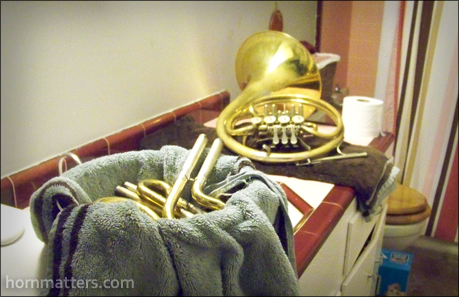
I used to do my cleaning routine in the bath. I would line the tub with big, folded towels, put the horn in the tub, add water and detergent, and go to work.

I get my horn professionally cleaned these days but in-between cleanings I use a simple routine that does a decent job of keeping the horn clean between professional treatments.

Ingredients:

All you need is:

The sink-to-shower hose

The key ingredient in this recipe is the sink adapter hose. I picked mine up in a large superstore, but they can be bought online like almost anything else.

The first step with the hose is to remove the shower head end and throw it away. The bare end will then attach to the horn’s lead pipe.

If the French horn lead pipe is larger than the diameter of the hose, a small cut with a pair of scissors can do the trick. If done carefully, the vinyl plastic stretches without ripping or tearing.

Attaching the hose to the lead pipe.

The large rubberized end attaches to the sink faucet and provides a water-tight seal. My sink adapter is weathered from the tool box I keep it in.

Attaching the hose to the lead pipe

* * *

Tips on using a snake brush

A few drops of dish washing detergent on the brush ends is all that is needed.

Use a snake brush sparingly and gently.

Using a snake brush on a French horn.

* * *

Tips on water pressure and drainage

Always turn the water on slowly and gradually. Too much water pressure may blow out slides and ruin your day.

To lower the odds of this happening:

  • Take out all the valve-tuning slides and set them aside.
  • Keep the main tuning slides in place, or keep a select few.

When the water is turned off, maneuver the horn into different positions to direct the draining water into the sink basin.  If the cushioning towels get soaked that is just fine; a wet towel stays anchored and keeps the horn from sliding around.

Directing the water drainage into the sink basin.

Valve rinse

Below is a picture of how I very carefully hold the horn over the sink basin and slowly open and close valves to give them a good rinse.

  • Keep the water pressure low.
  • Be alert for slides popping out.

Flushing out the horn with water.

Players with screw-bell horns with have a much easier time of this, with the bell removed.

Draining water from a French horn bell flare.

The H2O flush

In the sandy, desert environment I am always thinking about grit getting into the valves. If the dust storms in Phoenix continue, I will use this handy sink-to-shower adapter to do mini-flushes – with water only and no detergent.

I want this horn to last for many years and a quick water flush never hurts. I am okay with a plain water flush but have heard some players preferring to use a mouthwash rinse instead.

* * *

The tuning slides

After finishing with the body of the horn and drying it with a clean cloth, the slides get a bath of water and a few drops of detergent in a bowl.

Cleaning horn valve slides.

To make sure all traces of dust and dirt were gone, I gave each slide a quick once-over with a mouthpiece brush.

Cleaning out the horn slides with a mouthpiece brush.

After rinsing everything thoroughly with water, I dry the slides with a clean towel and leave them out to air-dry.

In the desert – where the humidity level rarely goes above 15% – this happens in under 15 minutes.

Letting the slides and horn air-dry.

When putting it all back together, I follow Dave Weiner’s advice using different grades of oils and lubricants.

I highly recommend this video on how to oil rotary valves from James Boldin.

* * *

Putting it back together again, another story…

Sometimes when putting the horn back together it helps to have an eager assistant.

Fortunately my little niece Livia stopped by to help put Humpty Dumpty back together again!

* * *