Home Blog Page 87

Getting that ‘Wow’ Factor in Your Playing

Without a doubt one of the best practice techniques for improvement on a wind instrument is long tones. A teacher of mine once professed that long tones were good for practically every aspect of playing – with the exception of tonguing.

Some of the benefits include:

  • improved tone quality
  • better breath control
  • greater embouchure strength
  • wider dynamic expression

Sustained notes

In the most elementary form, any series of sustained pitches might be considered as a long tone exercise. Some might call these quality tones.

One simple variation is to incorporate breath attacks. This technique subtracts the tongue from the equation of tone production and can solve a lot of problems.

Myself, I also put pitch-bending and glissando exercises into this general category of sustained notes being considered as long tones.

The “classic” long tone

While this simple approach indeed has great value, adding even the smallest crescendos and diminuendos can increase the benefit.

John Ericson noted in “A Key Thing to Practice” that a perfect and gradual increase and decrease in volume is key in executing the crescendo/diminuendo long tone. A primary concern is to smooth out any bumps or wavers in pitch, especially when transitioning from soft-to-loud and loud-to-soft.

This is something that I have also written about in “The Art of Practice, Part II”,

Practiced on a cycle of different notes for 5 to 10 minutes daily, unforced and gentle long tones like these produce tremendous results over the long term.

The main goals in practicing long-tones are:

  • the most beautiful sound possible
  • smooth transitions and even pitch throughout all dynamic levels

For myself, I practice the “classic” long-tone starting in the middle/low register and progress chromatically up or down, or in a cycle of fifths, depending on how I feel or what was practiced the previous day.

Along this line of thought, I have a distinct memory from a masterclass many years ago with cello virtuoso Yo-Yo Ma. In instructing a student, he emphasized that one should draw the sound out from the instrument rather than forcing it out.

This is a key distinction to keep in mind when practicing anything really, but it is particularly relevant in this case when practicing long tones.

Adding the”wow” factor

Adding more sudden and immediate effects – fast crescendos/diminuendos,  forte-pianos and sforzandos – adds an extra element that I call the wow factor.

I call it this in part because of the aural effect but also for the end result. Taking it a step further, here are variations on the same theme to consider:

Long tones do not need to be a boring exercise and these variations are only a beginning. Injected with a some inventiveness and creativity they can be beneficial and fun to play.

Firebird Awkward Cues

Awkward cues

The final horn solo in Igor Stravinsky’s Firebird Suite can be a touchy spot made even more precarious with a clumsy cue from the conductor. Looking at a video of the composer himself conducting, Kenneth Woods makes a good point.

Like Hindemith, the technique isn’t going to win any beauty pageants. More to the point, some gestures are very in tune with dynamics and color of the music, while other aren’t. The cue to the horn soloist at the beginning of the Finale couldn’t really be less musically appropriate or less helpful. It is almost the perfect cue to cause a split- an arhythmic violent stab at the beginning of a lyrical, exposed solo. In fact the player doesn’t split for two reasons: one, he is a damn good horn player, and two, it was Igor freakin’ Stravinsky who gave the weird cue. Trust me, if it was me up there, the horn player would have split it big time.

The “damn good horn player” in this case is Alan Civil.

[Extracted from a “Random Monday” post 2021 by JE]

The Most Popular Horn Quartet Composer

0

This was originally posted as part of a report on the 2011 Mid-South Horn Workshop, hosted by Dr. Paul Stevens at the University of Kansas.

My first official activity was as a judge of the collegiate horn quartet competition, along with Michelle Stebleton and Elliott Higgins. There were four groups all of whom sounded very strong (from Baylor, Oklahoma State [the winners!], UMKC, and the University of Missouri Columbia). The rules read,

Each quartet should prepare no more than 12 minutes of music. Groups will be stopped after twelve minutes, and each audition slot is to take up no more than 15 minutes. Changing music and setup between selections is included in your performance time. Each quartet should, within this time slot, perform two works or movements of contrasting style. Only one of those pieces/movements may be an existing transcription, while the other must be a work originally composed for horn quartet. The group may instead perform two contrasting movements or works composed for horn quartet (i.e., not transcriptions).

In short the groups could choose their own music, there was no required rep. So what composer was chosen most often? Kerry Turner. Every group played Kerry Turner as part of their program! Also it was very interesting that every group set up in the same style popularized by the American Horn Quartet, facing forward as below:

4 – 3
…2 – 1

For sure performances and recordings and these engaging works of Kerry Turner are a part of their success and what gets quartets motivated! As and “older timer” I have heard the American Horn Quartet for years but for sure there are readers out there for whom Turner and the AHQ are unfamiliar  If you are not familiar with the AHQ, be sure to visit their website now!

There were presentations, a solo competition, and recitals in the afternoon that I missed but I did not miss the evening concert.

The pre-concert performing group was the horn octet from Oklahoma State University conducted by Lanette Lopez-Compton. They sounded great and played several works including, you guessed it, one by Kerry Turner.

A Look at the U.S. Army Band Manual

A Roman cornu.

The U.S. Army remains one of the largest and oldest employers for musicians in America, and last summer I was happy to find a document that spells out some of the operational details behind-the-scenes.

The document bears the very simple title of  “U.S. Army Bands,” but contained inside is a wealth of information and ideas worth exploring. When compared to the operational procedures of most American symphony orchestras it is a fascinating study.

A key factor of this document is its modular compartmentalization of the varying elements that make up the whole program. This concept is relatively new with the approval of a Force Design Update from 2006.

This included a

… redesignation of bands as Army band (large) generally assigned to an Army command, Army band (medium) normally assigned to the Army Service component command or corps level, and Army band (small) usually allocated to division headquarters or individual installations.

This manual advocates an Army band staff cell (ABSC) as a theater-level asset designed to coordinate the employment of music performance teams (MPTs). The prototype of the ABSC was implemented successfully with the Multi-National Corps-Iraq during 2009 in Operation Iraqi Freedom.

This concept appears to fall in line with a broader U.S. military philosophy which focuses on concentrated elite units over large numbers of forces. I imagination that this too is an implicit purpose of the manual – to better attune the U.S. Army bands to the current policies of the Army.

Purpose and function

The U.S. Army bands, according to this manual, serve a clear function:

  • to build morale
  • to provide ceremonial and functional music
  • to build national relations and foster support
  • and, to recruit.

Within a historical perspective, musical instruments have been a part of military strategy for centuries, going as far back as the Assyrians and Babylonians. Ancient Roman cornus and Scandanavian lurs for example, served multiple functions – from scaring the enemy to providing celebratory fanfares.

The modular system

Most interesting to myself is the second chapter of the manual, “Band Structure and Capability.”

Army bands built of modular units support Army, joint, and multinational formations. Army band types are small, medium, or large and special. Army bands further subdivide based on operational capabilities in support of ongoing operations.

This is somewhat similar to how symphony orchestras and musician unions are structured.

In America a number of orchestra musician associations belong to conferences like the International Conference of Symphony and Opera Musicians (ICSOM) and the Regional Orchestra Musicians Association (ROPA). In many symphony orchestras – if not most – offshoot groups provide chamber music  – brass and woodwind quintets, and string quartets being the primary examples.

The big difference however is that a modular system like the Army’s is rarely spelled out with such clarity. Looking at the small ensemble Army modular unit for example:

Looking at The United States Army Band (“Pershing’s Own“), a different modular system is diagrammed.

This particular ensemble has large resources and personnel, so it breaks down into much larger subsets than that of a small band.

TUSAB is authorized 1 field grade officer as commander, 1 field grade officer as deputy commander, 1 field grade officer as operations officer or associate bandmaster, 2 company grade officers as associate bandmaster, 1 warrant officer bandmaster, 1 command sergeant major as enlisted bandleader, and 245 Soldiers.

One group that I was completely unaware of until reading this document was The Supreme Headquarters Allied Powers Europe (SHAPE) International Band at Casteau, Belgium. This band is the official musical representative for NATO and the allied headquarters in Europe.

Download the PDF

I highly recommend reading the U.S. Army Band manual; there is much more to look at than this brief overview.

I have often wondered about some of the ideas in this manual as something for American symphony orchestras to adopt. I have never served in the military but to myself at least, elements of the Army’s approach – especially towards organizational clarity and clear language – are perhaps something to be emulated.

A Study on Hand Position: A More Stable High Range and Hand Stopping

I found the link in Random Monday this week to a recent (2009) study very interesting, on the topic of hand position.

The title of the project is “Spectral Analysis of the French Horn and the Hand-in-Bell Effect” and author Adam Watts wrote the paper as a Senior Thesis in the Department of Physics, University of Illinois at Urbana-Champaign. In the introduction he sets out that

The placement of the player’s hand serves two functions, both vital to the playability of the horn. First, the hand causes upper resonances to decrease in pitch, effectively bringing the usually sharp higher notes more in line with standard tuning. This intonation effect is due to the added acoustical mass the hand creates at the end of the air column as it is pushed farther into the bell, lowering the frequencies of the system, which can be thought of as an approximate Helmholtz resonator …. The second effect of the hand placement inside the bell is the increase in playability of the upper resonances of the instrument; this is where the problem of accuracy in the upper range is addressed.

The second point is a very important one; when the hand is in the correct position it will give the most stability in the upper range, and improve accuracy, and help avoid tendencies toward being sharp in the high range. In the conclusions he notes also that

The normal playing hand technique of the French Horn player, wherein the hand is cupped inside the bell end of the instrument, serves to help the player access the high frequency resonant modes, or partials, of the horn. The hand helps reflect higher frequency waves back up to the player’s mouth, reinforcing the buzzing of the lips and increasing the stability of the note. This effect is supported by the data presented in this paper, as well as Backus’ data with the hand simulation, in that impedance peaks became more pronounced and defined in the upper range when the hand was added. The cupped hand also lowers the pitch of the higher notes, bringing them more into line with the harmonic series, and thus more in tune. The data in this paper supports this by showing that the peaks of the impedance curve, which correspond to playable notes, shifted downward in pitch in the upper range once the hand was added

The other major area studied in this paper has to do with hand stopping the bell. Traditionally we are taught in general these three points:

  • Close the bell tightly with the hand
  • Finger the note pitch a half step below the pitch you want to play
  • Use the F side of the horn only for better intonation.

(For a longer discussion of the topic see this article.)

The traditional understanding is also the basis of why a stopping valve also works on horns so equipped. It is a practical way that works well with a standard stop mute and speaking generally used to work for most horn players. I say “used to” as if you look back a hundred years most horn players were men which implies big hands. Today horn players are much closer to 50/50 male/female and the result is that the traditional approach does not work well for probably half of horn players out there and even back in the day did not work for everyone. The problem being that the traditional method will generally result in sharp stopped notes for players with small hands.

As a stop gap I have over the years developed a way of devising flatter fingerings based on the standard approach (see this article) that I often use with my students, and certainly I tell people often to use different fingerings than the standard way, experimenting until we finally get the problem pitches in tune. If it is in the staff or above it is possible to get any stopped note in tune with experimentation.

But the underlying problem is that the traditional understanding of stopped horn really it is not what is actually going on acoustically. That is pretty widely known but reading this new study out to the conclusion has given me even more to ponder. In the conclusion he notes that

Hand-stopping the horn inexorably changes the frequencies of the partials, but the exact nature of this change has been steeped in controversy. The apparent controversy between the nature of partial-shifting due to handstopping centers around the question of the direction of the shift; players disagree as to whether partials are shifting up or down, because there is reportedly mixed success with transposing in either direction to compensate for the shift. However, Backus’ data using a rubber stopped in the bell, further supported by the data in this thesis using a real hand, suggests that the partials are indeed lowered by the addition of a stopping mechanism. The confusion arises because apparently many players are inadvertently playing the next partial up from the note they want while stopping, and transposing downward to compensate. This situation explains why most horn teachers instruct to transpose down a semitone while playing stopped horn; they are encouraging their students to play the next partial up and to compensate downward with the instrument’s valves.

However, the data in this paper (to wit, Figure 15) shows that the partials do not drop a consistent amount due to stopping throughout the horn’s range. Rather, it appears that hand stopping drops the pitch of the horn’s partials substantially more than a semitone (100 cents) in the lower range, but hardly drops the pitch at all in the upper range. This could be a problem for horn students that are taught to transpose down a semitone all the time; if they are trying to play in the upper range, they will end up over-compensating. Apparently the rule to transpose down a semitone while stopping is only valid in the middle range of the instrument. This could have wide-ranging implications on how this particular technique is taught; armed with the data in this paper, horn teachers could begin showing that an all-encompassing transposition rule is oversimplifying the hand-stopping phenomenon.

In a comment on this paper where it was originally linked on Horn Matters on Monday this week Fred Richardson wrote the question to answer:

The handstop pitch change measurements in the article imply a new basis for stopped horn fingerings. It should be possible to take the findings (stopping changes pitch different amounts for different partials) and estimates of the deviation of different partials from even temperment to work out a more in tune fingerings than the standard ones. Any takers?

That would be a project that would take a little time but for sure it would be possible to work out a set of custom fingerings that took into account the variation of pitch change when stopping with the hand based on the statistics in the paper.

But then I back up and think well, but what about with a stop mute? There have been some recent innovations in these and the traditional approach does seem to work for most players with a standard stop mute, which again points to hand (and bell) size variations as the problem with the traditional approach.

I don’t have the answers but there are certainly things to reevaluate in terms of standard horn pedagogy and stopped horn. This study is an interesting one in relation to that topic and certainly worth a look.

From the Mailbag: The Horn Emergency Repair Kit

One recent question that came in is a practical one, of what to keep in your case. A reader wrote, “I’m wondering what I should pack along with me at all times repair wise such as: oil, valve strings, screws, corks, etc.”

A Repair Kit?

I used to keep a little kit in my case that included valve string (pre-cut and knotted), cork blanks for bumpers, a screwdriver, and an X-Acto knife blade, along with valve oil.

With changing flight regulations and with occasional travel with the horn I don’t chance even putting the screwdriver or knife blade in the case anymore. As to strings I keep the horn up, changing the strings every few years, but keep one in the case just in case. I have not broken one in (knock on wood) years and years. I remember one breaking on one of my first performances as a horn player but since then I can’t recall the line I use breaking in actual use.

So besides a spare string at this point my repair kit that stays in the case is just valve oil, which is the number one thing you need, sticking valves are a big drag. And even valve oil I make sure not to carry on to an airplane as a precaution; for travel I put the valve oil in checked luggage in a sealed baggie.
You probably could get a very small screwdriver and it would pass though OK and would be very handy to have. The other things listed earlier in the article would all be handy if you have space and know you won’t fly or you keep them in luggage.

Quick Repair Tips

Without a proper repair kit there are two quick repairs you can do with substitute materials in a pinch. One is that dental floss will work in a pinch as a substitute for valve string. The other quick repair I would mention that of what to do if you have a cork or bumper missing. Some tissue or paper, wetted slightly and jammed into the holder, will work well as a temporary bumper.

Hopefully you won’t need much emergency repair ever but do keep the valve oil handy, it is the one essential thing to have in your case.

Siegfried Horn Calls from Götterdämmerung

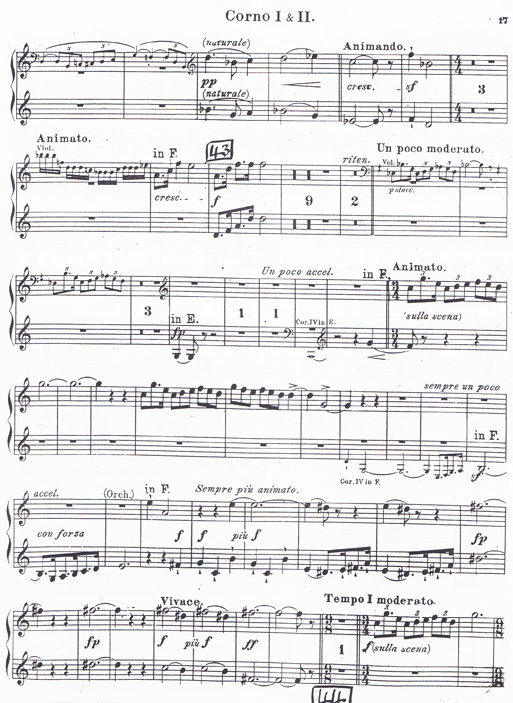
To wrap up my series on the Siegfried horn calls within Richard Wagner’s Ring of the Nibelung, today’s article features the calls in Wagner’s final opera in the cycle, Götterdämmerung.  The short call of course is something that most horn players are familiar with. The Prelude and Siegfried’s Rhine Journey is a fairly common staple in orchestra concerts.

It should be noted that in the full operatic version the short call appears on page 10 of the Horn I part. There is quite a bit to play before the famous call sounds.

Gone is the sleeping dragon and magical bird from the previous opera Siegfried. When performing this call this is something to bear in mind.

Our mythical hero is on a journey, carrying Brünnhilde’s shield and riding her horse Grane. The spirit in these calls is without a doubt, heroic.

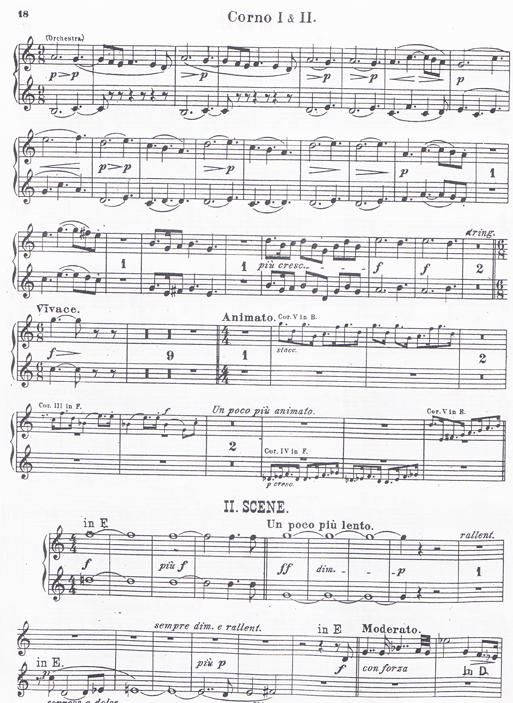
Pages 17 and 18 are interesting to look at. Horn calls are peppered throughout.

Act II Scene II

One final excerpt to consider is this segue from Scene I into Scene II of Act II. This is perhaps the final sounding of Siegfried’s horn call within the Ring cycle.

The beginning of this excerpt until the hand-written rehearsal number 8 has been on Arizona Opera auditions. It encompasses a wide range and requires smooth control over long phrases.

The entire Horn I and II combined part for Götterdämmerung by the way, adds up to a whopping seventy-seven pages!

Previously in this series:

Your Digital Footprint and its Future Impact

A subject that keeps coming up in trending web sites that monitor business and social networking, is social media and its impact on a user’s employment potential.

I think this is especially relevant for anyone under 30 years old.  Digital footprints – things written by you or that are written about you that can be found online – will only grow and loom larger as technology inevitably forges ahead.

While this is something not get overly paranoid about, it is definitely something for anyone of any age or occupation to at least think about. Enterprising musicians have even found ways to capitalize upon this trend and use it to their advantage.

Pew research findings

According to recent findings at the Pew Internet and American Life Project reputation management has become a defining feature of online life – especially for the young.

This management typically takes one of two paths: the user who is careful to project themselves in a controlled way for a specific audience; or the user who does not take any precautions in what they say or share online.

According to Pew:

The increased prevalence of self-monitoring and observation of others creates a dynamic environment where people promote themselves or shroud themselves depending on their intended audience and circumstances. There are good reasons to be more vigilant.

Online reputation matters; 44{2db8d9c9766c2c2a2bd7f7d2bb0fecf7978bb3ad0305fd3817dd032910c4b322} of online adults have searched for information about someone whose services or advice they seek in a professional capacity. People are now more likely to work for an employer that has policies about how they present themselves online, and co-workers and business competitors now keep closer tabs on one another.

I am musician. What, me worry?

Students applying to graduate or doctoral school, and most certainly recent graduates looking for teaching positions, should take their online profiles and comments seriously.

Virtually anything can be Googled, and digital footprints have a very long shelf-life. The trail might include any number of platforms and arenas, such as personal blogs or web sites, comments left on other sites, or within big social networking sites like Facebook.

I am not sure what that is up my nose, but this is what shows up when people tag you in Facebook

This also includes things that other people may have written about you. In Facebook for example, friends can tag you in photos that you may not even be aware of … like pictures of you from your wild and crazy college years with foreign objects jammed up your nose.

What on earth is your future boss going to think about that?

Google is your friend

Evaluating digital footprints is a great idea for a number of reasons. One big reason for the enterprising musician to take under serious consideration is reputation.

Reputation matters and with one little thing carelessly posted on a web site, a blog or on Facebook, it can be stained and even perhaps ruined.

A good first step is to Google yourself and see what is out there. Taking myself as an example, a lot of information has gathered together over time.

* Gulp.

More reading:

Mailbag: Why does Another Player in my Section Sound Loud, Bright, and Out of Tune?

Another question that came in recently was that of why a person in a horn section sounded bad. In the E-mail it mentioned the player was talented (high school aged) but that the tone was very bright, loud, and out of tune.

In short there could be a whole group of things wrong and it would probably take weeks to sort it all out in lessons.

From this distance something that sounds very possible is a poor hand position. One thing I have learned over the years is how lucky I was that my high school band director was a horn player. Many music educators really don’t have the concept of hand position on the horn figured out, and even if they do students don’t always do what they say. Hand position is discussed various places in Horn Matters but this article would be a good one to start with.

My guess is the hand position is either very open, palm against the bell, or not even in the bell. This would lead to an overly bright tone and a very sharp tone as well. And if the student is used to that sound and pitch—it seems normal to them—then they can’t learn how to adjust things.

If the hand position is great than another thing that comes to mind is the general topic of tension, possibly embouchure related. You are not going to be able to say much about that to a section mate though without coming across as a know-it-all, however.

Throwing out one other random thing, you may want to check that all the slides are in the right place. This can be a problem on certain models of double horns, you can end up with valve slides on the wrong side of the horn and this leads to nothing but intonation problems.

There are probably many elements to sort out, in reality, as to why the section mate sticks out and sounds bad. At this distance it is really hard to say much more than be observant and diplomatic, you may figure it out. Good luck!

Mouthpiece Pressure and other Tall Tales

0

I have argued that when mixing vague religiosity, sports metaphors and loose technical knowledge into a brass teaching method, there can be hidden dangers. The end result can look more like science fiction than logical pedagogy.

Occasionally too a popular teaching anecdote – such as paralysis by analysis – loses its original meaning as it gets mixed into our conversations about brass technique. Context becomes less clear as it passes from person to person, generation to generation, and in some circles this phrase has become somewhat of a rallying cry to denounce critical thinking in brass techniques.

Along this line of thought is “Mouthpiece Pressure Myths” by David Wilken. In this article David presents some fascinating highlights from research published in 1986 from the New Scientist.

In terms of the big picture I think it illustrates one thing quite clearly. Brass players are fairly flawed in their ability to gauge and interpret mouthpiece pressure.

Going further, David Wilken suggests that this

…is yet another reminder that I need to be careful about proclaiming judgments that I “know” to be true. Even experts in their fields are guilty of accepting certain false statements as true simply because they are commonly believed.

The results are fascinating and I highly suggest reading David’s article for an overview.

Mouthpiece pressure

On this particular topic, John Ericson has written a few articles of interest:

I echo John’s sentiments and encourage readers not familiar with these articles to give them a read.

I would only add that in my experiences with teaching large band programs at elementary and middle schools, I saw a number of beginning and intermediate brass students using intense pressure – without putting any facial muscle support behind it – in order to get high notes.

Points and counterpoints

A teacher of mine once said that heavy mouthpiece pressure was nothing to be concerned about as long as one “meets the mouthpiece.”

In illustrating this he would make two fists with his hands, touch them together at the knuckles and then push them against one another. With his hands, he was illustrating the concept that force and counter-force can balance one another.

A different teacher advised that I only use enough pressure to make a hermetic seal with the rim of the mouthpiece. At the time it made great sense and I made progress.

Another teacher suggested that I “blow the mouthpiece off the face.”

Yet another said that I should always buzz intensely loud on the mouthpiece; another suggested that this was harmful and something to be avoided.

All of this advice – in its time and place – meant something to me in my life as a horn player.

The rim as isolator

These days the pendulum swings in another direction.

My attention is focused on the mouthpiece rim as an isolator. In this role, I would argue that it helps to lock-down the vibrating area of the embouchure and separate it from the non-vibrating, supporting musculature outside of the mouthpiece.

With high and loud notes in particular, something much more than an airtight seal is required.

This is of course speculation based purely on personal observation. So, when conveying a concept like this to another person it generally comes with the dutiful and honest disclaimer of it works for me, and it has worked for some of my students in varying degrees.

Tell it on a mountain

Anecdotes and stories can without a doubt broaden the mind and inspire changes. They have purpose and value in music education.

As a classroom teacher for example, I maintained a vast arsenal of jokes, stories and activities. Sometimes the right story at the right time can ignite a spark inside of a student’s head.

However under the auspices of instrumental pedagogy and brass methods it is a good idea to back up the stories with sound technical knowledge, or at the very least with working hypotheses that lead towards tangible solutions and goals.

Delusion

Beyond the horn-related humor there was an underlying theme to my horn brain cartoon posted a few days ago. With even the strongest and greatest minds in the world there is no immunity from stray thoughts and delusion.

This is something too that the research published in the New Scientist really shows.

As humans we are all somewhat flawed.