Home Blog Page 89

Who is this James Chambers you Speak Of?

A few years ago I posted an article on the topic of “Who is this Philip Farkas you Speak of?” Along similar lines, perhaps it shows my age, but rather often it seems I have conversations with hornists who are really unaware of the great American hornist James Chambers (1920-1989).

Chambers published a series of excerpt books (International) among other publications but where his name comes up the most often in actual conversation is when I am talking with people about C series mouthpieces. Giardinelli made the classic version, but other makers carry on the tradition. The “C” stood for James Chambers. As we learn in his bio in the IHS website, which is also the source of the photo linked in this article,

Chambers played with the Pittsburg Symphony under Fritz Reiner for one year after his graduation [from Curtis] in 1941, then became solo horn of the Philadelphia Orchestra (1942-1946), and finally was solo horn of the New York Philharmonic (1946-1969). After retiring from horn playing because of his health, Chambers continued to be orchestra manager (1969-1986).

He was also on the faculty of Julliard for 42 years, so his influence on generations of hornists was very substantial.

There is a great interview with Chambers by Jeff Silberschlag from 1982 posted on the Osmun.com website, where he recalls his studies with Anton Horner and many details of his career. Chambers is associated in terms of equipment with the C series mouthpiece and the Conn 8D but with a three year period where he played a Reynolds horn. Initially at Curtis as a student he had no horn of his own but as soon as he could work out the financial end of it

…the local music store dealer ordered a Conn 8D for me. It is one of the first run of 8D, you seldom see one with an earlier serial number. I took that horn into a lesson with Horner and he played it for about five minutes and then said, “It is about time they started making a fine horn in this country.” So that horn stayed with me all my playing years, except for a short period of three years while I was developing a Chambers Model Horn for Reynolds. The horn that was finally developed was a much improved horn over what I started with and I actually used it in the Orchestra. Unfortunately, that horn is no longer being produced. nor is my name associated with it. So except that one short digression, it was not only Conn 8D, but the same horn. John Cerminaro now owns that horn.

Check the links in this article for much more on this great and hugely influential American hornist.

“Well, Duh!?!,” a Key to Accuracy

0

The comments to my recent article on “tut” tonguing are a reminder that tonging is always a good topic to address. You don’t want to paralyze with analysis but then again if you have problems with tonguing simply visualizing the production a sound you can’t make won’t help very much. The following was a post from my original HTML Horn Notes Blog exactly six years ago today, 2/19/05, to which I will add some follow up comments.

I had my first rehearsal as the new solo hornist of the Salt River Brass Band last week, a British style brass band except for we play [French] horns, not alto horns in the group. I am excited to join this group, a very fine, non-paying group that will be a great weekly workout for me (ASU tuba faculty colleague Sam Pilafian also performs in the group). The Salt River Brass Band is conducted by Patrick Sheridan, the well-known tuba soloist and co-author of The Breathing Gym. Pat in the rehearsal spoke about and had us do a number of very interesting things which will undoubtedly show up in my teaching and in the blog in coming weeks. In particular he said several interesting things on articulation.

The last few months I have been thinking about tonguing and how to teach tonguing. No horn teacher I know of has X-ray vision, so this is something that often you have to work with students for some time to sort out the problems fully. As a follow up to my item on Achieving the ultimate articulation, slur, and tone quality from November, one of the top things that Pat advocated was the use of “duh” as a main articulation, and in particular mentioning “duh-guh” as a main pair of syllables for double tonguing and “duh-dee-guh” for triple tonguing. As I said in November, “tuh” or “ta” is just too explosive and harsh an articulation for a lot of what we play, and brass players who have trouble with tonguing tend to labor too hard trying to say “ta” instead of just making the sound they want come out of the horn with lighter articulations.
Another new member of the horn section is a former ASU MM student and horn TA Nathan Stark, who is an elementary band director in the Phoenix area now [2011 update: Currently on the faculty of Case Western Reserve University]. In talking with him it came up that he has been working on tonguing lately in relation to improving accuracy and he noted recently in his playing that he was using too explosive a forward motion of the tongue. He is now trying to visualize the stroke being more of a backwards motion. This again falls into my “well, duh!?!” theory. Say “duh.” Which way does your tongue go? For me anyway it is more of a backwards motion than forwards.

Back to Pat Sheridan, his triple tonguing syllables are quite interesting too. This first concert is a concert of Latin music and I find myself needing to keep up work on my triple toughing, something that does not show up in a lot of horn music. It may seem a bit non-standard, but give “duh-dee-guh” a try, it works.

I don’t know if “duh” will catch on widely but it is a good way to think of things. “D” is a much better default syllable than “T.” Also, be sure to check out the article linked in the text, which I will also link here again. It contains in particular notes from a master class with Gunther Schuller that points out yet again the level and variety of articulations we have to master on the horn, from the crispest staccato to the longest legato.

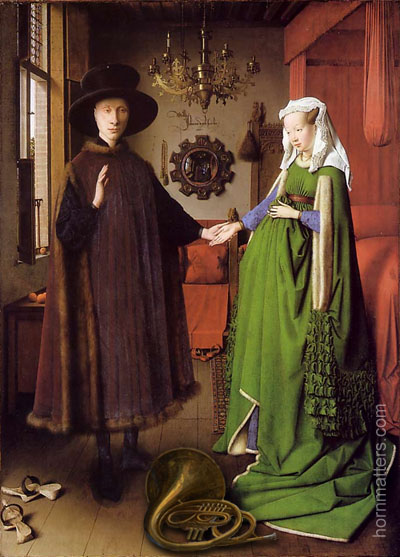
Parody: A Wedding Portrait with Vienna Horn

The Arnolfini Portrait dates from 1434. It was painted on an oak panel by Flemish artist Jan van Eyck and is also known as The Arnolfini Wedding, The Arnolfini Marriage, The Arnolfini Double Portrait or the Portrait of Giovanni Arnolfini and his Wife.

The perspective, detail and symbolism of the painting was remarkable for its time, most notably its use of non-Euclidean geometry in the reflective mirror on the back wall – which reveals the painter himself and a fourth “mystery” person.

Almost every detail can be interpreted as a symbol. The fruits on the window ledge for example suggest fertility and perhaps our fall from Paradise. The discarded shoes are believed to signify the fidelity and sanctity of marriage.

The dog

A small dog in the foreground is often seen as a symbol of faithfulness and love. In the version below, the dog is replaced with another object of great love and faithfulness.

It might be historically-incorrect for 1434 but imagine, what if Arnolfini had been a time-traveler like Dr. Who?

On Ethics and Integrity in Copyright Licensing

Over the winter holiday, my wife and I took a trip to Disney World in Florida. Besides the usual attractions, two things impressed me the most: the customer service and the excellent quality of the music.

In many of the attractions multi-tracked music and effects streamed constantly throughout. The superb writing talents of composer Bruce Broughton, known mainly for his Hollywood movie scores, are engaged in some areas of the park.

As implied in “French Horns in ToonTown,” the Disney amusement parks in a sense represent a Utopian ideal and the music certainly lends a hand in sustaining that effect. The quality – and quantity – of music at Disney is impressive.

An enjoyable evening

On one evening we enjoyed a package deal of food and entertainment. It began with a meal and a show at the Germany Pavilion. A polka band entertained and at one point the trumpet and tuba players pulled out alphorns and performed a nice duet.

The evening continued with a concert of Christmas music with a full orchestra, herald trumpets and chorus. Actor Edward James Olmos narrated. The quality of playing and singing was very good, and I presume that the orchestra musicians were all seasoned, local professionals from the Orlando area.

While I missed the horn players, I did spot the microphones behind the horn section and took a picture. These types of omni-directional microphones work well with a placement behind the bell.

Copyright and licensing

Overall I was left with a strong impression; all the music from top-to-bottom was composed, arranged, performed, and produced at a highly professional level. I imagine too that everyone involved – from the musicians to the arrangers and composers – were fairly compensated for their work and in some cases, receive regular residual payments and royalties.

In contrast I have participated in a number of groups over the years that used arrangements of popular material for similar purposes. Some of these arrangements were purchased, while most others were self-produced.

Most recently I played a concert that left me in a bit of a moral dilemma. It was an orchestra pops concert comprised of television, movie and radio hits from the Golden Era of entertainment. It included music from Disney films, Beatles repertoire and classic tunes from Las Vegas and the Brat Pack.

No information was printed on my part to indicate that these arrangements were licensed in a proper manner. With the vast amount of music involved, it was very difficult to believe that all of it had been licensed and secured properly.

Thinking back about my Disney experience, I started to feel as if I was part of a hustle – that this arranger was making a living off the backs of other people and not being very responsible about it. As a musician participating in this venture I even felt somewhat responsible. This was a gig that I could have turned down.

While I cannot say with any certainty that this was the case, it certainly served as a strong reminder. Proper licensing and purchasing of music is not only the right thing to do, but it also keeps our industry from cannibalizing and collapsing on itself.

To do otherwise as a practice is not only irresponsible, but also criminal – on many levels.

“Tut” for a Short, Crisp Staccato? Yes

Scott Whitener in A Complete Guide to Brass notes that

The so-called tongued release does have its place…. Professional players often make use of it by adding a “t” at the end of the note (“tut”) in very staccato passages. This produces a shortness and crispness that can be obtained no other way.

A mantra heard over and over in traditional brass teaching is to never cut off notes with the tongue. It sounds right, and is true in a general sense, especially for lyric playing. It is however actually pretty well known in some horn circles at least that “tut-tut-tut” is considered correct in exactly the circumstances as outlined above by Whitener, to produce a short and crisp staccato.

Bruce has a longer article hereThis is a topic that comes up pretty often with students. Many if not most brass teachers say not to cut off notes with the tongue in any circumstance, echoing thoughts expressed as fact by Farkas, but I feel very secure in saying that this idea is clearly mistaken. And I can point to still older sources and other schools of horn teaching for backup.

In the end, think it through logically: without the tongue being involved how in the world else is a crisp staccato produced? Something stops the note short or it would trail naturally off into a soft, fluffy ending.

The big picture problem here is that teachers say to never do it then students following their instructions try to play staccato and fail. The problem is they can never figure out how to play staccato as they are fighting nature. Of course the end of the note is cut off in some circumstances; there is a place for it.

That all being said, I suspect that many fine brass colleagues I have had would still say to never ever cut off notes with the tongue or you will die. Maybe not the death part but you have the drift of what they say and believe to be a great truth of brass playing. But clearly in horn we make use of this articulation a lot in producing staccato, even if it is something we are perhaps only vaguely aware of or perhaps think we are not doing.

Listen to Dennis Brain play a Mozart rondo, and make it sound like that. Done lightly or in a more heavy manner, tut-tut-tut really is the answer sometimes and especially so on a slow responding instrument such as the horn.

Introducing Ultimate Horn Technique and Ultimate Low Horn

To make it official, I have had a push on for some time toward the completion of two new publications, Ultimate Horn Technique and Ultimate Low Horn, and they went to the printer on Friday. They have already been added to the sales page and sample pages are online as well.

UPDATE 2018: Ultimate Low Horn is now off the market, replaced by The Low Horn Boot Camp, now in a second edition. And UPDATE 2019 Ultimate Horn Technique has been replaced by Horn Scales and Technique Exercises, also now in a second edition. More info at www.hornnotes.com

New books? On what topics!

I have actually hinted occasionally in articles here that I am working on several more books for Horn Notes Edition, in particular a technique book and a low range book. The covers seen here are of the last test copies made before publication. I have been working with draft versions of elements of both books with my students since 2006.

A technique book? Why do we need this? Can’t I just use Pares Scales or Schantl?

You could use Pares or Schantl—I have used both in my teaching—but in using them I always felt there had to be a better way. Both are OK in their way but are repetitive and don’t cover every key well, plus don’t contain any exercises for multiple tonguing or transpositions and especially in Pares I had to ask for many things to be worked out an octave lower as it does not cover the full range of the horn well.

My new publication Ultimate Horn Technique is more comprehensive in scope. It is based on materials from 19th century horn methods, mostly exercises that are unavailable today, in particular some great materials from the early valved horn method of Joseph Meifred, but quite a variety of materials from other 19th century masters including Gallay, Kling, Gumpert, Dauprat, and Schantl.

I have arranged the materials by key and have included exercises for double and triple tonguing, exercises for working on transpositions, and more. Besides being full of great exercises I am also excited that exercises in the book are non-repetitive. While many exercises are similar, hardly any pattern is actually repeated in the whole book, which keeps you on your toes and reading them carefully. This book is intended for horn players from the intermediate to advanced level.

And a low horn book?

It is not a secret; every horn teacher knows that developing tone and facility in the low range is the key to everything for an advancing hornist. Ultimate Low Horn is the result of a long search for practical and effective materials for low range study by intermediate to advanced students, containing focused exercises by Bordogni, De Pre, and Gallay to develop low range facility and characteristic playing.

Where can I see a sample copy?

Some sample pages are embedded in this article [UPDATE: But not now; see the actual listings of current publications in the Horn Notes Edition sales page to access sample pages] which give the general idea of each publication. If you want to see the full books I will have them available for purchase in the coming months at the Southeast Horn Workshop, the MidSouth Horn Workshop, and the International Symposium. Check them out at the sales table for Horn Notes Edition.

They should start shipping on Tuesday this week. They were added (with, temporarily, a black and white version of the cover image) to the Horn Notes Edition website on Friday night, and already on Saturday orders had been received. Order both books directly from Horn Notes Edition.

To conclude, while I know there should be some decent initial sales, horn teachers are generally speaking notoriously slow in adopting new products. They have a way they teach and that is the end of the story. I believe that these new books are both very good products, check them out as they are I believe very focused and practical study materials for horn players of today.

Before Farkas: The Dufrasne (Mercier) Routine, Part II

As I noted in Part I, a new publication of the Dufrasne Routine was recently put out in The Complete Hornist series. In the acknowledgements editor Thomas Bacon notes that his source was “an old photocopy of a handwritten copy done by Bill Mercier, another student of Dufrasne,” also stating that this was a “complete practice routine” used daily by Dufrasne “at the peak of his performing career.”

Having both publications in hand the first step is a simple comparison of content. They are musically identical and laid out nearly the same way. The main difference is that the Bacon edition has added meter and bar lines to those exercises that lacked meter and bar lines. The markings as to performance suggestions are nearly the same. One that is quite different actually is number 2 which was quoted in the part I in the original edition and also is excerpted below from the new edition. This shows also the comparison of the notation in the original publication and in the later publication.

It would seem that the source cited and used by Bacon is in fact the guts of Tonal Flexibility Studies for French Horn by William Mercier, which must have come to him in the form of a Xerox copy. The published version has the visual look of a handwritten copy and it was obviously done by William Mercier who was cited as the source. It would seem also that Bacon must not have had access to the copyright or dedication pages of the source version to know it had been published. But Bacon could also have used a different handwritten version by Mercier, perhaps an earlier draft, that corresponds closely to the published version as his source; clearly as excerpted in the musical examples found in these two articles the instructions on the exercises are slightly different and the published Mercier version lacks bar lines in some exercises.

Now that we have these details sorted out in front of us then the question would be who the actual author is. In the Mercier version on the dedication page it states that the book is dedicated to Louis Dufrasne “Whose studies comprise a large part of this book.” So while it may largely be materials used by Dufrasne, I am not sure we can say it is actually his routine knowing now that it is actually a version of a Dufrasne routine by William Mercier. Dufrasne inspired, yes; by Dufrasne, not really.

I think of it this way. Let us say that a few years after I pass on one of my former students tries to put together an “Ericson Routine.” I honestly would not have the slightest idea what they might come up with. At times I have used pretty set routines but at present I warm up somewhat differently every day. The “Ericson Routine” could be full of exercises I do now or once did often, but which ones? It might end up being a routine I really like but in the end it would be up to that later editor, not me, to decide what was published as the Ericson Routine.

That all being said it is still an interesting routine, nicely printed and easily available. Those interested should purchase the Bacon version. It is great to see an historic and rare resource such as this back in print from 1948, it is an especially interesting relic of  American horn pedagogy from the time before the Farkas book.

Before Farkas: The Mercier (Dufrasne) Routine, Part I

Ever wonder how the teacher of Farkas warmed up? Tonal Flexibility Studies for French Horn by William Mercier gives some clear insights.

Cleaning the office over break I came across this classic 1948 publication. First I was thinking to do just a brief article as it has such an interesting cover. A bit hard to read but a very striking cover!

On looking inside I was quickly reminded of the importance of this book from the dedication

TO
LOUIS DUFRASNE
Whose studies comprise a large part of this book

Louis Dufrasne (1878-1941) was the main teacher of Philip Farkas. In the Nancy Jordan Fako book Philip Farkas & His Horn, A Happy, Worthwhile Life we read that Farkas began his study with Dufrasne in 1930. She relates that

Dufrasne was born in Quievrain, Belgium, graduated with high honors from the Ghent Royal Conservatory of Music, and quickly became recognized as one of the finest players in Belgium. He played principal horn in the Brussels Opera and with an orchestra in Pau, France, and third horn in the Scottish Orchestra (Glasgow). After emigrating to the United States in 1907, he became first horn in the Pittsburgh Orchestra, followed some years later by the same position in the Cleveland Orchestra and the Chicago Opera, where he spent most of his career. When Phil met him, he was principal horn in the Chicago Opera Company. He was also known as a fine teacher and Phil made the long trip every week from his south side home to the Dufrasne home in the north shore suburb of Evanston. Phil considered the tedious journey by public transportation well worth the effort because he credited Dufrasne’s guidance as the key ingredient responsible for his initial success and as the biggest single influence in his life.

While Mercier in his book, copyrighted in 1948, makes no claim that this routine is actually the routine used by Dufrasne, he does state that his “studies comprise a large part of this book” and as such they are an interesting document to be sure in American horn pedagogy.

After a brief Foreword Mercier presents brief sections on posture, breathing, and the embouchure, including a pair of anatomical diagrams of the muscles of the head and the admonition to “avoid excess mouthpiece pressure.”

Then we get to the music. It starts with a series of interval studies with no meter or bar lines. This example is of the second exercise. The instructions here I find very interesting, to “Keep the jaw loose” and “Enlarge the mouth cavity when descending.” Good advice. There are eleven total exercises written in this same manuscript hand spread over 22 pages, mostly in the form of interval studies on the F horn. Every exercise is slurred, this seems to be a key emphasis to the whole book.

It is a very workable routine but longish in terms of actual warm-up. But again the title is Tonal Flexibility Studies so it is more than a warm-up; it is a tool to learn flexibility and slurs. There are parallels to the Farkas routine but overall it is fairly different.

Interested to see a copy? The original publication is long out of print but Thomas Bacon in 2005 made available a new published version of this routine. I will have more about that soon in Part II.

Update: How to Purchase a “Watt Lifter”

0
This is not a Watt Lifter™ but represents a similar function and purpose.

Earlier this week, I received a message from Bob Watt, the inventor of the Watt Lifter. (Be sure to read up on Mr. Watt’s background in this LA Times piece.)

Contrary to your belief, “The Watt Lifter”™ is available commercially through me. I’ve been selling them for decades now and yes, I did invent it.

It retails for $80.00.

If anyone wants to purchase the lifter they need only contact me.

UPDATE: This is the website:
https://www.robertleewatt.com/wattlifter

The price is certainly reasonable and I am looking forward to trying one out for an extended period. I plan to order one and review it for Horn Matters.

In the interests of supporting this (and all other handy horn inventions), the article from last week with specific measurements for a home-made version has been taken offline. My apologies to readers that took the time to add comments.

Myself, I am not so handy with shop tools – let alone sawing through Lexan plastic – and so trying to make one at home was a bit of a pipe dream. Getting this email was a nice surprise and it may have even saved me from losing an eye or a finger.

“Hey, I Did Not Miss Any Notes”

0

Ever think this after a concert? The first time that stands out in my memory is a performance of the Gounod Petite Symphonie for winds when I was a freshman or sophomore in college, playing first horn because I had actually a very poor low range. A graduate student played second horn.

I was reminded of this thought last weekend, hearing the work performed very nicely here at Arizona State. It is not a thought we often have in the horn world, that we did not miss any notes, and it is not a thought I can honestly say I have very often had after a major performance. Another time I recall thinking the same thing was at the end of the Third Horn audition I won in Nashville. 100% accuracy is certainly a part of what it takes to win a job.

Book after book has been written on how to best achieve that place where you can play at your peak. Some address the physical side of the equation, but most go at the mental side of things. I have written about The Inner Game of Tennis before which is a classic and one I have referenced and generally recommended. It is a popular approach. But really, when you get down to it, at this time for me the closest to my personal approach in a publication by a hornist is to be found by Farkas in The Art of Musicianship.

Farkas is an iconic figure of the horn world, but a first point would be to be careful, his writings are not without their problems. Regular readers should have picked up by now that I feel that some elements of his pedagogy as published are clearly problematic. His over the top warnings about too much pressure (that can lead readers to use too little pressure, instead of finding that place that is “just right”) and his one-sided approach to tonguing (that readers try to duplicate, in vain–there is a bigger picture) are good examples. At the same time, there is a certain practicality to what he says that is refreshing, which is part of why I like what he says on performance anxiety.

Too much of what is said out there on the topic can border on psyco-mumbo-jumbo, understood only by initiated insiders. I am not at all into the visualization thing or tactics that border of self-hypnosis. His approach to performance anxiety specifically takes on a religious overtone that for me rings really true and gets to the place I want to be when I perform. Check this article for more on this, and as with many of the articles here at Horn Matters I hope that readers can step back for a critical view of their own approach with the goal of figuring out ways to reach the next level in their playing.

Image credit Bruce Hembd.