Home Blog Page 139

What horn models do they really play in London?

0

Many hornists recommend the London Horn Sound CD for their students, it is a classic and full of inspiration for younger hornists. I have it on my short list of “must own” horn CDs.

The London hornists are back at it again with a new CD just released. Give it One is billed as “The World’s First French Horn Big Band CD” and looks to be a lot of fun.

They have launched a website for the CD [UPDATE: no longer online]. It is a very nice site with lots of information on the new CD, including a blog, audio samples, and other background information. Being interested in equipment I was particularly interested to see the listings of equipment used by the 19 hornists performing on the recording. It is a window into what would be seen in a typical performing situation in London. Instrument models seen include:

Full doubles:
Alexander 103 and 1103
Conn 8D and 28D
Holton H188
Paxman 25
Schmid
Yamaha 668

Compensating double:
Paxman 33

Single B-flat:
Schmid

Descants:
Alexander 107
Paxman 40 and 45
Schmid

The full list of performers and horns may be found here (see UPDATE). This site is well worth poking around in and the CD looks to be a great one worth checking out.

UPDATE: The site linked above is gone, but the info is still correct in our post.

A Shortage of Young Horn Players

Some things never change.

John Ericson has made it a mission to promote and encourage more young horn students in Arizona. As a private (and sometimes classroom) teacher, I share his concerns.

Along these lines here is a quote:

There are not enough horn-players, and not enough people taking up the horn today. They are frightened away, perhaps, by its difficulties, and I want to dispel this bogey by saying that the difficulties are exaggerated. You can get a great deal of pleasure out of horn-playing in the quite early stages. Progress even then is not slow, and one can advance to a useful stage quite quickly. By a useful stage I mean command over two octaves (E to E). This is a range which enables a player to take his part in many a great work. Moreover, it is the “safest” range, and I urge all beginners who may be out of reach of expert guidance to limit attention to that range.

This quote is from 1928 (!) in an article written by Aubrey Brain, “The Horn of Many Colors.”

Interesting…some things never change I guess.

Philip Myers on Playing a Triple Horn and Accuracy

1

I recently noted a link to a 1998 interview with Philip Myers, Principal Horn of the New York Philharmonic. He is a very notable advocate of the triple horn and explains at length his reasons. This reason for me really sticks out above the rest:

Accuracy. Man, I was so tired of floating through the solo of Tchaikovsky 5th and then a few measures later missing some accompaniment note between third space C and G. Maybe I simply have more of a problem with accuracy than others, but I was tired of not being able to get through a concert clean, usually of some soft attack on an accompaniment note. I remember Clevenger telling me “we’re the first generation that are accurate enough that we’re not sitting on stage worrying about whether we’re going to miss something or not”, But I told him right then, “No, not me, I’m worried plenty.” (I don’t know if he would remember this conversation, it was 1978 and you see, he is that accurate, but I never was.) But now, twenty years later, with the triple, I finally feel like part of the generation that Clevenger was talking about – I don’t worry about missing stuff, I can just think about what I’m trying to do musically. On the double I couldn’t take that approach. So, if for me, that takes the triple I think I’ve got to accept that about myself.

Later in the article he states that it took him two years to get it all together with the triple horn. To really take full advantage of the instrument takes dedication, you have to learn how to use the high F side well (he notes “Do you know how weird it is to think about fingerings for the first time in twenty-five years?”).

This gets at why some players can have a bad first impression of triple horns. They are typically somewhat heavy and can be perceived as less responsive to play if you treat them more or less as a double horn. It is however a different animal with fingerings to come to terms with to make the best use of the instrument.

For more of my own thoughts on the topic check my publication Playing High Horn at Horn Notes Edition.

Top Ten: Favorite French Horn and Music Related Texts

Some of my favorite texts.

Still in time for the holidays, here is a top-ten list of with some of my favorite horn-related texts. As with previous Horndog Blog top-ten lists, this is not a comprehensive list nor is it set in any particular order.

  1. Philip Farkas:
    Art of French Horn Playing
    , The Art of Brass Playing, The Art of Musicianship
    Farkas’ Art of French Horn Playing is often referred to as the “bible” for horn players. These three books together might be referred to as the “holy trinity.” Each volume addresses different aspects of playing and I believe that it is good to read them in the order above; start with learning about the horn, progress to learning about the mechanics of technique and end with the basics of musicianship.
  2. Collected Thoughts on Teaching and Learning, Creativity and Horn Performance by Doug Hill. While I have never personally met Mr. Hill, I know of many people who consider him to be a great mentor and teacher.
  3. Zen in the Martial Arts by Joe Hyams
    Aside from being a tome devoted to basic zen concepts, these book contains some excellent advice for dealing with a variety of issues directly related to being a musician. The author was a student of Bruce Lee and offers special insights to Lee’s approach to his training.
  4. The Inner Game of Tennisby Timothy Galway
    Of all the “Inner Game” books, the original remains my favorite. While there is an Inner Game of Music book, my opinion is that the simplicity and freshness of original message gets lost in the translation.
  5. Horn (Yehudi Menuhin Music Guides) by Barry Tuckwell
    While it does contain some historical inaccuracies, this book remains a favorite of mine to lend out to young students. It is written in plain language and is generously illustrated and is a great primer for any student.
  6. The Horn Handbook by Verne Reynolds
    This is an excellent supplement to the Farkas trinity. Its main focus is on etude, solo and chamber repertoire. With all due respect to Mr. Reynolds, I learned more from this book than in my one year of study with him at Eastman.
  7. Living Dangerously With the Horn by David Kaslow
    I am not exactly sure how available this book is, but at Amazon it is selling for 98 cents (!). Mr. Kaslow addresses loftier topics of artistry, fearlessness, health, relationships and perfectionism. A sample of his writing may be found here.
  8. Essentials of Brass Playing by Fred Fox
    I remember seeing a master class once long ago with Mr. Fox and he left an indelible impression on me; he was straight-talking and forward thinking and his wealth of experience as a symphony, studio player and teacher was impressive. I regularly use this book as a reference.
  9. Arnold Jacobs: Song and Wind by Brian Frederiksen
    Mr. Jacobs legacy lies in his students – unfortunately he never wrote a book to document his teachings. This book is mostly a biography, but there are about 20-30 pages in this book that give good insight into his teaching philosophy.
  10. Thoughts on Playing the Horn Well by Froydis Ree Wekre.
    This book is part method, part text. I always enjoy what Ms. Wekre has to say, but I am a bit dismayed at the cost ($36 on Amazon). Its housing is basically a spiral-bound notebook and for that price I would expect a hardback cover. This aside, I very much like her diplomatic, open-minded view of playing concepts. Whenever there is more than one approach to a specific topic, she lists several, then simply states her preference.

A Screw Loose on Conn 8D

A word from the wise.

Whenever I use my Conn 8D, I am always careful to check on the screw that keeps the thumb lever in place. There is a design flaw with this little screw – it regularly comes loose and if I don’t check on it, it gets dangerously close to falling off.

Not too long ago, it finally happened – the screw fell off and I cannot find it. Fortunately, the tension of the string still holds the thumb lever in place but I am annoyed.

With my Yamaha this is not a problem. The thumb screw is attached in a manner where it cannot fall off. While this flaw with the 8D thumb screw is a little thing, it very disappointing that Conn has not bothered to address this.

Artworks Inspired by the Horn (II)

Art inspired by the French horn.

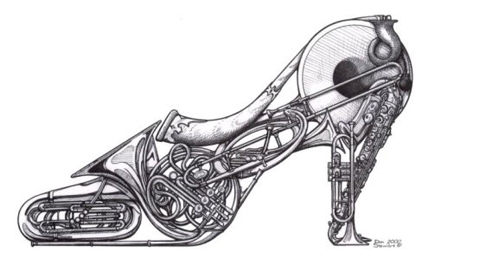
Artist Don Stewart combines creativity and intellect in his whimsical “composite” works. Through his web site, all these works are available for immediate purchase.

[Click on any image in this post for a closer view.]

The French horn example shown at right, is typical of his unique style. These pen and ink works are images comprised of other images; small objects are pieced together in a way to construct a larger image. With “French Horn” a hodge-podge of images – including a wine bottle, a French baguette, a quarter, and an ice cream cone, among others – make up the composite image.

This would make a very nice gift – it is priced a very reasonable $75.

Pictured at left is a piece that made me both giggle and think “hmmm, cool!”

It is a collection of brass instruments arranged into the shape of a shoe. It is titled, appropriately, “Shoehorns.”

Pictured at right is a related item – “Medusa.” Medusa’s head is comprised of serpents – of the trombone variety.

Clever stuff that is visually fun and interesting.

Married to Don is Sue Ellen Brown, who is an illustrator. Her “French Nautilus” combines a horn with a nautilus shell. This particular piece is not for sale directly, but through her web site more information may be found if so desired.

*All these images were all used with the kind permission of the artist, Don Stewart. I have purposely reduced their quality to discourage illegal reproduction. All rights are reserved by the artist.

Artworks Inspired by the Horn (I)

Artistic expressions inspired by the French horn.

Beyond the little trinkets and baubles mentioned yesterday as Holiday gifts, there are other, higher end items to consider. An original work of art might not be as expensive and out-of-reach as you might think.

Artist Jo Sedlack has two daughters that are musicians – one is a horn student at the Cincinnati Conservatory of Music. The piece pictured at right is sold, but Ms. Sedlack anticipates making other horn-related pieces in the future. It sold for $250 – a great price for an original piece.

[ Click on the image for a larger view. ]

The use of vibrant color and expressive line captures the spirit and energy of the musician in action. I admire the “balanced asymmetry” to this piece – between the vertical lines at left and the horizontal lines at right, and the round horn shapes in the center.

This image was used by the kind permission of the artist.

Holiday Gift Ideas for the Horn Player

Miscellaneous trinkets and baubles.

Looking for cool gifts for yourself or that horn player in your life?

Here are a few ideas:

  • Put Your Face on a Caricature
    If the Ecliptic option is a bit steep for you, for $10 at FindGift.com you can get a fun caricature done with any face on it.
  • A cute poster
    This might make the perfect gift for a student horn player or for a private teacher. The artist, Rivka, offers a whole selection of posters with kids playing instruments.The web site where I found this – AllPosters.com – offers numerous horn-related pieces at very economical prices. I could see these adorning a private studio or band office wall to help create a kid-friendly atmosphere. Art.com also has a nice collection of horn art.
  • Pencil Clip
    A handy pencil is one of the most important tools to have at any rehearsal. I get these for all my students as a little present.
  • The International Horn Society (IHS) has some nice items to consider.

Why Go to Live Concerts? (II) The Loudness War

Part II: The Loudness War.

In Part I, I presented questions over live concerts versus CDs, MP3s and DVDs. This post addresses one aspect of this issue, namely a production technique referred to as the “Loudness War.”

This term refers to producers tendencies to record and produce music at progressively increasing levels of loudness make a CD stands out from the competition. The maximum volume level of a CD can only go so high, so the overall loudness can only be increased by flattening the overall dynamic range. This is done by pushing the lower dynamic levels higher.

This technique alters the true fidelity of the music being recorded and manipulates it in a way to make it sound “better” to the average listener. At one time “high fidelity” was a major concern and selling point for classical music production on vinyl records.

Perhaps this is one reason why many audiophiles prefer vinyl records over CDs.

While this technique is more commonly used in popular music, I have heard a few examples in classical CDs where overall levels sounded compressed to my ears. When I compare old vinyl recordings for example, to their new, re-mastered CD versions I hear a substantial difference and find myself adjusting the volume knob.

I notice this more so with MP3 downloads. One supposes that engineers do this to compensate for the signal loss that occurs with MP3 compression.

Louder is better

Beyond classical recordings, I bring up this loudness issue for another reason; it is an assault on the senses and a deliberate attempt to manipulate. Loudness can be like a narcotic and enthusiastic musicians may sometimes confuse loudness with “goodness.”

From a 2007 Rolling Stones article “Death of High Fidelity:”

[According to] Daniel Levitin, a professor of music and neuroscience at McGill University and author of This Is Your Brain on Music: The Science of a Human Obsession

….Human brains have evolved to pay particular attention to loud noises, so compressed sounds initially seem more exciting.

This is a popular trick that television commercials employ on a regular basis. If it is louder then it must be better, our brains tell us.

The bigger picture

Fortunately classical music has mostly been spared from this phenomena. I have read some blogs claiming that certain classical labels do this more than others but I cannot substantiate any of those claims.

My broader point here for brass students especially is that it is a slippery slope to get enamored with loud CDs and to associate loudness with excellence (i.e. “I must play loud so that everyone can hear my Art!”).

Caveat emptor.

In my younger days I went through a “Captain Blasto” phase where forte dynamic levels and above were more like a competition rather than a balanced dynamic and sound within an ensemble. Fortunately for me I was eventually “educated” by a musician on why this was not a good thing to do. (See this page, #1 for details).

“Loudness war” issues aside, there are other more common and tangible manipulation tricks in classical recording to discuss in future posts – digital editing being the major one.

With the right software, a moose can be made to sound like an angel.

Resources:

Because Bigger is Better, The World’s Largest Tuba

Giant tuba invades London.

Who could play this monstrosity?

Be sure to check out the other odd instruments at this site, such as the Atlantic City Pipe Organ, the Lego Harpsichord, and the Harmonic Generator, among others.