Home Blog Page 50

From the Files: Mouthpiece Pressure in Horn Playing

With this article I begin a new series of articles for Horn Matters featuring quotes from print articles from not that long ago really. It is striking though how if it is not on the Internet it seems like it does not exist anymore; people just don’t dig around in back issues.

One resource to use to find those articles is the Brass Bibliography by Mark Fasman. Published in 1990, inside you will find listings of well over 6,000 publications (articles and books) related to brass instruments! It is a must use reference resource for the brass researcher.

As comprehensive as the Brass Bibliography is, the fact is that some articles fell through the cracks. One example will be the first article I would like to highlight in this series. It was published in the Brass Bulletin, a magazine published in three languages which ceased publication in 2003. There is no date on my copy of the article, which I inherited in files from my predecessor at ASU Ralph Lockwood, but with a bit of searching I was able to determine it was published in issue No. 40 in 1982. It is still available as a back issue, in fact.

bb040The article, “Über den Anpressdruck des Mundstückes auf die Lippen des Hornbläsers” (mouthpiece pressure in horn playing) is one very much deserving of highlighting. The article begins,

In the autumn of 1977, when I started to study horn at music college in Augsburg, a number of rumors were circulating about “miracle horn players” (particularly in the United States) who were said to be able to play without any mouthpiece pressure…. My teacher at the time, Georg Schmiedt from Augsburg, always said he could not believe this and that every players needed a certain amount of pressure, at least enough to provide a seal between the mouthpiece and lips.

What Buerger did was make a device that fit between the horn and the mouthpiece that measured mouthpiece pressure. The concluding observations tell the tale.

When I started this work, I expected to come up with measurements which would constitute a terrible warning along the lines of “good player – little pressure; bad player – heavy pressure.” This is just not the case. On the contrary I tested very good, indeed first class horn players who pressed their mouthpieces very hard against their lips, at least in the octave up to high C. On the other hand many half-formed players got by with very little pressure.

More detailed measurements are in the article but all of the players tested used some mouthpiece pressure and all also used more pressure in relation to louder volumes and also to playing in the higher range. In particular note this observation in relation to the low register.

There is a point in the horn compass referred to (as with singers) as the “break.” On the horn this generally lies around G below the stave. The note speaks badly in F and FF because it is the transition from the middle to the lower register. Faultless articulation here requires the lower jaw to be pushed well forward and increased mouthpiece pressure on the lower lip is the consequence. This can be seen clearly in several curves where this G receives more pressure than the C above it.

This article is worth searching out in full. There are many gems out there, and it is my hope every few weeks to dig in the files and pull out another to highlight.
Horn Repertoire Week 11: The Valved Horn in the Later 19th Century

Continuing forward in horn history, some of our best, most characteristic horn literature (especially orchestral) dates to the second half of the nineteenth century. The main reading this week looks at the big picture of those years.

Composers took wildly varied approaches to the valved horn

The ways composers treated the horn varied wildly in this time frame. From the article linked above, but worth repeating in this article, I love this quote of Nikolay Rimsky-Korsakoff in relation to his early works. He recalled,

Of the fact that chromatic-scale brass instruments had already been introduced everywhere, Balakireff’s circle had no inkling then, but, with the benediction of its chief and conductor, it followed the instructions of Berlioz’s Traité d’Instrumentation regarding the use of the natural-scale trumpets and French horns. We selected French horns in all possible keys in order to avoid the imaginary stopped notes; calculated, contrived, and grew unimaginably confused. And yet all that would have been necessary was a talk and consultation with some practical musician. However, that was too humiliating for us. We followed Berlioz rather than some talentless orchestra leader.

Heldenleben-snip

There is a lot to cover

We have a lot of ground to cover this week and actually, those taking the live class know, we are spreading last week and this week over three weeks of classes as we have the time. Besides standard solos like Strauss 1 we need to cover orchestral works by composers including Dvorak, Strauss, Bruckner, and Mahler! Important music that we don’t need to rush through.

Two less serious links

To break up all the heavy reading a bit, I have two lighter links related to major players of the time:

Plenty of “standards” to touch on

Turning back to solos, there are a number of works in my PDF list of old standard solos (below) that we will briefly look at more closely this week. And we have a lot more next week!

Continue in Horn Repertoire Course

This is week 11 of a fourteen week course in horn repertoire, the second semester of a broad overview of horn repertoire, performance, and pedagogy. The introductory article is here, and the series is presented for the educational purposes of our readers.

Interview: Rose French on Rangesongs

In 2012 Mountain Peak Music released a new book for horn players. While outwardly an etude book, I am hesitant to put Rangsongs in that category as, while usable as an etude book in lessons, it also would work well to guide “self help” study to improve range. I have found this book to be very interesting to explore. I had a few questions that I thought it best to address to the author.

RangeSongs_Horn_SmallJE: What is the history of the horn edition of Rangesongs?

RF: In the fall of 2011 I played with the Flagstaff Symphony for the International Alliance for Women and Music Conference and met with David Vining. He asked me to take a look at the Rangesong book that he had published for trombone and then transcribed for horn. After playing through many of the etudes and thinking of my students and my own range development, it was clear that the etudes as written did not work for horn as well. This was mainly due to the intervals used that I assume work naturally for trombone and the harmonics of the instrument. These wider intervals, especially towards the top of the staff are what I know freak out my students!

So, I met with David, and his response was: great, you fix them! I spent the next year working with the etudes, sharing my versions with my students to see how they responded and enjoyed them. I like the concept because it works on a technical problem in a musical way, but without it directly being involved with a concerto, solo, or orchestral excerpt. Instead of confronting range issues when students see it in Strauss or Mozart for the first time, there is now the option of working on a short musical étude with Several approaches to the target note. I like the idea of putting something difficult in a musical setting to take some of the technical focus off, allowing it to happen more naturally. In addition to range development, these etudes are also a great way to work on transposition, reading bass clef, phrasing, and working in less familiar keys.

I included some etudes that worked with harmonics, it’s something that I hadn’t given much thought to until thinking about range development on horn and a great way to work with beginners for developing range.

JE: Speaking of beginners, one thing I note as well about Rangesongs is that it could be used by a horn player of pretty much any level. We really have limited options as to materials for beginners. Besides this book, what materials have you been using lately?

RF: I’ve actually started beginners now without a book and teach them to play using harmonic exercises to learn how to use their embouchure correctly, instead of playing stepwise notes. Taking away that visual element makes a big difference for the first weeks of playing the horn.

I really enjoying Marian Hesse’s Daily Routine books, and have been using a lot of folk music, classical transcriptions and having students write their own compositions.

JE: Yes, those are very interesting books, reviewed briefly on Horn Matters here. Back to Rangesongs and speaking of reviews, are there any points made in reviews you have read about the book that you would wish to expand upon or refute?

RF: The reviews have been really positive, I was honored to have Jeff Snedeker write a review for The Horn Call. I’ve seen a review from James Boldin, who also published a video on youtube of an etude (

), which has over 500 hits!

JE: It is great to have this publication out and available, it fits in a unique place among horn publications. As a final question, could you share anything about other upcoming projects?

RF: I definitely think there is a need for more material that addresses beginning and intermediate students. As you know, I originally wanted to do a new method book during my DMA at ASU, but went another direction. Having a background in Music Education with an emphasis in the Kodaly Method and the work of Edwin Gordon, I’ve thought a lot about audiation and how it becomes increasingly more difficult for beginners of horn to connect their singing voice to the horn, because they don’t learn how to sing and are unfamiliar with common folk songs! I am working on a new method book for beginners and a collection of solos for total beginners to intermediate students.

I have been teaching for almost ten years at a music academy in Phoenix called Rosie’s House: A Music Academy for Children. Students receive free instruments and lessons and must perform on recitals, a jury, and several exams throughout the year. So even if a students has been playing for two months, they have to play on a recital! This has caused me to write, find and transcribe music for total beginners to students who are auditioning for college. It’s given me some great perspective on the total development of a student from the time they first pick up the horn to when they are finishing high school and what helps them grow as a horn player and a musician.

JE: Congratulations again on Rangesongs for horn and looking forward to seeing these materials as well! Rangesongs may be purchased from the publisher here, and for more on Rose French visit her website. 

Question from the Mailbag: What Level of Horn Should an Adult Amateur Buy?

0

supercar

Ryan asks:

I am in the market for a new horn and I’ve noticed intermediate horns seem to have the same specs, but are typically $1000 less than professional horns.

Seeing as I am an amateur player, mostly for fun and the community band, would an intermediate horn be a good choice for me or do I still need to get a professional horn?

What makes them different? If it makes a difference, I have no difficulty handling or playing a professional horn.

This is a really great question, one that leads to a lot of other great questions – for better or for worse.

If budget is ultimately not a concern, the simple and pat answer would be to play on whatever horn that suits your fancy. If you want to own the latest thing that everyone is talking about, there is nothing wrong in giving that a shot. If you see something on eBay that looks interesting, give it a try.

However, if someone were to buy a high-performance Masarati, but only drive it to church on Sundays, the full artistic potential of that vehicle is arguably not being met. One could say that owning a high-performance car for such a humble purpose is extreme overkill – it is a waste of money and that car’s super-charged potential.

The fork in the road

There is nothing wrong of course with owning a high-performance toy as an object of admiration, having fun with that toy, and getting enjoyment from that interaction. Along this line of thought, late-night television host Jay Leno and his huge car collection comes to mind.

But for only getting groceries and going to church on a regular basis, a cheaper, electric golf cart would in reality serve the same basic function and purpose. (At least this is how the argument goes.)

So, for the adult amateur French horn player shopping for a new instrument, a philosophical fork in the road might appear in the headlights:

  • Do I buy an economy horn that meets my basic needs and budget?

– OR –

  • Do I chase a rainbow and look for a horn that fulfills a deeper, more spiritual need?

Five practical tips

This dilemma is really no different for professionals or serious music students. Given the wide spectrum of choices, all that can really be given here in terms of practical advice are some general guidelines:

  1. Go to an IHS workshop/symposium and play on a lot of horns.
    This is really the smart way to spend your cash.
  2. Talk shop with people. Consider a used instrument.
    This another good reason to go to a workshop or symposium. The after-market for used horns is fairly huge and there are diamonds in the rough to be discovered. The dealers in this market are good people to talk to. Unless you are specifically in the market for a brand new horn, take aggressive sales pitches on new instruments with a grain of salt.
  3. Consider the three standards of horns out there: budget/economy, intermediate and first-class.
    Determining these levels and what works for you in more concrete terms can be subjective and gray, depending on who you talk to and what horn is being talked about. Caveat emptor.
  4. Consider updating your current equipment first.
    Sometimes a simple thing on your horn, like a new mouthpiece or lead pipe, changes everything.
  5. Consider a hybrid or off-brand horn.
    Along the line of the previous point, I have been very happy with my Patterson/Yamaha horn. John is equally happy with his Willson brand instrument.

Further reading

Speaking of John Ericson, a great article to check out is “Buying a Horn: The Question of New or Used, Factory or Custom or Upgraded,” which is here at Horn Matters.

The heady relationship between horn and player

Closing out this topic I would turn the conversation towards a more abstract concept, that of the emotional relationship between the player and their instrument, because this is ultimately what a choice of instrument is about.

The broader question being, does this instrument give me thrills and goosebumps when I play on it?

Many years ago in a private lesson, I was confronted by a music teacher for blaming my mistakes on my horn. He wisely noted that whenever I put my horn down in frustration I would also glare down at it, as if the horn had a mind of its own and was at fault.

In hindsight, I now understand that a deeper problem existed with my music-making; one that really had little to do with the instrument I owned, or its make or model.

The grass is always greener on the other side

Along these lines, a certain amount of anthropomorphism can be a healthy thing. I have heard of people giving their horns names, for example, and this sounds like a fun and positive thing to do. If however, your horn’s personality becomes a source of fault and blame, a deeper issue may be at play that has little to do with brass tubes.

Looking at the big picture, the player/instrument relationship is a marriage of sorts. If you are truly unhappy with your partner, begin the journey by looking inside and asking deeper questions before throwing out the baby with the bathwater.

Horn Repertoire Week 10: The Early Valved Horn

This week we have one fairly long (but focused) reading that, with the linked articles, covers a lot of ground!

The Konzertstuck and more

In addition, also check out the reading in the descant and triple horn E-Book on the Schumann Konzertstuck, as we will also discuss this work and the Adagio and Allegro in class. This additional reading is worth skimming as well:

In that article I note

It is a work that has long interested me; I featured it in my dissertation and also in a later article, “Crooks and the 19th-Century Horn,” The Horn Call 30, no. 1 (November, 1999), this article also being winner of the 2000 Harold Meek Memorial Award of the International Horn Society. (That article content is not easily accessed online at this time and I should go back and convert some of that text into new articles for Horn Matters).

Konzertstuck-snipSpeaking of early valved horn

This was the focus of my dissertation — and I still love this topic. I could easily spend an entire semester on just the early valved horn. We will stick with the early valved horn next week too, with a focus on the late 19th century.

Continue in Horn Repertoire Course

This is week 10 of a fourteen week course in horn repertoire, the second semester of a broad overview of horn repertoire, performance, and pedagogy. The introductory article is here, and the series is presented for the educational purposes of our readers.

Some Favorite Horn Memes

A few of my favorite memes from past Horn Matters articles.

* * *

Necessity is the mother of invention.

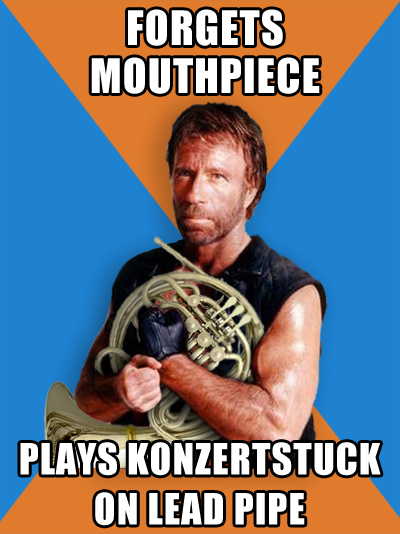
Chuck Norris Plays Konzerstuck

What if Action Mega-Star Chuck Norris played French Horn?

* * *

Do as I say, not as I do.

Meme - Clean your mouthpiece

LOL Cats, ‘Goggies’ and yes, French Horns

* * *

Ensemble deportment.

Orangutan French horn meme

Saturday Funnies Meme Flood

* * *

We hear that a new principal is needed in Chicago.

Keanu blows his big chance at first horn.

Internet Memes ‘Sad Keanu’ and ‘Strutting Leo’ with French Horns, I

* * *

Polly wants a raise.

Parrot plays french horn meme

Saturday Funnies Meme Flood

* * *

Don’t mess with Chuck.

Chuck Norris French Horn


8 Chuck Norris Memes with ‘Walker Texas Ranger’ as a French Horn Player

* * *

A mind is a terrible thing to waste.

Orchestral Maneuvers in the Dark, Brain Memes and Random Videos

* * *

[Extracted from a “Random Monday” post, 2021, JE]

An Interview on Orchestral Horn Auditions. Part IV, the Future and Final Tips

0

This article concludes an interview conducted 2/13/13 with Ashley Cumming, a Doctoral student at Indiana University. Part I starts here.

With increased numbers of people flying to auditions and greater accessibility, has that played an impact on the homogeneity of sound in an orchestra?

I again feel somewhat puzzled by your question as I flew to auditions with often 40-80 applicants present and had access to every recording I needed in the late 1980s. Things have changed very little since then. The only main difference I see being I could carry on two horns when I was taking auditions, which would be impossible with the airlines today. As to sound, I think horn section sounds have been pretty homogenous in many orchestras for a long time. Sometimes Music Directors get a bug to make changes, but players always want to hire people who fit in.

THE FUTURE OF ORCHESTRAL AUDITIONS
As pedagogues, what do you observe in today’s students or what would you like to tell them about orchestral auditions?

The key things still are the basics. Rhythm, intonation, style, phrasing, dynamics, tone, and musicality all come to mind. Play so well they can’t ignore you, and learn how to prepare and pace out the final days so that you can play at your peak on the stage when it counts.

Do you think the level of talent/virtuosity/musicality/technique has changed?

Low hornNo.

After sitting on audition panels, do you have any further comments about the process now or from previous generations?

It cannot be said often enough that really basic things cut people in initial rounds. Students usually think it is because they missed notes, but actually it almost always rhythm and intonation that kills people right away. Especially in a first round, you can be forgiven several missed notes it the package of everything else is solid, any good horn player can and will miss a few notes. But if your rhythm and intonation are bad, that was no simple mistake, it is a basic problem you have not yet fixed. It is the type of issue that screams that you are not ready for the job.

How do you feel about committees being hesitant to hire anyone for available positions?

I go back to my quote from the old Nashville contract. It is the Music Director that is ultimately making the hiring decision. If no one is hired they are ultimately the reason why. Sometimes too you have to realize that the Music Director may not like how the existing horn section sounds and the committee advances people that would fit in the existing section but actually the Music Director would never hire, because they want something different. In the end all the applicant can do is play their best. Much of the process after that is completely out of your hands.

What would you suggest for an ideal hiring process?

The system now really is pretty good overall at finding the best players out of a large applicant pool. I appreciate very much that how one advances in an audition today is not governed by connections or where you went to school. In the end you play your way into the job. That part of the system is as it should be.

Would you prefer to remain anonymous in this dissertation or any further publication that arise from it?

No, in this type of project I think it is essential for the responses to not be anonymous. I will also be posting a version of this interview on Horn Matters, and thank you for your efforts with this great topic.

Return to Part I of Interview

Horn Repertoire Week 9: The Natural Horn in the Romantic Period

This week our discussion will focus on topics discussed in and articles linked from the following article:

Two true masterworks

Highlights of our listening and discussion this week will include these two masterworks:

  • Schubert: Auf dem Strom (horn, soprano or tenor, piano)
  • Brahms: Trio, Op. 40 for Horn, Violin, and Piano

With a bit of focus on Brahms

There is an additional topic I would like to expand upon, from an article not linked from the longer article (above) on the romantic natural horn, the topic of why Brahms wrote for horns in different keys.

From that article,

Brahms wrote for the natural horn in all of his works, but wrote for it in a period when the valved horn was in widespread use. Remembering that the valve was invented by 1814, that the valved horn was in fairly common use in Austria and Germany by around 1850, and that, for example, Brahms first symphony was completed in 1876! That is pretty late for natural horn.

As his orchestral works are such standards, the horn writing remains something that is both fascinating and puzzling to us today. I have looked at this topic quite a bit, and it boils down pretty quickly in my mind to two key points:

  1. Brahms clearly did write all of his horn parts for natural horn,
  2. But did the players of the time actually perform them on natural horns? No.

As to why he wrote for natural horn, part of it certainly is tradition, and that tradition also mixes in with other things including an anti-Wagner stance on the part of Brahms. The style of natural horn writing does mark his music with a type of sound that is unmistakable.

Next time we turn fully to a topic that is also addressed somewhat this week, the early valved horn.

Continue to Week 10

This is week 9 of a fourteen week course in horn repertoire, the second semester of a broad overview of horn repertoire, performance, and pedagogy. The introductory article is here, and the series is presented for the educational purposes of our readers.

An Interview on Orchestral Horn Auditions. Part III, Technology and Preparation Today

This article continues an interview conducted 2/13/13 with Ashley Cumming, a Doctoral student at Indiana University. Part I starts here. 

TECHNOLOGY AND THE TWENTY-FIRST CENTURY AUDITION
How has technology played a changing role in your versus your students’ preparation?

As I was using tape recording back then it really is not that much different. We had tuners and metronomes back then too, and plenty of recordings to reference. Those are still the main tools.

Are you using any of the following?
Ivasi

No

Recording devices

Certainly

Smartphone or iPad applications

Myself no, but students do.

hornexcerpts.org

It is a great site and students love this site, but actually I try to wean students away from it. Work from the actual parts and seek out other recordings. For example full parts of most major works are on Horn Matters, and recordings are easy to seek out in a variety of formats.

Spotify

Students I am sure use it some.

YouTube

It is a really handy tool for preparation.

International Music Score Library Project

Yes, but when possible I point people to the same music on Horn Matters, they don’t need to dig as hard to get the same materials.

Skype-profile-snipSkype/Broadband (for auditions or training)

No. I have taught a little by Skype, but only with prospective ASU students whom I could not meet with otherwise for a lesson in person. Some things you can hear, other things you just can’t by Skype. Honestly, without wishing to offend, I question the ethics of seriously teaching audition preparation by Skype. I suppose it is better than nothing, but in my opinion in person lessons are much more effective for audition training of actual horn excerpts.

Audition training websites (orchestralconservatory.com, joanwatson.com etc.)

I have never used these or recommended them due to the concerns already implied. But I have posted some very relevant readings in Horn Matters, especially in the Orchestra 101 series, and there are some very practical materials I like in the Douglas Yeo trombone website.

Other (please explain)

For preparation of the solo Smart Music is a great tool. The solo is very likely the first thing performed on the first round and needs to be prepared to the highest level possible.

(Please note if you are still using resources such as libraries/hard copy scores/Thompson Edition/Orchestra CD-ROM Library/excerpt cds/older excerpt books: Labar, Chambers etc.)

The level of the student is an element of the answer to the above (“are you still using” certain older materials). For the initial learning of excerpts, excerpt books can certainly be useful. I recommend to my students either the Anthology of French Horn Music by Moore and Ettore, published by Mel Bay or the Horn Player’s Audition Handbook by Arthur LaBar, published by Belwin. The Anthology is to be especially noted for not only presenting well thought out and laid out excerpts, but for also giving good solid suggested metronome markings and other tips for every work, information that is alone well worth the cost of the volume. The only major shortcoming is that this publication has no Strauss, Mahler, or Wagner excerpts. The LaBar book has broader coverage (including major excerpts from Strauss, Mahler, and Wagner) and is more of a one stop source for initial excerpt study. Either book will work well, especially when supplemented with the actual orchestral parts.

How has this access and advanced technology changed the audition process?

I don’t see the audition process as much changed fundamentally since the late 1980s. Orchestra contract language is still roughly the same; the process has to follow the rules laid out there.

Has the increased accessibility of recordings impacted the specificity of your audition preparation?

This question puzzles me, as in the 1980s you could walk into any music school library and listen to multiple copies of everything, and there were many recordings of any standard work available for purchase at brick and mortar stores. Everything was easily accessible without too much effort. Only the delivery method has changed today.

Do you think there is an advantage to physically copying and studying scores versus today’s instant access?

Some teachers make a big point of full score study, which I think is what you are getting at with the question. This was not a part of my training. I feel listening to many recordings is more of a key element, so my answer would be no.

Continue to Conclusion of Interview

Brief Review: The Jupiter Hybrid Horn/Mellophone Mouthpiece

Back a few years ago I wrote (at some professional risk) a number of items on the mellophone, including a method for mellophone now UPDATED in a third edition. (Purchase here!)

Quantum-side-hornFollowing up on that, I very recently had the chance to try the Jupiter 7CH mouthpiece, which seems to be only sold packaged with their Quantum mellophone. From the website, this is “a unique Hybrid mouthpiece with French horn cup that is perfectly suited for warm ballads and ensemble use.”

I located one this past week, and it feels great to my French horn chops. When this was being developed a source indicated to me that it was based on or similar to a Schilke 31 horn mouthpiece blended into a mellophone cup/shank, and was based on a mouthpiece that had been used by horn doublers at the Disney theme parks.

Quantum-rims-hornIn the photos with the horn mouthpieces a Schilke 31 is on the left and a classic Schilke FARKAS MODEL on the right. The #14 bore of the Jupiter is just fractionally smaller than the #13 bore of the Schilke 31, and the rim is essentially identical. The cup of the Jupiter is however a good bit shallower than either Schilke mouthpiece.

Quantum-side-altoThe second pair of photos compares the Jupiter to a standard Dennis Wick E-flat tenor horn mouthpiece and the IYM hybrid mouthpiece. Note the length of the Jupiter is similar to the Wick but of course the rim and cup are much wider on the tenor horn mouthpiece. (What is a tenor horn? See this article). The IYM rim is somewhere between the two rims in width. As noted in yet another article, I personally like the sound and feel of the IYM, but the rim does not interface well with my chops.

For some horn players it won’t matter a lot but for me, the way I set up on my lower lip, I need a horn rim to play comfortably. Quantum-rims-altoOverall I really like how the Jupiter hybrid mouthpiece feels and plays on first impression. It fits the “grooves” on my lips very well, producing a smoky flugelhorn or descant horn sound on the mellophone. This is to say also that it will never catch on in drum corps, their brass techs mostly seem to strongly favor a sound that “cuts” and come to everything from more of a trumpet playing angle. But perhaps it will catch on in marching band use and I certainly would hope that it or a similar clone  by another enterprising maker could be more widely available for horn players who double on the mellophone (or tenor horn, it works fairly well on first impression).

With a final footnote being at Arizona State, where I teach, due to a recent curriculum change marching band is no longer a required course in any degree program! So if you or prospective students you know are thinking about music education and don’t want to play in marching band at all, ASU is an option to consider.