Home Blog Page 64

Understanding the Hornmasters on Range Development

Next up in the Hornmasters series will be the topic of developing the high range. The quotes start in the next article. As a prelude, however, I have a few thoughts as to context and understanding of some of the published approaches to range development out there.

Key concept: Don’t be too literal

One initial point I would make is I know at least of myself that I tend to read words and take them literally. Words should say what they mean, right? But there is danger in reading horn pedagogy texts literally for several reasons.

1. Horn/brass teachers are not always good writers, and they did not always get clear feedback from editors either. This was driven home to me recently as someone I know took a lesson with a teacher who wrote a text related to range development. In short, the main takeaway item from talking about that lesson was that I was trying to follow the instructions in that text much too literally. No wonder I had difficulty making them work!

2. Some books put out a big slate of suggestions. By design, some of them might work for you, but some of them clearly won’t work for everyone. Certainly also you could not make all of the suggestions work if applied at the same time in a literal way; even though every suggestion was valid and made honestly, at the same time you actually can’t do some of them in combination.

3. With the passage of some time in “the business” I have had the chance to see some authors play after reading their books and can also say with some certainty that they don’t actually make use of all the suggestions in their books. The text presents an idealized approach to the issues at hand.

4. Sometimes what the author says is a visualization at best. Be very aware that physiological reality certainly does not line up with what some books state as fact, and that the attempt to do what the book says could actually cause more problems than they solve.

5. Be aware that there is another tactic lurking out there, the book that is a bit vague. Sometimes it is unintentional, but for others I am inclined to think at this point that it may actually be intentional, as in, you need to go take a lesson with that teacher or someone who worked with them to actually understand what they are talking about. They do not give away all the secrets!

Be a critical thinker

In short, think critically and don’t accept anything as the gospel of range development. You will see some good ideas in many of the publications out there but at the same time a percentage of what you read is just plain wrong, and some ideas are maybe right for some people but not necessarily for you. The only publication actually that I would take very literally is the Third Edition of Horn Playing from the Inside Out by Eli Epstein, described here, which makes use of MRI studies to inform the pedagogy presented.

A secret to the high range: Teeth

And now a secret, not mentioned in horn texts at all: the teeth. Or, more specifically, some of the players with the best high ranges in fact have gap teeth or crooked teeth. It seems like brass folklore but it is actually true, either one seems to allow the air to pocket a bit behind the lip which helps the vibration. For more on the topic overall see this article.

And a quick cautionary tale

To close I have a brief story. One time I was teaching a lesson to a new student who wanted to work on their high range. We worked through some of my favorite exercises (from my now out of print Playing High Horn) and clearly the student could buzz up to higher notes than they could play on the horn. I finally got the idea to try their horn and discovered that it literally had the worst high range of any horn I have ever tried! On my horn the student could play up to high C easily. This is to say sometimes it is not you; it could actually be your horn or mouthpiece holding you back!

Continue in Hornmasters Series

The spectacle of the horn in Baroque works

This originally was posted as part of a review of Day two of the 2012 International Horn Symposium in Denton, TX. This concert was extremely notable, and gave a great insight into why people like Telemann suddenly started writing for the horn; the sheer spectacle of horns with orchestra. It was a crowd pleaser at the time to be sure.

The evening concert featured something I have never heard at a workshop, an evening of Baroque Horn Concerti! Natural horn soloist Andrew Clark was joined by Steven Denroche, Paul Hopkins, and Bruce Atwell on works by Telemann, Handel, and Heinichen. It has been a while since I have seen natural horn featured in such a big way and this concert with baroque orchestra was stunning.
My personal favorites performed were the concluding works on each half of the concert. The first half closed with the Telemann Concerto for Violin and Three Horns in D Major. The first movement has long been a favorite of mine in particular and it did not disappoint! The second half closed with a Concerto for Two Choirs by Handel, the “choirs” in this case being two groups of instrumental soloists. For our performance the solo groups were reduced to just horns and the effect and frankly spectacle of the two solo groups of Baroque natural horns (one on each side of the stage) was again just stunning.

The instruments were of period dimensions (small bells/bore) but the performers made use of vent holes to correct intonation. All in all, this concert was a treat and is of a type that is very unlikely to be seen again at a horn workshop, at least not for many years. Which made the fact that it looked like a good percentage of participants chose not to attend this program at all a bit disappointing to this writer. Bravo to host William Scharnberg for putting this program together, it was a highlight of the week for me.

Year Three Statistics – Who Reads Horn Matters?

As Horn Matters approaches its third year, now is a good time to take a look at who our readers are and where they are from. Generally speaking all of our site statistics continue to climb, and we are particularly excited to see a rise in international and mobile traffic.

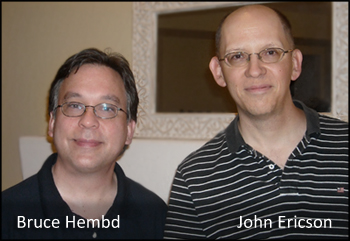
For those not familiar, Horn Matters was officially launched on September 1, 2009. Before that date John and I operated our own separate horn-related websites (we called them blogs back then) and over a period of years, we had both accumulated a large library of content.

From a ‘Year One’ gathering. My face has since gotten fuzzier and my hair a bit longer.

Background

John and I have been colleagues since our student days at Eastman, and at some point in early 2009 we got the bright idea to merge our content and efforts into one massive web site. Because we both live in Phoenix, Arizona and also because we have a history of working together on the International Horn Society site, it seemed like a logical move.

The rest is history more-or-less, and we have since rolled the site under the business umbrella of Horn Notes Edition LLC in order to protect ourselves, our advertisers, our visitors and our content.

In defining what Horn Matters is as a content provider, we have branched out from the outdated idea of Horn Matters as being a merely a blog. We look at it instead as more of an online magazine.

From our About Us page:

Horn Matters is an online magazine co-founded by John Ericson and Bruce Hembd. Bruce and John bring together a wide range of experiences, tips and stories to Horn Matters.

The missions of Horn Matters are to encourage, inspire, inform, and challenge horn players and to promote the best instrument ever, the French horn.

(More.)

We currently have over 1,700 articles of great information to look through – and this number grows every day. While our main focus is on matters related to the horn, we also like to occasionally address topics of interest to brass players at-large and to classical musicians in general.

Who reads Horn Matters?

The trend of site visitors continues to climb steadily upwards. This graphic shows the monthly trends – from September 2009 to the present.

Since September 1, 2009, a whopping 421,149 people have visited the Horn Matters site.

Here is a breakdown of those unique visitors organized by country, according to our Google Analytics tools.

  1. United States 297,003
  2. United Kingdom 24,322
  3. Canada 18,909
  4. Australia 10,722
  5. Germany 7,625
  6. France 4,120
  7. Belgium 3,750
  8. Italy 3,385
  9. Spain 3,085
  10. Netherlands 2,930

While the vast majority of our readers originate from the USA, we are excited to see a slight rise in international traffic, when compared to stats from 2011.

The grand total of page views has added up to over 1.2 million (1,289,461 to be exact). For a niche web site devoted to the French horn, those are some pretty impressive numbers!

The current year, 2012

From January 1st of this year to today, the numbers look like this:

  • Visits: 102,669
  • Unique Visitors: 58,256
  • Pageviews: 234,969

By country:

  1. United States 71,003
  2. United Kingdom 6,266
  3. Canada 4,792
  4. Australia 2,269
  5. Germany 1,880
  6. Italy 909
  7. Spain 763
  8. France 757
  9. Singapore 706
  10. Norway 685

Going mobile

One trend that we have been keeping our eye on is the big increase in mobile traffic.

In the past year alone, the number of mobile users has increased almost ten-fold, from about 1% of visitors to about 10% of visitors. With the increasing popularity of smart phones and tablets we expect this trend to continue on its sharp, upward climb.

Facebook

In tandem with the main web site, our Facebook page currently has over 4,200 followers, and that number also continues to grow every day. Besides functioning as a feed for site articles, it also provides a platform for sharing miscellaneous items of interest that do not necessarily merit a full write-up.

From our Facebook page we are able to glean more specific demographics than we can from Google, but unfortunately Facebook only allows data from the past 90 days.

That caveat aside, the proportions illustrated in this chart have more-or-less remained the same. A large chunk of our Facebook audience falls into the 18-24 age range.

Click this image for a closer look.

Of the approximate 4,200 followers on Facebook, a breakdown of the top 15 countries looks like this:

  1. United States of America 2,396
  2. United Kingdom 190
  3. Spain 146
  4. Italy 139
  5. Australia 137
  6. Canada 101
  7. Germany 89
  8. France  68
  9. Brazil 60
  10. Norway 60
  11. Mexico 59
  12. Sweden 55
  13. Venezuela 54
  14. Portugal 44
  15. Austria 40

The perks of Horn Matters advertising

Related to the topic of web traffic, one question might come to mind: why does the Horn Matters site support and encourage banner advertising?

The answer is pretty simple.

While we are not looking to get rich from selling banner ads we do enjoy providing a free, open-door resource for horn players to get good, solid information at their fingertips. That being said, maintaining and supporting a web site costs money; creating interesting and useful content takes time and effort.

We welcome inquiries from horn and brass related advertisers interested in promoting their products and services to our huge online audience. When compared to expensive and limited-engagement print advertising, our ad services and rates here at Horn Matters are really a smart choice.

Contact us now

There are plenty of spots left – including a prime spot above each article. For more information, please take a look at our Banner Advertising page.

We would love to hear from you!

Even More Memes: I Do Not Huff and Puff

Today’s collection is based on a few established memes (the so-called “Insanity Wolf” and “Futurama Fry” memes) and one original (a cat natural horn player).

Please feel free to download and share these in your favorite social media platform. Click on any image for a larger view.

* * *

* * *

* * *

* * *

* * *

* * *

* * *

* * *

* * *

[Extracted from a “Random Monday” post, 2021, JE]

Konzertstück: A Four-Minute Mile — Especially on F horn!

0

One of our most loved works for horn is the Konzertstück for four horns and orchestra by Robert Schumann. A staple of recent horn events and especially challenging for the first horn (with numerous excursions above high C), I am honored to be performing this pioneering work for valved horn again for the second time this year at IHS Texas.

It is a work that has long interested me; I featured it in my dissertation and also in a later article, “Crooks and the 19th-Century Horn,” The Horn Call 30, no. 1 (November, 1999), this article also being winner of the 2000 Harold Meek Memorial Award of the International Horn Society. (That article content is not easily accessed online at this time and I should go back and convert some of that text into new articles for Horn Matters).

Part of my preparation for the performance earlier this year was to play the piece a number of times with recordings (see this article for a bit more), mostly with the American Horn Quartet version. At that time the performance was from the AHQ revised parts, which spread the first horn load around between the first three horns. However, at IHS Texas we will be playing the standard version, so even while I am still playing third I have some things to work out anew.

Yesterday I got back to the preparation phase of playing with recordings and could not find the AHQ recording. So I went back and pulled the version recorded in 1997 by John Elliott Gardiner and the Orchestre Révolutionnaire et Romantique on period instruments to play along with. I had been reminded of it earlier in the week reading an article in the newly arrived 2011 issue of the Historic Brass Society Journal as well, for in the introductory paragraphs of an article on Brahms and the orchestral horn author Anneke Scott wrote of this recording of the Schumann Konzertstück that

To many period horn players, this performance and the subsequent release of a recording were comparable to the breaking of the four-minute mile.

…to hear it played on single F rotary horns, instruments often deemed more primitive and more risky than the modern horn, was awe-inspiring.

Yes fans of the horn, this recording is on single F horns! Having a reproduction period instrument of that same general type as they used (more here – made for me by Richard Seraphinoff) I was again as awestruck as I was when I first purchased this recording, part of the set of complete Schumann symphonies. It really is a very exciting performance with a lot of “edge” and energy. BRAVO to hornists Roger Montgomery, Gavin Edwards, Susan Dent, and Robert Maskell, this is one that really must be heard. No descant or triple horns! Amazon has it here.

In honor of this recording, at the end of my practice session yesterday I got out my single F. With a very small mouthpiece (smaller than I would normally think of using on a natural horn or early valved horn) I can get a lot of the sound of the lead players in the section on the recording and reach the high notes. So while I have now performed the AHQ version (video here) and next week will play the original version of the Konzertstück on modern instruments with a great section, now I have a new item for my bucket list — to play this work in a great section on single F horns! It would be awe-inspiring if done well, but alas this may never be attempted at a workshop on this side of the pond. Any takers?

To close, the new HBSJ article already mentioned by Anneke Scott is very worth reading, hitting on many of the same sources and topics as my own more concise article on Brahms and the orchestral horn. More on the Historic Brass Society may be found here. And while you are surfing also check out the website of Anneke Scott, I am a fan of period horns and she is a player I hope to hear more from.

Orchestral Horn Playing 101, a Session at IHS 44

UPDATE: Materials related to this session have been updated into a publication through Horn Notes Edition.

======

I am excited to lead a session on the Saturday afternoon of #IHSTexas, “Orchestral Horn Playing 101 – How to Get In and Stay In the Business.” It is a panel discussion and my goal is to feature a small panel of hornists that not only have at least five years of full time orchestral performing experience but also can present materials in an open way, like mentors to the audience.

Part of my personal preparation has been to create a PowerPoint to guide the discussion. The following is based on a draft of that PowerPoint, to give those that can’t be at the session a sense of the topics, and hopefully also a bit more of a sense of what it takes to get and stay in the business.

My essential outline is that you can build an orchestral career in three easy steps!

I. Serious Preparation
II. Early Professional Experiences
III. Full Time Performance

Within those topics the following subtopics are on the agenda:

I. Serious Preparation

  • Think big
  • Get your technique down
  • Get the major works down
  • Move on from a student model horn
  • Consider summer festivals and extra studies
  • Treat amateur groups and “wire stand gigs” seriously

II. Early Professional Experiences

  • Learn how orchestras work
  • Play extra
  • Be a good assistant
  • Build a resume
  • Start taking some auditions
  • Know who your audience is
  • Obtain the X-factor
  • Win an audition

III. Full Time Performance

  • The money question
  • Tenure
  • How to get fired

Feel free to comment below before the session with suggestions and I hope to see you there!

If you are on the fence about attending the symposium, I believe this will truly be a great horn event, one that I very much look forward to being a part of next week.

Ask Dave: What Can I Do About a Leak?

0

Ryan asks:

I’ve been using a older, heavily used Conn 6D until I can afford a better horn. It has a few quirks, but it’s hasn’t been too bad. Recently, any note played using the third valve sounds real weird, as if I’m just buzzing in a long open PVC pipe or as if I took the 3rd slide out of the horn, but the sound still comes out the bell.

I thought it might be a leak, so I took my slides out and tested them all. With my finger stuck blocking each slide’s airflow, I could still blow air in and hear a hissing sound in the bell, on every slide.

So I guess I have two problems or are they related? Any chance the 3rd valve sound could be embouchure related? Any ideas, or is this an automatic trip to the shop?

Dave replies:

These things stick out:

  1. You used the term “recently” so I assume this was not a problem before and is now a problem.
  2. It’s the third valve so it’s an isolated problem.
  3. You tried the rotor which may be leaking based on your test. (Maybe not. This pressure test is not always indicative.)
  4. It seems to be on both sides of the horn, so it is likely we can eliminate the slide tubes themselves, because it is unlikely they both have the same problem (unless the horn was dropped).
  5. This is older, heavily used horn so worn parts are to be expected.

First, I really think we can eliminate embouchure problems. It seems that there were not problems before, and there are no problems with valves 1 and 2, so I doubt your embouchure is at fault.

Second, this sounds very much like a leak which somehow involves the third valve. Check all the tubing joints, and especially those around the third valve. Your horn may have come unsoldered in a place that you least expect but is not apparent until you play third valve. Check the slide tubes for leaks, too, just to rule them out. Cold water in the slide tubes should reveal any problem.

Check the rotor itself for looseness in the casing. And, better to check for leaks by using an extremely heavy oil to seal the valve rotor inside the casing, such as 90 weight oil. You can clean out the heavy oil by pouring in some light oil or filtered lamp oil. Also possibly is that the top bearing plate is loose and is allowing the rotor extreme end play.

The final possibility is that something has gotten stuck in a tube, somewhere. Use of a cleaning snake and/or compressed air can find stuck foreign objects.

This is a long shot, in my opinion. Chances are you have a leaking rotor or a broken solder joint. Either way, it sounds like a trip to the shop to me.

Question from the Mailbag: How do I Improve my Trills and Tongue Speed? (Answer: Do Research)

trill-v-shake2

A questioner asks:

I’m a freshman in high school, and Im playing Mozart horn concerto no 2 in e flat major k. 417 for an audition and there are some lip trills in it. I have never played a lip trill in my life, but I’ve played a regular trill. Is there any advice or some pointers you can give me to help?

And (unrelated to the previous topic), what are some ways I can help speed up my tonguing?

Lip trills are one of those techniques that gets used only once in a while and (at least at first) they require some regular, dedicated practice.

Tonguing is another topic entirely but it is also something that requires regular practice.

The power of the internet

Instead of addressing these questions outright I would like to offer some tips on how to easily find this information online yourself.

With the advent of search engines, information like this is fairly easy to find and independently researching these topics online is something that young students should get used to. There can be great personal satisfaction and reward to be gained from doing the research and trying to teach yourself.

Using a search engine

There are a number of lip trill methods and techniques to consider and in looking for tips online, using a search engine like Google is a good place to start. The results at this link offer a lot of information to look at and sort through.

Another search engine to use is the one right here at Horn Matters. It is located at the very top left of our web site. Typing in the term “trills” produces three pages of results.

Among those results are two specific articles that would be of interest:

For tips on tonguing, the research methods are more-or-less the same: check with Google and use the Horn Matters search engine.

With our internal site search engine, there are a number of articles to look through.

Among the dozens of pages of results:

Do your research, reap the personal rewards

Earnest questions are, of course, always welcome here at Horn Matters and we certainly try our best to provide answers.

This being said, a good practice for young students to adopt early on is to seek online information and do physical research first, before asking another human being (other than your personal music teacher). Preliminary research helps in multiple ways, including how to ask better, more incisive questions.

In preparation for the future – high school, college and adult life – this is a very useful and practical ethic to adopt.

A serious music student should aspire to be self-motivated, curious and hungry for new information and the internet offers a virtual smorgasbord of information to satisfy that hunger. All it takes is the motivation to pick up a utensil and to start spoon-feeding yourself.

5 Tips on Creativity and Being Creative, from John Cleese

Within last week’s Random Wednesday article a video was included of actor John Cleese speaking on the topic of creativity.

Mr. Cleese is a very good (and entertaining) speaker and his main points hit on some great strategies for making our own personal activities as musicians more playful and inspired.

The creative process begins, he argues, with setting boundaries and establishing an oasis where we can feel free to play and create. In this sense, boundaries are what allow us the freedom to create.

He delivers five salient points:

1.) Space

You can’t become playful, and therefore creative, if you’re under your usual pressures.

2.) Time

It’s not enough to create space; you have to create your space for a specific period of time.

3.) Time (Persistence)

Give your mind as long as possible to come up with something original and learn to tolerate the discomfort of pondering time and indecision.

4.) Confidence

Nothing will stop you being creative so effectively as the fear of making a mistake.

Under this point he makes an excellent comment about being serious in your business, as opposed to being solemn. One mindset implies humor and play, while the other implies pomposity and self-importance. There is a clear distinction worth observing and taking to heart.

5.) Humor

The main evolutionary significance of humor is that it gets us from the closed mode to the open mode quicker than anything else.

Two modes of creativity

Mr. Cleese goes on to describe creativity as operating in two modes: open and closed.

In the open mode, we are free to create and brainstorm without restriction, in closed mode we narrow our focus and fine-tune the process. The total process of creativity involves shifting between these two modes.

He notes that all too often, we can get stuck in the closed mode. In politics for example, the adrenaline of the atmosphere can become very addictive (and restrictive). The desire to ponder problems openly becomes much more difficult while stuck this mode.

Humor: 8 Chuck Norris Memes with ‘Walker Texas Ranger’ as a French Horn Player

Put briefly, memes are a virally-transmitted form of communication and interaction. Cultural symbols and pop icons are often incorporated, and a very popular one for several years has been the Chuck Norris meme.

I don’t get it. What is the joke?

It should be noted that Mr. Norris’s personal politics have little or nothing to do with this humor; the mega-Hollywood image takes center stage and politics are ignored.

And as far as I know, Chuck Norris has never touched a French horn in his life… but I could be wrong.

The point of the joke is very straightforward. It is a “what if” situation where a god-like figure is put into impossible situations. It pokes fun at the classic hero-archetype and the situations in which that hero is superimposed.

Previously…

There have already been two previous Horn Matters articles with this meme:

Walker, Texas Ranger

For today’s memes, the main character is taken from Norris’s television show Walker, Texas Ranger. For many years it was a highly-watched program in the United States.

To get started, let’s put a French horn in his hands. Since Walker is from the great state of Texas, the horn must be a Conn 8D.

Chuck Norris Texas Ranger French horn meme
Click to view this template and download. It has a transparent background for you make your own variations.


* * *

This is a good start, but it needs a background to spice things up.

* * *

* * *

This is nice, but it is still not quite right. It does not capture the superhuman, over-the-top vibe that is typical of this humor.

* * *

Chuck Norris as Walker Texas Ranger, with a Conn 8D

* * *

OK, this is definitively an improvement. But somehow it is still not awesome enough. It needs even more punch.

* * *

Chuck Norris French Horn

* * *

Oh yeah! Now we’re in business.

* * *

Chuck Norris French Horn

* * *

* * *

Chuck Norris Clam Filter

* * *

* * *

* * *