Home Blog Page 92

2010 Web Site Stats Report

Echoing John’s sentiments from yesterday, I would also like to extend a big THANK YOU to all our readers. Since launching Horn Matters about a year-and-one-half ago, John and I have watched the site’s statistics start from meager beginnings, to the relatively big numbers that we have today.

We use several different statistics tools to keep a tab on things and see if what we are posting is catching on. Here is a rough overview of the past year.

The gospel according to Google

These are results from our Google Analytics reports. We had one blackout month – mea culpa – which skews things a little. (You can see this in the graph below during August.)

Overall however these reports give a decent picture to look at.

Generally speaking, site traffic is moving steadily upwards. Instrumental in this trend has been our Facebook page, which currently has over 2,600 fans.

Benchmarks

In these graphs below, sites of similar scope and size are marked in gray. When comparing Horn Matters (the blue line) to this baseline, we seem to be doing fairly well.

Since January 1, 2010

For some reason – and I am not sure exactly why – the benchmark stats vary from other areas within Google Analytics. From the site visitors reports, we get numbers that are a little different.

  • 40,000 Absolute Unique Visitors
  • 461,922 Pageviews
  • 4.57 Average Pageviews
  • 4:38 Time on Site
  • 26.04% Bounce Rate
  • 38.73% New Visits

Huh?

When comparing this to a different, independent stats tool, I am left scratching my head a little. Here is what it says for page-views and visitors for 2010.

Discrepancies aside, these raw stats at a bare minimum show that Horn Matters has a devoted and growing following of readers that like to stop by and look around. From what we can tell, about 60% of our visitors are returning readers.

Breakdown by country

Again these are stats are from January 1, 2010 to today according to Google. It is fun to see how many different readers visit from around the world. (Australia wins for average time on the site – a whopping 20 minutes.)

Country Unique Visitors Average Pages Average Time
United States 72,150 4.58 4:15
United Kingdom 5,540 4.29 3:19
Canada 4,758 4.92 3:55
Australia 3,087 5.80 20:50
Germany 1,674 5.14 4:20
Belgium 1,405 4.13 5:24
France 1,148 2.97 3:58
Sweden 995 4.49 3:11
Netherlands 765 4.25 3:10
Spain 699 3.86 2:48
Italy 632 4.81 3:37
Singapore 483 6.21 6:35
Japan 459 3.85 4:05
Mexico 458 4.62 4:55
New Zealand 454 3.89 3:01
Hong Kong 361 5.94 5:17

If it ain’t broke, don’t fix it (?)

0

Phil Collins gives very good reasons for embouchure care and practicing away from the instrument. This comment in particular caught my interest:

Beating the lips into submission is one of the mindsets I was raised with unfortunately. Mind-over-lips has its place but also has its consequences. Denial of our limitations is not the strategy for improvement. When your lips scream at you, you need to listen. A wise approach to playing is not a warrior approach nor is it a wuss approach. Finding your balance is critical for long term lip life. Chop-protection is as valuable as chop-building.

[UPDATED 2021 — JE — from a former “Random Monday” post]

Review: Orchestra Excerpt CDs

0

Although we all know it is coming soon, I was recently struck by the statement “The CD really is dead” in a post in the Polyphonic.org blog by Robert Levine under the title “The times they are a’changin…”

A lot of things are changing out there to be sure. The fact that you are reading this article on Horn Matters is yet another evidence of the revolution underway in the arts. Our traffic has been growing steadily this past year and what we write is aimed for online rather than print consumption. In the same ways that print publications are on the way out the CD as a format is also on the way out, which is a huge change in how we think and create projects in music. Recordings to this point have often been put out with an overall concept in mind, but now people tend to just buy tracks.

With that context in mind I have been meaning for some time to feature three different CD horn orchestral excerpt projects that it would be great for horn students to keep in mind for excerpt study while we are still in an era when CDs are easy to buy and use.

OrchestraPro: Horn

This was I believe the original recording of this type and format. It is at present listed in iTunes as “Orchestral Excerpts for Horn” and was recorded and narrated by David Krehbiel, former Principal Horn of the San Francisco Symphony and prior to that of the Detroit and Chicago symphonies. This project includes recordings of twenty major excerpts with insightful commentary and is available from Summit Records (cover image source) and other sources.

Audition: Improbable

Not long after the Krehbiel project another appeared featuring Roger Kaza, then of the Houston Symphony but at present Principal Horn in St. Louis, with a cast of characters including William Ver Meulen, Brian Thomas, Philip Stanton, and Bruce Henniss. The setup is that Audition: Improbable is a conference or workshop lecture by “Professor Bruno von Hornigschnegel” that features secretly recorded selections from the finals of a major orchestra audition. The information included is spot on and presented in a very entertaining format. Of these CDs, this is my favorite.

The Horn in Opera

The most recent of these projects is The Horn in Opera by Richard Chenoweth, Professor of Horn at the University of Dayton and for 35 years second hornist with the Santa Fe Opera. This came out in 2008 and includes excerpts from 19 different operas. This is more in the style of the Krehbiel project but with a bit more depth. There is much more on this recording and the content in The Horn in Opera website, the source of this cover image.

The Future?

All three of these projects are certainly worth buying and to my mind really are best heard as physical CDs. Any of them if you were to just cherry pick out a few tracks you will pick up something but there is a bigger picture in all that you can only pick up listening to the whole recording top to bottom in order. The Krehbiel is available as a download in iTunes and if you buy it there buy the whole album! So far as I can tell the others are not available as downloads. Perhaps they will be in the future or might someday be converted to a web-based format. All three though are ones that students of the horn should be aware of and make use of today.

Knowing Your Line: Planning for Success & Improvement

A key element in improvement on a musical instrument is to know your line. This concept boils down to becoming familiar with how hard or regularly one can push before becoming unduly stressed – or in a worst case scenario, breaking down.

Having played and taught music for over 25 years now, this process for myself more-or-less operates on an instinctual level. Unless focused on a new task (such as an embouchure change or in teaching), I rarely think about things in such detail while performing.

However there is a time and place for everything, and for adapting to unfamiliar change it can be helpful to understand this concept in order to get started and move forward.

Charting it out

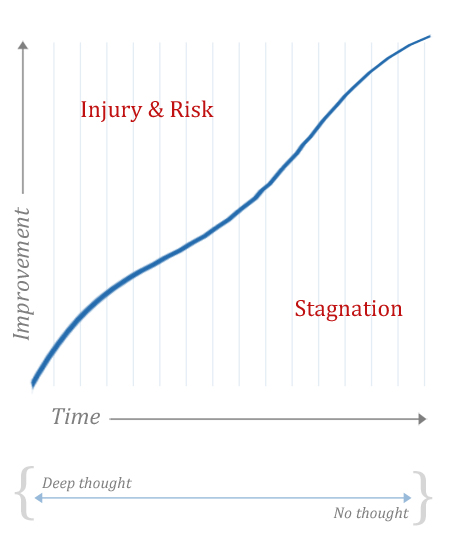
The horizontal progression from left to right represents time. The progression from bottom to top represents improvement.

This model and its scope would be different in each and every situation. The blue, curvy line can represent practice intensity or the learning curve, or just improvement or success (you decide).

In reality its contour might resemble any number of things – from a straight, diagonal line to a jagged zig-zag with peaks and valleys like the stock market.

Know your limits, stay the line

The first step in exercising control over destructive habits is to simply be aware of them. Being very honest and familiar with limitations can go a long way towards overall improvement.

In fleshing out limitations, asking simple questions is always a good, baseline approach. This discovery process might generate itself through a variety of avenues, including: field experience, in private lessons and consultations, during technical research or even just through through lots of time and diligence in a practice room.

Ouch

Looking at just the facial muscles for example:

  • Are my lips tingling?
  • Are my chops burning?
  • Do they feel swollen?
  • Does my face feel tired?
  • Do I feel pain?
  • Is it a sharp or dull pain?

It should be emphasized that these are basic questions not to obsess upon, but merely to be aware or conscious of. Pain and stress is something absolutely not to be ignored.

Above and beyond thinking about the chops:

  • Am I stressed out?
  • Do I feel aware, relaxed and focused?
  • Should I take a break?
  • Did I get enough sleep and food today?

Again these are just basic questions, but they can be very pertinent while charting out unfamiliar territory.

The main point of knowing your line is that playing an instrument while in a stressed or unfocused state is less-than-optimal. It wastes precious time and in extremes can be counter-productive and even lead towards injury.

A new pathway becomes old

In a very broad sense, we learn things in order to forget them.

As time progresses a method like the one suggested here gets refined, condensed and processed into a bare essential – something that might hold great meaning and worth to its users. Eventually it may even pass into deep memory and become a pathway upon which greater things are built.

As implied by the graph chart above, I am suggesting that different learning pathways can exist on the same continuum – in a range from deep-thoughts out to no-thoughts.

Since I assert that learning pathways are dependent on context, I would also suggest that there is ample room for multiple paradigms.

A random list of phrases

Along this line of thought, over the past week I have been collecting various axioms and catch phrases into a list. This list ultimately means nothing, but it is interesting to ponder and compare the concepts behind the phrases.

  • tow the line
  • ride the line
  • know your limits
  • hold the course
  • push the limit
  • break the rules
  • rock the boat
  • damn the torpedoes, full steam ahead
  • put your back into it
  • put your nose to the grindstone
  • break down barriers
  • the straw that breaks the camel’s back
  • paralysis by analysis
  • the unexamined life is not worth living
  • a stitch in time saves nine
  • a bird in the hand is worth two in the bush
  • an ounce of prevention is worth a pound of cure
  • a teaspoon can cure while a tablespoon can kill
  • give one hundred and ten percent
  • go for the gold
  • ride the wave
  • try harder
  • try softer
  • don’t try, let it happen

A Horn Right Hand Position Survey

A great new resource has been posted in The IHS Online, “Two Surveys of European Horn Playing Styles.” What you will find there are two different surveys of major European horn players, the first done in 1964-65 by Pete Exline and the second done this past year by Dan Phillips. Both include photos and recordings of the major players included.

There is a lot to take in there, you could easily spend a couple hours poking around if you are an IHS member, but among the consistent things seen player to player in the part of this resource that can be accessed by anyone is there is always a photo of the right hand position used.

Those images jogged my memory to again dig out this big folder. This is all the raw data of a survey done by my ASU predecessor Ralph Lockwood in 1982. It is a survey on hand position (and more!) and was sent out with the specific note that the results would be compiled into an article in The Horn Call—but the results were in fact never published [See UPDATE II] or even completely compiled so far as I can tell. Over 100 players responded, a number of them being big name players we would all recognize today.

As the permission granted by the respondents was to use the survey data to develop an article for The Horn Call I won’t be publishing the results in Horn Matters but if you want to do your own mini-version of this same general idea check out the Exline and Phillips survey in The IHS Online and focus in on the photos of right hand positions. The positions used by these players are surprisingly variable, especially back in 1965.

Congratulations to Dan Phillips and Pete Exline for their efforts to create this extremely valuable resource, and perhaps at some point I will do more with the Lockwood survey of right hand positions as well.

UPDATE: Continue to this article (in two parts) to see brief notes on the results of the 1982 Lockwood survey, articles presented as a prelude to my presentation on the same topic at the 2013 IHS International Horn Symposium.

UPDATE II: And for a much fuller look at the results see the May, 2015 issue of The Horn Call, pages 50-55.

A Holiday Gem for Low Horn

It is December and that means holiday pops concerts for many musicians. Along with sugar plum fairies, sleigh rides and jolly old elves, a toy parade by Victor Herbert is sometimes thrown into the mix.

The March of the Toys from “Babes in Toyland” is nice march that goes beyond the usual oom-pah writing of John Philip Sousa.

A theme for a muted first horn is repeated throughout the composition in several variations.

Click for a larger view.

My favorite theme from this little gem is a melody that appears about halfway through. It is orchestrated with all four horns in unison.

Traditionally, the first four notes are held back and the dotted-half notes in the second measure are very drawn out. The third measure proceeds a tempo. When the 8-bar phrase repeats, sometimes this effect is repeated for extra measure.

No matter how long or tiring my day has been, this happy melody sticks with me. It ends up being incorporated into a warm-up the next day or hummed in my head while walking around.

Click for a larger view.

Introducing the Marching Natural Horn, a High School Art Class Project

One small chapter of my story is the making of this marching natural horn. It was the first horn I made.

I have always enjoyed working in metals. In addition to several shop classes, I was able as a high school senior to take an art class that allowed me to do several projects in metal.

Browsing in a hardware store I realized that you could buy copper refrigerator tubing in several sizes and also brass fittings. The art teachers directed me to where I could locally purchase a sheet of copper as well. So what you see in the photo is me as a high school senior holding my creation. And yes, I used to have hair.

It is in G for no reason but that is what worked out as the key it was in. It plays but the intonation is, not surprisingly, rather poor and not a lot of volume can be produced. The tubing could only be bent so far without kinking but I did get a good circle and with the help of a several brass pipe fittings made a tuning slide.

It has a nice artistic look and did get me started with soldering with a torch. The bell was the hardest part to make, as I had to beat it out by hand and anneal the bell many times to even get the shape you see.

The finished product has character to be sure and is in my office to this day. It was a great project and I throw the idea out there to anyone else looking for a metals project.

Anatomy of a Mouthpiece Pouch

0

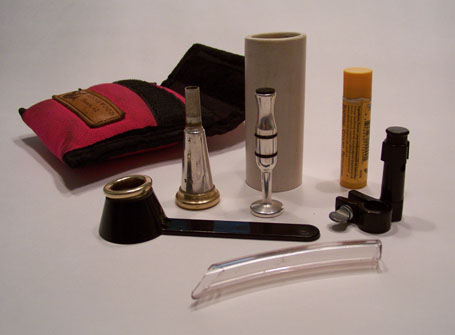
Last September I posted pictures of my home office space in “Anatomy of a Practice Space.”  Here is a look inside my mouthpiece pouch, which I carry with me to work and gigs.

Years ago I purchased a bright, magenta mouthpiece pouch at a horn convention.

While some people would say this is pink, I insist on saying magenta simply because its sounds more manly. So, I chose this manly, magenta pouch thinking that because it was so bright and festive, I would always find it and would never lose it. Thankfully so far, that trick has worked. Magenta. Say it slowly.

Expanding liquids

I travel back and forth across Arizona and keep all my French horn lubricants in a separate plastic sandwich bag (with a “zippered” top). That bag gets left inside the case. Traveling across the varying elevations – from about 7,000 ft. to sea level – forces the sealed liquids to expand and contract.

The result can be a big, greasy mess and the plastic bag is basically a … uh … prophylactic. If anyone has a better idea or solution over the Ziplock method for altitude leakage, please leave me a tip below. With every trip, I am washing greasy valve-oil bottles.

What’s inside?

Some of these items have been the topics for current articles, and a few of the others will be fodder for future topics.

Hornmasters: Farkas and Schuller on Practice

Horn teachers have always wanted their students to practice. Sometimes, the methods used are not healthy ones.

The traditional take

Farkas in The Art of French Horn Playing divided practice for purposes of improvement on the horn into three categories; what to practice, how to practice, and how much to practice. The overall point being that

The foundation of a performer’s musicianship and technical proficiency is practice. Upon the quality and quantity of this practice depends his entire success. Of course, talent and natural ability play an important part in musical development, but even the highly gifted player must devote tremendous amounts of time to careful, arduous work on a chosen instrument.

Farkas mainly has the angle that we do have to practice to get better, and progress to the highest levels our our art requires quite a bit of quality practice.

A darker take on the topic

Gunther Schuller had, on the surface, a similar thought — but clearly has a darker take when he advised in Horn Technique,

While on the subject of practising, I should like to utter a word of warning to those who propose to take the horn seriously and make it a career. If you wish to achieve a position prominent enough to assure you the kind of livelihood you think you deserve, there must be some time in your student years during which you put in the six to twelve months of brutal hard work without which an enduring successful career is not possible. This ‘basic training’ period is necessary not only in order to refine your playing to the highest professional level, but to build up the easily underestimated amount of resistance, both physical and mental, that the nervous tension of everyday professional playing demands. Any short cuts in this respect will sooner or later lead to trouble.

Advice that sounds like good advice, but is bad advice

Of these two quotes I think the worst advice is this from Schuller: “If you wish to achieve a position prominent enough to assure you the kind of livelihood you think you deserve, there must be some time in your student years during which you put in the six to twelve months of brutal hard work without which an enduring successful career is not possible.” (Italics original to the quote).

He probably thought of it a straight talk, but it is certainly not good advice. Don’t go into a dark place of brutal study, and don’t seek out that highly critical teacher as a mentor. It may seem like correct advice, but it is bad, unhealthy advice of the type that you could eventually need therapy to get over.

On top of that, you could easily beat up your chops so much that you never really recover! I will talk about this more later in this series, but you are best to think of your day having three, solid playing sessions a day maximum. A playing session being a rehearsal, a concert, or an hour of individual practice. You start pushing it further and you will not have the results you desire. But again,

Avoid the dark practice space and the Highly Critical Teacher

Those familiar with my story know that I lived a version of that brutal study theory during my Master’s degree study with a CT — I never worked harder and it did lay a foundation going forward. If you are curious for more on that, this article is a reflection on the things I learned in that time frame. But still, the Schuller advice, while it sounds like good advice, is bad advice.

What gets us going, what motivates our practice, is a love of the art and craft of horn playing, and of making great music with others. To be able to do it as a career is an ideal outcome, but in the end you should still love music whatever direction your studies and life overall take you.

Continue in Hornmasters series

Using the Karpman Drama Triangle as a Teaching Tool

UPDATED: Dec. 9th in the PM. Fixed broken resource links.

* * *

Sometimes in our musical lives with colleagues, teachers and students, a dance-of-power can rear its ugly head; one that can lead to a lot of unnecessary drama and anxiety. Stephen Karpman first described this psychological dance in 1968 as the drama triangle.

A basic understanding of the roles and pitfalls behind this triangle can be of great value to musicians, students and teachers. It is a classic model of human interaction and behavior that counseling and leadership experts reference today.

A vicious cycle

Karpman’s model outlines three habitual (and toxic) roles that a player might take on in a given situation. The progression typically cycles in this order:

  • Rescuer
  • Victim
  • Persecutor

Blame and guilt are in the stew that feeds this triangle, and I imagine that this is why it is so hard to recognize and break out of once trapped inside.

The pattern goes roughly like this: one individual tries to steer and control another, feels victimized when things don’t go as planned and then, ends up resenting their target.

Ulterior motives

This is a power game really, played all too often in the music profession. I would daresay that a number of well-known teachers in our field utilize this power play as a default – whether by accident or on purpose. Students too may take on the Victim role as a starting point in order to exercise control over their teachers, parents or other students.

The ulterior motive in this game is for unspoken (and possibly subconscious) desires to be met in a way where satisfaction and power are achieved. This behavior ignores of course the broader harm being done to the situation as a whole. It is based on personal needs, rather than on responsibility or true altruism.

Rescuers

Rescuers are fairly easy to spot. They get caught up in enabling and helping people – whether they need it or not. They see themselves as good and doing good for other people. Their approach can vary, ranging from soft-and-gentle (passive aggression), all the way up to being assertive and bossy (active aggression).

They offer unsolicited advice and will rationalize it as “I care so much” or “I am just trying to help.” Rescuers are generally not aware that pity and disrespect are often at the core of their behavior ( i.e. “I know what’s best for you”).

When in public with my sister-in-law and her new baby for example, I am always amazed at mothers that will approach her with unsolicited child-rearing advice. This kind of encounter is typically more about the person giving the advice than the person getting it.

A Rescuer will typically slide into feeling victimized  (“Poor me, I give so much, yet no one returns my efforts or truly recognizes them”). In time a Rescuer will even grow to resent their target (“That jerk just doesn’t get it. Why did I waste my time?”).

This cycle goes round and round, and with each shift in roles there is Drama, hence the name of the model. What is most destructive with this cycle for musicians is that it is all about the Drama, which ultimately stands in the way of problem-solving and progress.

Indifference as a tool

I have only taken a handful of lessons from Philip Farkas, but I once heard that when introducing a new concept, he would wait for the student to become inquisitive before repeating himself and spelling out the new concept in more detail.

Avoiding the Rescuer role in music education translates into accepting that indifference can actually be a good mindset. It can be very useful and productive to wait and see if a student steps forward for themselves or to see how they end up doing things differently than originally anticipated. As David Krehbiel (former principal horn of the San Fransisco Symphony Orchestra) would often say, it is an attitude of “creative not-caring.”

What the drama triangle illustrates for us as musicians is the value of being non-reactive, and somewhat detached and non-judgmental in our practice.

That is not to say that we must be devoid of emotion (like the ultra-logical Mr. Spock character from Star Trek). I would suggest rather that identifying strong feelings and thinking about them appropriately before speaking out loud is a more positive and productive approach.

This realization alone can be very helpful in owning and experiencing our feelings, instead of being controlled by them.

It’s a trap!

Understanding the general idea of the drama triangle alone can help us as musicians to be more aware of our own tendencies to engage in dysfunctional emotional entanglements. To someone tangled in its web, simply knowing about it can bring some relief.

If caught in a drama triangle, the only escape really is to confront the problem. Learning to be comfortable as a Bad Guy is necessary in this instance in order to break the pattern.

I am not a psychologist or a doctor and have only a surface understanding of this principle, but I think at a minimum it should be noted that unwanted, unsolicited advice as a personal practice can be a very slippery slope.

For the receiver, it is strong indication of a hidden agenda to be wary of.

Resources used in this article