Home Blog Page 122

The World’s Toughest Woodwind Quintet

1

Years ago I first saw this record cover at the apartment of a friend, and finally I now own a copy that is proudly framed in my office.

It is of a record by the group Kansas titled Drastic Measures, and this image is linked from the Wikipedia article on this album, released in 1983.

If you are a typical horn player you might first look to see what kind of horn the hornist has over on the right. Looking at the actual cover, it looks to be a Conn 6D. Hmmm, wire music stands, not too classy. Wonder what music it is on the stand? Looks like etudes.  Then scan your way across the group to the other instruments–bassoon, rocket launcher, clarinet, … rocket launcher! Wait! With ammo on the floor! That is one woodwind quintet I would not mess with.

Horn Section Placement on the Stage or in the Pit

I believe that am the type of person who can generally get along with most anyone. The most heated argument I have got into in music was in an orchestra with a principal player of another brass section and it had to do with seating or placement on the stage of their section and of the horns. Bottom line was I think that person wanted me to know clearly my place in the pecking order of that orchestra.

anatomy2-pitWhere the horns are on the stage or in the pit is an important issue and, unfortunately, we often end up being the pawns in larger orchestral games of personalities and turf. Personally I would rather sit in a row behind the woodwinds even if it means sitting in front of the timpani. I would much rather be there, close to the woodwinds, than in front of the trumpets and/or trombones.

A few months ago there was a post related to this in the Julia Rose blog. Julia after noting various seating arrangements and issues experienced in her orchestra explains

I see 2 problems that have caused this musical chairs fiasco. The 1st is (obviously) our poor concert hall. The 2nd is a lack of leadership in the matter from the podium. I can speak freely about this now that we are going on our 2nd year without a music director. Our past music directors have not made the sound of the orchestra a priority with regard to seating, but instead have been swayed by factions of musicians complaining. The horn section has been a pawn in the whole game, and we get shoved into locations no other musician wants to be placed, just because we don’t complain as much.

It is a big topic. I may be biased but the horns do get pushed around probably because we are in fact nicer people overall. Ideally you will have a conductor with a good ear who manages the situation so that the best sound is the goal, but that is not always the case due to the various squeaky wheels and self-appointed brass section leaders in the orchestra. And some conductors don’t have a good ear, but that is a topic for another post.

On Phrasing in Mozart

Clues to look for in plotting an interpretation.

In planning out a performance of a Mozart horn concerto, some theoretical knowledge of musical forms is very helpful. All of the first movements in fact, adhere to the Sonata-Allegro form and all the finale movements are in rondo form.

Beyond this, analyzing some of the themes themselves might shed even more light into how to shape a performance.

The rule of three

A number of the themes in the Mozart horn concertos may be divided into three subsets. I prefer this approach over seeing every theme merely as an 8-bar melody divided into two or four measure chunks.

For example from K. 447:

mozart3rondo

There is a nice symmetry to this kind of division: two short phrases, followed by one long phrase. The location of the rests too, support this notion of a “rule of three.”

Another example from K. 447:

Mozart3first

From K. 412 the three parts are not as clearly defined by rests, but nevertheless the rule of three may still be applied:

MOzart1first

In the exposition of the K. 495 concerto, the primary theme is much longer than in the previous concertos. Even so, it also divides into three clear sections:

MOzart4

Even though the subsets in this example are equal in measure length, there is a tangible aural symmetry; two legato phrases followed by a fleeting technical flourish.

Beyond pointing out these sets of three, I offer little more. I do not propose to elevate one interpretation over another — a romantic interpretation versus a more “historically informed” performance, for example. I only wish to suggest that the performer shape and color these phrase sets in a manner that fits into their view of the larger picture.

A rule of two

Another common device in the Mozart horn concertos is the use of phrase repetition. From K. 495:

MOzart4-devo

The second phrase may be seen in a variety of ways: as an afterthought or an echo; or as a deep and profound contemplation of ground already covered. Think of it as being more nostalgic, or bold, or sad — whatever seems most appropriate to your tastes.

Shaping it differently in any case, with a contrasting dynamic or articulation or perhaps even both, can help to bring out a more profound and emotive interpretation. Myself, I like to add an ornamental turn in the 14th measure of the example above.

From K. 447:

moz3rondo2

It may not be a bad idea to have fun with the repeated phrase, adding a little variety.

Another from 495:

MOzrt423

Other resources:

Next in this series – a  few thoughts on cadenzas.

signatureBRUCE

Recordings as a Guide in the Journey for Inspiration

girl_with_pearl_earbuds
Girl With the Pearl Earbuds

I once knew a teacher who discouraged students from listening to recordings when preparing solo repertoire.

This teacher felt that it was important for the student to seek out and find their own muse — presumably through blood, sweat and tears. Exactly how or where this quest for truth was to begin was never clearly addressed.

For a player advanced in years this perhaps may be good advice. An experienced musician would already have an arsenal of innate instincts to call upon, having learned from the some of the greatest teachers of all — Time and Experience.

A less-experienced player can certainly plot out some interpretive elements — rubatos, dynamics, places to breathe, tempos, etc. — in advance. This aside, they may not have quite found their inner voice yet; that X-factor that helps to give their interpretation some extra character.

In this case, listening to recordings can be a great way to light that fire. In hindsight, I am not so sure this teacher’s advice to avoid recordings was very sound.

Imitation — a great way to learn

As Jonathan West has suggested at Horn Thoughts, musical interpretation and maturity begins with prolonged exposure to music. It is an aural tradition handed down from master to apprentice.

Every great artist, whether it be Itzhak Perlman, Dennis Brain, Engelbert Schmid or Pablo Picasso, began by imitating a great master.

After a while, the apprentice will branch out and take chances — breaking with their training.

A master chef for example, may start out with standard recipes but in time will add personal touches and their own dynamic flair. New gourmet signature dishes are born this way.

The historical relationship of master and apprentice exists for a very good reason. Imitation is not only a sincere form of flattery — as the old axiom goes — it is also a great way to search for and discover your own voice.

Recordings

In our modern Internet age, we can listen to a wide variety of masters at the click of a button. When it comes to the horn concertos of Mozart there are dozens of fine recordings to listen to. Listening to a recording, like reading horn-related publications, is almost like getting a free lesson from a master.

Here are some of my own personal favorites:

Classic

Period Instruments

Do you have a recommendation? Please suggest it in the comments section below.

Next in this series – a few conceptual ideas to consider.

signatureBRUCE

A Look at Giardinelli Horn Mouthpieces Through the Ages

8

One of the classic, old standard brands of mouthpieces in the United States has been the series produced by Giardinelli. Giardinelli Band Instrument Company was located in New York City and produced some of the best horn mouthpieces available. However, over the years the production standards changed as the company itself changed hands.

giardinelli3On the left in the photo is the oldest Giardinelli horn mouthpiece I own. It is marked a 2C but in the terminology we are more used to it would be a C-2. The C signifies it has a Chambers cup (as in James Chambers, longtime Principal Horn of the New York Philharmonic) with a number 2 bore. [This number being the size of drill used to make the hole in a numbered drill set; 1 is the largest of these numbered drills and horn mouthpieces are rarely made with a bore smaller than number 18.] I believe this mouthpiece to date from sometime around 1950.

This style of Chambers cup was superseded by type in the middle, which is the classic style for Giardinelli horn mouthpieces [UPDATE: but also see comment number 3, below]. This one dates to sometime in the 70s or 80s. The mouthpiece blank is slightly shorter and the rim is the classic “cookie cutter” type shipped out with this model. It has always puzzled me why this was made with such a narrow, reverse peak rim as the stock rim. It is a rather extreme design and it is actually sharper in contour than on the older mouthpiece on the left. Fortunately, better Giardinelli mouthpieces from this era have screw rims which could be made in shapes that better suit the average player. In this era their quality control was good which is another part of why they became such standard models. I have had periods in my own playing where I have used Giardinelli B and C cup mouthpieces from this production era. The C series cup was their most popular model, the C-1 being the quintessential New York style mouthpiece but with a bore around #8 being more common among players.

Fast forward to closer to today; the mouthpiece on the right is an example. Note the shape is different, the blank it was made from is longer, and if you could see it the rim is yet different. Giardinelli was purchased Musician’s Friend during the 1990s. If you go to www.giardinelli.com today you actually get redirected to a new venture for the brand. There you will see that Giardinelli horn mouthpieces are no longer for sale, only accessories.

Classic Giardinelli mouthpieces still see some professional use. To play these now you have two options. One is to luck into a great old classic that has been stored in a cigar box for thirty years. The other is to look into other makers who produce mouthpieces that are close copies inspired by the best of these classic mouthpieces. Perhaps the best known of these are the series produced by Stork; John Stork actually was a mouthpiece maker at Giardinelli in their classic production era. Of this he recalled [UPDATE: This article seems to no longer be on their website],

It was the fall of 1980. I had just completed a 6 year hitch with the Air Force Band, followed by a cross country tour with the Tommy Dorsey Orchestra. I found myself in New York, alone and without work. I walked into the Giardinelli Band Instrument Company, located at 46th street just off Broadway. I was looking for a job that day. What I found was a career.

Giardinelli’s in the 1980’s was not just a band instrument company it was an International Brass Center. There was nothing like it anywhere else in the world. Mr. Giardinelli didn’t rely on high speed computerized machines. In fact, the machines he had were antiquated even for their time. Instead, he relied on craftsmanship, skill and experience. He was a firm believer in the old saw, “It’s not the gun, it’s the gunner!” Bob Giardinelli had gathered a team of the finest craftsmen in the field of instrument repair and fabrication, to work with the finest musicians in the world…who just happened to be his everyday clientele.

Mr. Giardinelli was himself the quintessential artisan. There was not one job in that shop that he couldn’t do. He had learned the art of instrument manufacturing from his father in Sicily, who had been taught by his father and so on for many generations. The instinct didn’t just run in his family, it galloped! From repairing a horn to repairing a lathe, from scratch building a clarinet, to making the tools to do it with, his skills set the standard.

I began working in this fertile environment learning the basic skills of mouthpiece manufacturing by hand, one skill at a time. After two years of back boring, polishing, hand stamping and buffing the unexpected happened; the man doing the custom work was suddenly let go. Within minutes Mr. Giardinelli called me into his office and told me, “You are now my custom mouthpiece maker. Come with me, young fellow!”

The Giardinelli store recalled above is long gone, an era has ended.

Mozart Horn Concertos: Editions

4
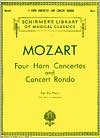
Schirmer Edition, Mozart Horn Concertos
The Schirmer edition

Even when working from a critical edition of the Mozart horn concertos, one should bear in mind that at least of some dynamics and articulations — and some cases, the actual notes — are editorial markings made by people other than Mozart. By the very nature of their fragmented condition, these concertos have had even the most informed scholars scratching their heads and making some educated guesses.

That being said, the G. Schirmer edition for horn and piano offers a good deal for the economy-conscious. In one bound volume are all the concertos plus the (“mutilated” version of the) Concert Rondo for under $20 (US).

Despite its inaccuracies and solo part transposed to Horn in F, the Schirmer edition is priced ideally for those under a tight budget.

Caveat emptor. You will get what you pay for — the Schirmer edition is not an urtext.

One positive about the Schirmer edition

There are without a doubt other editions that are more accurate and faithful to Mozart’s manuscript but many a pianist has expressed a preference for this edition. Bearing in mind that an orchestral reduction to piano can be very tricky and problematic, the playability of the piano part is something to very much consider.

Even in a concerto, it isn’t all about the soloist.

A panicked accompianist tripping over a clumsily transcribed piano part can throw off even the most calm resolve and most patient audience member.

Free editions are available at the IMSLP web site. I cannot give these the highest recommendation but for an impoverished student living on Ramen noodles and peanut butter sandwiches, this might be the only practical choice. It is better than nothing at all.

For the less cost-conscious musician, here is a list of some critical editions to consider:

Any other edition suggestions are encouraged and are most welcome in the comments section below. Please include a few details as to why you might prefer one edition over another.

Other resources:

Next in this series – is learning a piece and using ideas from recordings a bad idea?

signatureBRUCE

Mozart Horn Concertos: Fragments and Good Intentions

1

Working on a Mozart horn concerto for the first time is practically a rite of passage. Mozart is a ticket to getting into college or landing a job — most auditions will require a Mozart concerto.

mozart-portrait

A little bit of knowledge can go a long way in getting the most of out of the experience. In Part I of this week-long series, a bit of history on the original manuscripts.

Studying the manuscripts

A good resource to consult is the book Das Horn bei Mozart by Hans Pizka. In a recent online check I could only find a copy for purchase at Amazon.com for the outrageous price of $595. It could not even be found on the author’s web site.

As an alternative, I would recommend a university music library.  Das Horn Bei Mozart should be on the shelf as a reference or available through an inter-library loan. Either that or borrow a copy from a helpful horn professor who collects horn texts.

The beauty of this tome lies in its complete reproductions of Mozart’s original manuscripts. It wasn’t until consulting this book that I fully realized how fragmented and incomplete the Mozart concertos really are.

Frankenstein Plays HornAnother reliable resource for Mozart manuscripts would be the Neue Mozart-Ausgabe which again, might be found in a university music library. (Very soon this entire source will be digitized and made freely available online.)

Frankenstein’s monster

When studying the original manuscripts it becomes apparent that the only concerto that is more-or-less intact is K. 447, the 3rd concerto. The others — in one form or another — have been found in fragments or in incomplete sketches, and have been stitched and pieced together by music scholars and editors.

As a result, there are notational discrepancies between published editions. It probably does not help, as noted in Das Horn bei Mozart, that Henri Kling may have added a few of his own extra flourishes; most notably, this triplet passage preceding the recapitulation in the first movement of K. 495:

mozart4Kling

This passage appears in most current editions.

While Mozart left enough clues for scholars to fill in the gaps, putting the pieces back together again is a little bit like the classic fable of Humpty Dumpty. The hypothesis and debate on these concertos is an ongoing process.

For instance, John Ericson has pointed out that newer editions of the Concert Rondo K. 371 have 60 additional measures. A publication by the Harvard College Music Library confirms this and has cataloged it into a collection of K. 370b + K. 371.

This fascinating work, possibly commissioned for the Viennese hornist Jacob Eisen, is one of a number of incomplete concerti left by Mozart and one that suffered an unfortunate circumstance. In 1856, for the centennial of Mozart’s birth, the composer’s eldest son, Carl, decided to cut up and give away portions of the autograph (first movement) as souvenirs to several admirers of his father’s music.

The published version we know of as the Concert Rondo, according this Harvard source, was published by Henri Kling in 1909.

This movement entitled “Rondeau” by Mozart was, until recently, known in a misleading incomplete form and performed in a mutilated version for over half a century.

So it appears that while we have Kling to thank for at least making the Concert Rondo (and other Mozart horn concertos) more widely available, for all his good intentions he is also somewhat responsible for some of the current debate over what is what.

Other bits and pieces

I have also seen and heard several different versions in recent years of the Concerto in D K. 412 second movement rondo. An entirely new section within the Rondo adds a new perspective to the movement as a whole.

As for the concerto in D major, KV412 (1791), Mozart only left the opening Allegro and a score sketch of a rondo finale. The composer’s early death was no doubt the reason why he did not write a slow middle movement. The rondo was completed by Mozart’s pupil Franz Xaver Süßmayr on Good Friday, 6th April 1792, in a very free manner. He not only took no notice of the original accompaniment but also replaced the original middle section by a paraphrase of the Gregorian melody to the laments of Jeremiah, which are sung on Good Friday.We may assume that he only had Leutgeb’s copy of the horn part at his disposal. Nevertheless it was not until the 1970s that this familiar version (KV514), which has scarcely more than the rondo theme in common with the original, was shown not to be Mozart’s own work.

Based on other discovered fragments, it is also believed that Mozart may have written other several other horn concertos.

For myself, the E major K. 494a fragment is a real heart-breaker. What begins as something that promises to be a profound and major work, ends after only a few hundred measures.

My heart sinks whenever I hear or see this sad little fragment of something great that is never-to-be.

Other resources:

Next in this series – thoughts on editions.

signatureBRUCE

Mean Horn Teachers who wrote Etudes

There are some really great etudes out there that have a few things in common, besides being hard. The main thing is they have traps, informed by their experience as horn teachers. These take many forms and actually most of the problems with working out these etudes are related to the following traps.

1. Breathing. One classic trap in Kopprasch and Gallay is phrase length; they are geared to being phrases you can make but only with great breathing and the right tempo. Maxime-Alphonse gets even meaner; there are phrases that simply can’t be done and then you have to figure out how to make bad breaths sound good.

Kopp-10-snip2. Dynamics and contrasts. A lot of the classic etudes are very black and white. For example in Kopprasch many phrases are either soft or loud, short, long, etc. If you play it in the lesson all at mezzo-something with a medium articulation you are giving the teacher much to comment upon!

3. Terms. One of my favorites to see in an etude is L’istesso tempo. If you make a tempo change, it is a great chance for the teacher to ask, “so, what does L’istesso tempo mean?” You should know this from the preparation of the etude. If you answer “streetcar” it does not get you extra points. You should know every term in every etude and excerpt before you bring it in to your teachers; this is basic preparation.

4. Range. Besides high range I love etudes that run you down to the bottom of your range. It can be a huge challenge to get the volume and articulations to work in the Neuling low horn etudes for example but that is what it takes to really have the range worked out–and it must be worked out to achieve a high level on the horn.

5. Nuance. For this Maxime-Alphonse is great. He expected quite a variety of nuance of articulations from very long to very short at a variety of dynamics, something that must be in total control to play musically.

6. Musicality. For this there are some great etudes, especially in Maxime-Alphonse and Gallay. Some of their etudes are written of course more to learn to bang out the notes, but there are others that are true musical challenges such as the Gallay Unmeasured Preludes.

7. Transpositions. The printed transpositions in Kopprasch actually are not original to their first published version but there is a point that you just have to learn how to transpose well and etudes are the starting point for this, especially Kopprasch and Gallay.

8. Scoping out your problems. Finally, the goal is not so much to be mean I think from any of these teachers that wrote etudes, the point is to scope out your problems and point out what you need to work on. To reach the next level you always need to keep pushing past the things that hold you back

The reason I love these etudes above of Kopprasch, Gallay, Maxime-Alphonse, and Neuling is not because they are full of traps but because they are effective for working on problems and making technical progress. And I also don’t think these teachers actually were mean; they most certainly wanted to guide their students effectively toward better technique, the goal of any good teacher.

Mozart Rondo Smoothies

1

mozart-portrait-mixerThis post is a prologue to an upcoming series on the Mozart Horn Concertos, starting in earnest next Tuesday Monday. Topics will include: some simple basics, resources and tips, interpretive suggestions and a few ideas on cadenzas.

The Horn concertos of W.A. Mozart are among some of the most treasured of the horn repertoire. We are most fortunate to have such great music in our performance catalog.

An accidental remix

A colleague long ago told a story to me about a rehearsal where she was working on a Mozart Rondo with her piano accompanist. Things were going fairly well for a while when suddenly the two parts did not seem to match at all.

It took a few minutes of head scratching until they figured what had happened.

It turned out that while the soloist was playing the Rondo in E-flat from the 4th concerto, her pianist was reading the music to the Rondo from the 2nd concerto. In spite of this, the mixed combination actually worked for a while before falling apart.

They had a good laugh upon discovering this.

Stacking rondos

That story has inspired a bit of digital mischief done with audio software. These are posted here just for fun and amusement.

First, stacking the 2nd and 4th right on top of each other:
[dewplayer:/wp-content/uploads/2009/09/mashup12.mp3]

The vertical alignment goes askew every now and then between the two tracks due to some tempo fluctuations, but the similarities between the melodic and harmonic profiles for the first minute or so are very close.

Mashups

From the three E-flat concertos, the opening themes are mixed into mini-mashups.

Variation 1:
[dewplayer:/wp-content/uploads/2009/09/mashupB1.mp3]

Variation 2:
[dewplayer:/wp-content/uploads/2009/09/mashupB12b.mp3]

Variation 3:
[dewplayer:/wp-content/uploads/2009/09/mashupB123bcd.mp3]

signatureBRUCE

The Mouthpiece Wheel of Doom

The topic of Episode 94 of The Mellocast is the Mouthpiece Wheel of Doom. It is a term jazz hornist Mark Taylor uses relating to the testing of horn mouthpieces, and for sure since the recording of the show I have entered yet again a phase of mouthpiece testing.

Even before the show I was looking. I had been using a couple different 80 series Laskey mouthpieces for some time but I wanted to try something just a bit bigger, so I was trying all summer to adjust to the 825 series, which has an inner diameter of over 18 mm. The bottom line I realized was that while it felt nice on my lips for me it was just a bit too much mouthpiece, so I had recently gone back to the 80 series. But then, after recording the show I thought to myself, hey, why not try a smaller diameter again? What would be the harm?

One general piece of advice I would have is own a lot of mouthpieces. It may seem like bad advice actually, and it can get a bit expensive, sure, but it is an investment that will pay off. I am sure I have over 100 mouthpieces, most purchased used. In ways I guess I am a mouthpiece collector.

I have a couple specific mouthpieces in the collection that I will never sell and can’t replace. One is a Schilke FARKAS MODEL mouthpiece (pre-Holton) that I won my job in Nashville playing on (more on that in another post) and the other is the mouthpiece I played on both of my solo CDs, a Conn 5BN from roughly the 1970s.

osmunconn5bnA Conn 5BN?!? I know that sounds a bit hard to believe and rather random in fact, but some of these are quite good. I have three of them actually, one being not nearly as good and two of them quite close with one having an edge over the other. It is on the right in the photo, with the original Conn gold plating. I am told that these were actually produced by outside jobbers, not by Conn itself. This is why these (and other classic brands) vary so much, it always really depends on who actually made the mouthpiece and where, especially these older mouthpieces that were not machine made on computer lathes. Even the most generic mouthpiece must have a few that slipped out that were actually quite good, totally up to specs and made by a very fine machinist. Just for the cheaper brands many more were shipped out that “looked like a mouthpiece” and that was good enough for the price point they sold at.

I purchased my first 5BN in a batch of mouthpieces from a retiring horn player about 15 years ago, and first tested it seriously when I was testing mouthpieces after the purchase of my Paxman 25A over ten years ago. Through some quirk of the black art of mouthpiece making the 5BN just feels great on this Paxman double, and trying it again I will probably stick with it again. But on my upcoming recital I plan to play one half on my triple and one half on the double, and the Conn 5BN only feels good on the double. The triple is made to take a slightly different receiver. What to do?

One investment I made about eight years ago was to have Osmun make a copy of my best 5BN, the sliver mouthpiece in the photo. I had this made mostly as I knew I was playing on a mouthpiece that I could not replace (danger!), but no student could buy a copy of it either which was a problem in my teaching. I had never really liked that copy in the double and used it very little, I headed into different directions and over to the Laskey products. But getting it out again now the Osmun 5BN copy actually feels pretty solid in the triple. The shank is just a bit larger on the Osmun version which is a part of it for sure (on the Conn 5BN I like in the double the shank is slightly undersized compared to standards). I did not even own the triple when that copy was made for me. Yet another reason to hang onto any mouthpiece that seems like it might ever be promising to use, it may pay off when you are on the mouthpiece wheel of doom yet again.

In short practicing is suddenly a lot more fun on this new combination of horn and mouthpiece. I know I will probably switch again eventually but for sure I feel like I have come home again and some things are just easier, I feel more accurate and generally comfortable.

But I can also see why I quit using it. Most of the playing I was doing at the time was in loud groups and the Laskey 80 puts out more sound, and also on the triple the Laskey helped out the low range production and as mentioned the Conn 5BN did not fit the horn. While I can tell on the 5BN mouthpieces I have to be a bit more careful with low note placement, overall comfort is better for the type of general playing I do now.

This gets at part of why Mark calls this the Wheel of Doom. It is a wheel as you may end up right where you started after all the experimentation. But if nothing else the journey is worth taking, you will figure out better what different equipment lets you do and does not let you do.

If you want to try a Conn 5BN good luck! They have been out of production for many years and even if you find one you may only find a dog as they were made in batches, and thousandths of an inch really matter in mouthpieces. Osmun may still be able to sell you a copy of mine and I may invest in yet another of these. Also, a final note would be that I know there are pros out there that use prime examples of the old Conn 3BN as well. These old Conn mouthpieces are not as far out in left field as you might think; these two models are ones to try if you can luck into a good one.

UPDATE: For a more current (2024) view of my thoughts on the “Wheel of Doom” see this article