Home Blog Page 68

University of Horn Matters: The Natural Horn in the Romantic Period

The transition era from the natural horn to the valved horn is a fascinating one. Perhaps the clearest way to understand the basic issues at work is to focus on the natural horn writing of three major composers in this transition era, Beethoven (whose Sonata was just briefly examined in the previous installment of the University of Horn Matters series), Schubert, and Brahms.

Context: Not everyone welcomed valves with open arms

NOTE: The following section is based on materials that were for many years posted as part of a longer article on Horn Articles Online. A version of these materials was also published in my article “Brahms and the Orchestral Horn,” The Horn Call 52, No. 1 (October, 2021), 47-51.

In the nineteenth century there were a variety of attitudes toward valves. While we, from our perspective today as valved horn players, would think that the valve was a great invention and that it must have immediately been recognized as such by all parties, the valve actually had a very mixed and rather slow reception. In some areas the natural horn remained in use for many years and it certainly had its strong supporters [4]. Differing opinions circulated on the valved horn; recognition of this fact is essential in understanding the musical reality of the time.

Among composers, the lines had been drawn by the 1830s. On one side you have composers who were open to the use of valved brass instruments. One composer of this side who actually composed no works for the valved horn, making his example even more interesting, was Felix Mendelssohn (1809-1849). Commenting in 1834 on his overture Die Schöne Melusine, Op. 32 (1833), which featured the horns and trumpets outlining the minor triad (written c”, eb”, g”), Mendelssohn stated that

The E flat for the horns and trumpets I put down trusting to luck, and hoping that Providence would show the players some way to do it; if they have new contrivances for it, so much the better [5].

In other words, the work was composed to require hand stopping by not only the horns but also the trumpets (!), but Mendelssohn was open to the idea of valved instruments playing these parts [6].

On the other extreme you see composers who felt that valved brass instruments were simply a bad idea. One such composer was Karl Gottleib Reissiger (1798-1859). Reissiger was an important musical figure at the time, holding the position of Hofkapellmeister in Dresden during from 1828; this was the court where Richard Wagner (1813-1883) would hold the position of second Kapellmeister (under Reissiger) from 1843-49. Reissiger wrote in 1837 that

I hear such a beautiful, sustained solo performed in a colorless monotone on a valve horn, and it seems to me as if the instrument is moaning: ‘My love, I am a horn. Don’t you recognize me any more? I admit that I am too severely constricted, I am somewhat uncentered and hoarse, my sweetness is gone, my tone sounds as if it has to go through a filter sack in which its power gets stuck.’ [7]

His comments about the “colorless monotone” get at the idea that the tone of the horn should have shades and nuances of tonal color, a central characteristic of the tone of the natural horn. Many other later quotations relating to this same idea could be cited [8]. This division between supporters of the valved and supporters of the natural horn is central to understanding what Brahms is getting at in his horn writing, as he is the most successful of those composers whom advocated the natural horn in this period.

NOTES:

4. See for example my article, “Trashing the Valved horn? Comments on Valved and Natural horns from Turn-of-the-Century England,” The Horn Call 29, no. 1 (November, 1998), 53-56.

5. Felix Moscheles, ed., Letters of Felix Mendelssohn to Ignaz and Charlotte Moscheles (1888; repr. Freeport, NY: Books for Libraries Press, 1970), 97, cited in David Whitwell, A New History of Wind Music (Evanston, IL: The Instrumentalist, 1972), 26.

6. That Mendelssohn did not think much, however, of the keyed trumpet is shown in a letter of February 14, 1831 to clarinetist Heinrich Bärmann (1784-1847), cited in Edward H. Tarr, “The Romantic Trumpet,” part 1, Historic Brass Society Journal 5 (1993), 248, footnote 90, trans. Tarr. Of the trumpeters in Rome Mendelssohn wrote, “I must still add that the trumpeters play all the time on the accursed keyed trumpets, which seem to me like a pretty woman with a beard or like a man with breasts–they simply do not have the chromatic notes, and now it sounds like a trumpet castrato, so dull and unnatural. But there is one here who plays variations on it!”

7. C. G. Reissiger, “Über Ventilhörner und Klappentrompeten,” Allgemeine musikalische Zeitung 39 (September, 1837), 610, trans. in Ernest H. Gross III, “The Influence of Berlioz on contemporary nineteenth century use of brass instruments,” part 1, Brass Bulletin 67 (1989), 21.

8. “Trashing the Valved Horn?,” ibid.

The serious topic of aesthetics and the hand horn

Continuing a thought expressed in the quote above, there is a very serious topic of aesthetics to consider. Dauprat in his Method (published in 1824, a massive publication) gets at the idea that shifts of tonal color from open notes to stopped notes was to be desired and gave important shades and nuances to the sound of the horn. His comments may be read in the brief article linked below:

Links related to Beethoven, Schubert, and Brahms

Longer articles specifically related to Beethoven, Schubert, and Brahms are linked below, and will be considered to be required reading for those following the University of Horn Matters series in full.

Question older sources and conventional wisdom on horn history

In all of the above articles there is a bigger picture to see, and that is that there is an older literature on horn history that says some sketchy things that modern students of horn history need to keep clear. They would include:

  • Beethoven 9 is rumored to have been for valved horn but that is not the case, it is natural horn writing even if the first player to perform it was a valved horn pioneer,
  • Schubert did not compose Auf dem Strom for valved horn either; it is still natural horn writing even if associated with the brother of the same valved horn pioneer associated with Beethoven 9, and
  • Brahms wrote all his horn parts for natural horn, there is no indication at all that he was thinking of sections split between natural and valved horns in any way, natural horn writing for him was to maintain traditions as part of an anti-Wagner stance

As to major natural horn players and teachers of the time, in terms of today certainly the best known is Jacques-François Gallay (1795-1864), as several volumes of his etudes have become standards. This image is from his Method. For an introduction to Gallay and one of his best known publications please read:

In honor of Gallay, the featured horn image is a horn of his time, Halari as copied by Richard Seraphinoff.

The nineteenth century was a transition era; it took us from the natural horn with no valves to the double horn! We will have more on that era in the next installment of the University of Horn Matters.

Continue to next article in University of Horn Matters

Return to Week 9 of the Horn Repertoire Course

University of Horn Matters: The Horn in the Classical Period

The Classical period saw the horn gain immense popularity as a solo instrument and as a member of orchestras and wind groups.

The two main designs in use

By the end of the eighteenth century two primary types of natural horns were found in general use, the most common being the orchestral horn. The earliest instruments of this type were seen as early as 1703 but lacked a central tuning slide, which was added to the instrument by the 1760s. This design features terminal crooks, which lie between the mouthpiece and the body of the horn, and can be made in various lengths to place the horn into keys as high as C alto and as low as B-flat basso. This small illustration is from the Kastner, Manuel Général de Musique Militaire.

The other type of natural horn was known as the Cor Solo. This particular model was introduced by the Paris maker Raoux in 1781, but is derived from the German Inventionshorn, introduced in Dresden in the 1750s. This type of horn featured crooks, which were inserted into the middle of the instrument in the manner of tuning slides. These crooks are variously called internal, insert, or sliding crooks, and were normally made in the period to crook the instrument only in the central keys of G, F, E, E-flat, and D. An example of this type of instrument is illustrated here, a French Cor-Solo as illustrated in the Gallay Methode.

A great period for the horn

This was a great period for the horn. In terms of technical developments, the two major developments of the late Baroque, the division of horn playing by range between high and low horn players and hand horn technique, were fully adopted by players in this period, and while horns did vary in terms of internal dimensions from area, after the adoption of a central tuning slide the overall design of the instrument was set.

Not only were the technique and construction of the horn both fairly stable in this period, but also it is one that would see the horn become firmly established as a standard instrument in the orchestra and also fully take its place as an important solo instrument.

An important aside: Mouthpieces

It is important to note that mouthpieces in this period differed a great deal from those used today. They were made of sheet metal and were very deep, complementing the design of the natural horn in terms of tone and flexibility. A typical modern mouthpiece does not sound or work that well on natural horn.

In my own playing on natural horn I typically use a “compromise” mouthpiece, but, if you are serious about playing the natural horn on Classical period works, you need to track down a mouthpiece such as this one made by Richard Seraphinoff.

A new resource: Method books

It is also in this period that method books were first published for the horn. In particular the comments found in the method of Heinrich Domnich (1767-1844) are especially important to study today. My article is a bit of a long read, but well worth the trouble, as it clearly lays out the state of natural horn playing at a high level in the early 19th century.

The horn as a soloist

While there were many great works for horn composed in the Classical period, the works that tower over all others are the Mozart concertos. As they are very well known in the horn community I would offer these two articles for additional reading and background:

Another composer I like to feature in any look at the Classical solo horn repertoire is Rosetti. He wrote a lot of music for the horn! Haydn wrote some great music as well! Recommended, brief reading:

A final work among many that could be noted in this brief overview would be the Sonata, Op. 17 of Beethoven, which is certainly the first great sonata for the horn and is today the most frequently performed horn sonata from the era. Composed for an April 18, 1800 performance in Vienna with the horn virtuoso Johann Stich (1746-1803, better known under the Italianized name of Giovanni Punto) the work features the horn and piano as equal partners. In terms of technical requirements the work is composed for performance by a low horn player of the time with highly idiomatic arpeggio figures. The “factitious” written low G is also idiomatic (this was not a true note in the harmonic series and would have been obtained by bending the pitch down with the lips from low C; this pitch will center with a clear tonal color), and with a general range that never goes above written g’’ it is a work that is very suited to modern natural horn study.
When we return the topic will be the natural horn in the Romantic period.

Continue in University of Horn Matters

Return to Week 7 of the Horn Repertoire Course

(Ouch!) Four Practical Tips for Painful, Swollen Lips

Back when I was in graduate school, swollen lips were more-or-less a regular thing for me to deal with.

This was due to a number of factors, but in hindsight I would attribute it mostly to my own reckless attitude. My playing schedule was very heavy and I was burning the candle at both ends.

Temporary lip swelling is not a major issue; it is a natural part of the muscle-building process. Over the long term however, it can lead to more serious problems.

Muscle Inflammation 101

I am not a physician, but what follows is my basic understanding of why lip muscles can feel swollen and achy after hard playing sessions.
Soreness in a stressed muscle is initially due to an accumulation of lactic acid. This acid is a byproduct of muscle metabolism; it can irritate and cause soreness. Typically, it dissipates within 12 hours or so.

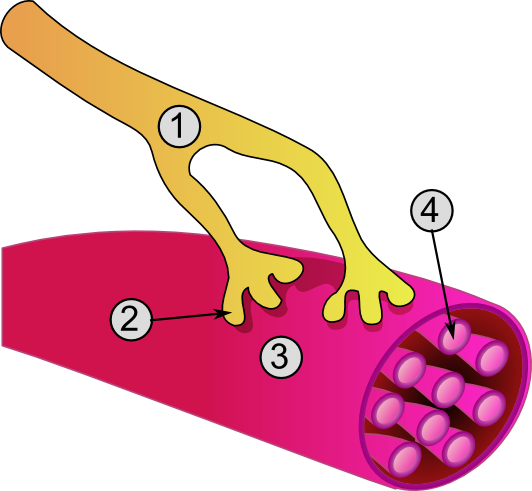
Another natural part of muscle building is microscopic tearing of the myofibrils (labeled as #4 in the illustration below). This process, known as anabolism, is what builds up a muscle fiber and makes its stronger.

In a very broad and metaphorical sense, we tear down our embouchure muscles in order to build them up.

Soreness that occurs days after a heavy workout is known in athletics as Delayed Onset Muscle Soreness (DOMS). DOMS can make your chops feel swollen and puffy because your body is sending all sorts hormones, fluids and cells to the area in order to make repairs.

This is a normal response to what might be a change in routine or an increase in muscle activity.

1.) Ask questions.

This all being said, it can be helpful to think seriously about what might be the root cause of a swollen lip – especially if it is impairing your performance level over a period of days or weeks.

A few questions to ponder might include:

  • What did I do yesterday?
  • What have I been doing over the past few days?
  • Am I playing too much (or not enough)?
  • Have I been making significant changes to my daily playing schedule?
  • Am I focusing on one aspect of my horn playing too much; for example, too much fortissimo playing?
  • Have I spoken to my teacher about this?

2.) Get the mouthpiece off the face.

Probably the best tip for sore chops is to immediately stop playing and rest. If time allows, not playing the horn at all – for a half day, whole day or even a few days – can sometimes be the best medicine.

If taking time off is not possible, taking mini-rest periods – even while rehearsing – might help.

Tempering the louder dynamic levels is also a great tip; try reducing everything to a mezzo-something (or mezzo-nothing!) dynamic for a few days.

If you are playing music that is in unison with other players, try laying out altogether. If work or school politics is an issue, keep the horn up to your face and pretend that you are playing. In the context of a loud unison passage, few people will even notice.

Also, (whenever possible) try physically removing the mouthpiece from the lips in order to relieve the pressure – during several measures rest, or even on whole, half or quarter rests. Every little bit can help.

3.) Think about recovery.

From the world of sports and athletics, the acronym P.R.I.C.E. is often recommended as a recovery method for aching or swollen muscles. It stands for:

  • Protection
  • Rest
  • Ice
  • Compression
  • Elevation

Four elements of this method – those that apply more specifically to the embouchure – have been highlighted: protection, rest, ice and compression.

In using ice to reduce swelling, care must be taken to not ice the lips for a period longer than 10 minutes. Research indicates that keeping any muscle iced for too long of a period can backfire. While it can indeed reduce pain and inflammation, it may also reduce blood flow and hamper healing if left on the lips for too long. Frostbite can also be a concern.

Typically the compression element of the P.R.I.C.E. acronym refers to wrapping the injured area with an elastic bandage. With embouchure swelling this is really not practical, but one can certainly massage the lips, and perhaps even kill two birds with one stone by using an ice massage.

The easiest way to perform ice massage on an injury is to freeze water in a small paper cup. Rip the cup to expose the ice. With the injured body part elevated above the heart (if possible) to reduce swelling, massage the injured area. Keep moving the ice in a circular motion for 10 minutes; never hold it in one place. As the ice melts, tear down the sides of the cup to expose the rest of the ice.

(Skip)

The most effective and safest use of ice has been found with a repeated application for 10 minutes at a time. Allow the injured body part to warm for at least an hour before repeating the ice massage. Using repeated, rather than continuous, ice applications helps sustain reduced muscle temperature without compromising the skin. It also allows the superficial skin temperature to return to normal while deeper muscle temperature remains low.

(More.)

Most importantly, avoid playing for at least one hour after using the ice treatment. A freshly-iced embouchure is susceptible to further injury.

Non-steroidal, anti-inflammatory medications – such as ibuprofen, naproxen and aspirin – may also help. For myself, I temper ibuprofen doses to a higher level, taking three tablets every six hours – as opposed to two tablets every four hours. I have also found that antihistamines can help, especially if I am having an allergy attack and my entire face feels swollen.

4.) Re-think your methods.

The big trick in avoiding swollen chops and lip injury is, of course, to not overdo it in the first place. As the old saying goes, an ounce of prevention is worth a pound of cure.

To close out this topic, here are a few ideas that might help you to make a change for the better.

a.) Consider implementing a warm-down.

When you are playing a lot it is tempting to not warm up much but it is also especially tempting to not warm-down at all. You are tired at the end of that 2 1/2 hour service and want to get the horn in that case again!

But you will set your chops up better for the next service if you cool-down a bit.

(More.)

b.) Balance your warm-up and practice routine with your performance schedule.

Do you want a better high range? Try spending more time on your low notes. Do you want better fortissimos? Try balancing your loud playing with more pianissimo playing.

(More.)

c.) Examine your warm-up routine and your attitude towards it.

Many players like to practise exactly the same things every day. That way, they claim, they can “measure” what shape they are in for the day as well as their progress. I feel somewhat restricted by this idea. On “heavier” days, when the lips are strange from too much or too little playing, or from the weather, the food, the drinking, the mood, the lack of sleep or whatever, I find it better to play something easy and pleasant to boost the self-confidence first.

(More.)

 d.) Take more breaks.

Muscle conditioning is a gradual process and when muscles tingle or burn that is normal. This is normally a sign of lactic acid building up in the muscle tissue and it is a natural part of the re-building process.

It can also be a sign to take a break – for a few minutes, or even for a few hours. In more extreme cases these sensations may even be micro-tears in the embouchure muscles.

(More.)

e.) Consider other equipment.

A final student came to me complaining of endurance and range issues. The mouthpiece this student uses is a popular model but with a very thin, “cookie cutter” rim and at #8 bore it might be just a bit too big. Some of you reading out there are thinking “what, #8 too big???” but having been there, done that and bought the T-shirt in terms of big mouthpieces I would dare to say you may be working too hard, and while a thin rim is good for accuracy, too thin can cut and reduce endurance significantly.

(More.)

 f.) Examine the timing and length of each practice session.

Whether it be for a full-time player in a major orchestra or a part-time player with a day job, a busy lifestyle forces one to adapt the practice regimen accordingly.

Necessity, goes the old saying, is the mother of invention.

This is not to say that the old rules suddenly become invalid, but rather to suggest that pedagogy is something that exists on a continuum. Experienced teachers and players, well-versed in a variety of approaches, know this and are prepared with an arsenal of learning tools to draw from.

(More.)

Sore chops?

  1. Ask questions.
  2. Get the mouthpiece off the face.
  3. Think about recovery.
  4. Re-think your methods.


Sommerville on Conductors

Interview
Jamie Sommerville (principal horn, Boston Symphony Orchestra) gets the Q and A routine at James Strecker Reviews the Arts.

On conductors:

One thing that I have found to be very interesting about Music Directors is how each time one leaves a long-held position, the one who follows is so clearly different from the last. In many cases, there is a clear, diametric opposition. So the TSO went from Gunther Herbig, a very traditional, kappelmeisterisch leader, to Jukka-Pekka, who is very much a conductor ‘ in the moment’ I would say, with an extremely varied, quicksilver, expressive baton technique and then to Peter Oundjian, who again is more traditional, physically, but expressive, intelligent, and knowledgeable.
In Boston, we went from Seiji, who showed everything with his hands – probably the most fluent and musically clear technique I will ever see – and said very little about the music; then to Levine, who consciously eschews a lot of traditionally demonstrative flourishes, but rehearses very verbally, and has clear ideas of what he wants musically and how to articulate them to the ensemble.
All of these approaches, of course, can be very successful in the right hands and setting. I guess the overarching lesson I’ve learned is that you need a sophisticated and objective self-knowledge to conduct well, to know what kind of musician and communicator you actually are (as opposed, perhaps, to what you would like to be), and then exploit your strengths, and avoid your weaknesses!
(More.)

[Extracted from a “Random Monday” post by JE, 2021]

Brief Reviews: Music from the Americas and A Passionate Horn

0

Today we have short reviews of two recent CDs. First up is Music from the Americas featuring the Lieurance Woodwind Quintet on the Summit label. The recording features works of Liduino Pitombeira, Robert Muczynski, Alec Wilder, Paul Valjean, and John Harbison. The Lieurance Woodwind Quintet is the longstanding faculty woodwind quintet at Wichita State University, and this recording reflects well that they are an outstanding group. The recorded quality is excellent, with hornist Nicholas Smith producing a wonderful, blending sound. The balance of the group and ensemble is excellent.

Of the works recorded I have performed the Muczynski and Harbison works previously, and these are great performances. Of the others, on hearing them I would love to perform any of them, they are all very attractive works. If woodwind quintet is an interest this new recording is in the category of “must own.” It is available for download on iTunes or can be purchased online through normal CD outlets. The listing in the Summit website is here.

The other CD of the day is A Passionate Horn featuring Andrew M. McAfee. The CD represents the playing of McAfee well and includes works of Gliere, Franz Strauss, Mendelssohn, Schumann, Büsser, and James Winter. I recorded three of the same works on my own CDs (Les Adieux and Canto), so to those I won’t offer specific comments, but I would like to focus in on the Sonata by James Winter.

This work was a new one to me and will be to many in the horn world. James Winter (1919-2006) was recognized during his lifetime by the International Horn Society as an Honorary Member. Long time horn faculty at Fresno State, he was also editor of The Horn Call, president of the IHS, and according to his bio in addition to horn taught “music theory, history, conducting, brass instruments, and brass pedagogy.” The important item in that quote being music theory, as I was completely surprised to learn he was also a composer and has a PhD in composition, having earned this degree during a leave from Fresno State in 1954.

I had no idea what to expect musically of this Sonata but was very intrigued to find out. In the context of the recording I was expecting something lyric but instead this is a fairly gritty, “modern” sounding work. The work was composed in 1955 and this is the world debut recording. The short samples on CD Baby give a sense of the work, one that will hopefully become better known in our horn world through this recording.

University of Horn Matters: The Baroque Origins of Hand Horn Technique, and the Early Classical Horn

To continue we today have what is likely to be one of the longer articles of this series, as it is on a topic where the conventional wisdom needs reexamined. It will conclude as well with a look at an exciting new model of early Classical natural horn that is now available for purchase and use today.

The conventional wisdom

Dresden hornist Anton Joseph Hampel (1710-1771) is frequently credited with either inventing or codifying hand horn technique sometime after 1750. As this is repeated in so many sources, I was curious how this was documented, how it became the conventional wisdom on this topic.

The primary source behind the Hampel story is the Méthode de Premier et de Second Cor (1808) of Heinrich Domnich (1767-1844). Domnich was a student of the great horn virtuoso Johann Stich (1746-1803), who was better known under the Italianized name of Giovanni Punto, and it is thought that Domnich had obtained his information from Punto. Punto had been a pupil of Hampel and later also published an edition of a horn method by Hampel.

To briefly summarize the account presented by Domnich, Hampel was experimenting with mutes of wood when he was struck by the idea of inserting a pad of cotton into the bell of the horn, inspired by contemporary oboe players who inserted cotton into the bell of the oboe to soften the tone of the instrument. In the words of Domnich,

It was a ray of light to him … he saw the means, by introducing and pulling out the stopper alternately, of running through the diatonic and chromatic scale of all keys without interruption. Then he composed for the horn new music where he introduced some notes which until now were strange to him. Some time after, having noticed that the stopper could be replaced advantageously by the hand, he ceased to use it.

Before this revolution, fortunate as it was brilliant, the manner of holding the horn was the same as that used today (1808) for the tromp de chasse [hunting horn]. But as the arm on which it was supported was required for the execution of the stopped notes, the holding of the instrument was changed….

Creator, in a sense, of a new instrument, Hampel, who was not experienced in his youth in the practice of stopped notes, restricted the usage to slow pieces. It was reserved for one of his disciples to give to this discovery all the extension and brilliance of which it was capable.

[Heinrich Domnich, Méthode de Premier et de Second Cor (Paris: Le Roy, 1808), III-V, trans. in Birchard Coar, A Critical Study of the Nineteenth Century Horn Virtuosi in France (DeKalb, IL: Birchard Coar, 1952), 6-8.]

Domnich was the first to answer the question of who invented hand horn technique and virtually every account since that date has in one way or another simply repeated his account.

Questions could be asked

It is worth noting that the account of Domnich was published after the death of Punto, the supposed source of this information on events which had occurred over 50 years previously. The story Domnich presented is certainly very believable, but, on the other hand, believability is certainly not a standard by which one can prove anything to be a factual, accurate assessment of history. In fact, a skeptic could even begin to question the motives of Domnich, Punto, or both for presenting this story. Without question there is a certain note of status and authority a musician obtains by having received information passed on to them directly from a famous expert–and Hampel we are told invented hand horn technique, making him the final expert on this important topic. Did Domnich present facts in his story, or did he or Punto perhaps bend the facts just a little bit?

Looking at the Baroque horn, again

Before addressing this question more directly it would be best to first briefly examine Baroque horn technique in general. The Baroque horn, addressed in the first article in this series, is similar in many respects to the Classical natural horn. As I have a short overview of how the natural horn works elsewhere, please take a minute to review this article. The photo below is another view of the Baroque natural horn after J. W. Haas by Richard Seraphinoff, mentioned in the earlier University of Horn Matters article and published here with permission.

Baroque horns generally have a smaller bore and bell size than that of horns used in the Classical period, could be built in a fixed pitch or could utilize terminal crooks, and did not have a tuning slide.

It would not be difficult to hand stop a Baroque horn

In general the size the overall wrap of the instrument is larger than that of the Classical natural horn, but not so large that it would be of any great difficulty to place a hand in the bell for the purpose of hand-stopping. This fact alone is perhaps the first reason to question the idea that hand-stopping was not used on the Baroque horn, as it is certainly not difficult to stop the bell of a Baroque horn with the hand. In fact, it is quite likely that horn players must have begun to experiment with hand-horn technique as soon as they figured out that they could put their hand into the bell–almost immediately after the horn was created.

Hand horn technique was know by 1720 in Dresden

Thomas Hiebert in his article, “Virtuosity, Experimentation, and Innovation in Horn Writing From Early 18th-Century Dresden,” published in the Historic Brass Society Journal 4 (1992), addresses the subject of Hampel and the beginnings hand-horn technique in Dresden in quite some depth. Hampel joined the Dresden Hofkapelle in 1737, but Hiebert points out convincingly that hand-horn technique was actually known by hornists working there before 1720. Specifically, the second movement of J. D. Heinichen’s Sonata, written ca. 1719, requires a number of notes outside the harmonic series and could represent one of the first experiments with hand-stopping in Dresden.

The frequency of the use of notes outside the harmonic series increased with the arrival of Hampel in 1737, with an especially notable example to be found in a concerto for violin by Franz Benda (1709-1786), dating to 1740. Hiebert also commented in his subsequent article in The Cambridge Companion to Brass Instruments (1997) that this Dresden work exhibited “a very advanced form” of hand-stopping. A concerto from this period, traced to Dresden and thought to be by Hampel, also required “a developed form of hand-stopping in a two octave scale from the twelfth harmonic down to the third (from G5 to G3).” Hiebert further states that “this would not be possible by lipping or partial hand-stopping.”

And it was known outside Dresden

Evidence of hand stopping is to be found in period musical works outside of Dresden as well. Hiebert in particular (in the Cambridge Companion article) notes that

Others were involved with experiments similar to those at Dresden. In 1792 Ernst Ludwig Gerber mentions that Bachmann, second hornist at Sondershausen, was using a fluent right-hand technique by 1750, and a concerto for second horn by Franz Xavier Pkorny dated 1754 contains a passage remarkably similar to that referred to above, written by Hampel. Pkorny’s and Leopold Mozart’s concerti for two horns from the 1750s, possibly written for horn players at Regensburg and Wallerstein, were among the first in the genre of the true double concerto in the more Classical style. They also show similarities to the writing characteristics used in Dresden, with well-defined first and second horn techniques including factitious tones.

That hand-stopping was practiced in a variety of locations by a variety of players in the 1750s speaks volumes toward an earlier date of invention than traditionally cited.

Hand horn technique was widely known, at least among the best players

Richard Seraphinoff in his thought provoking article “Nodal Venting on the Baroque Horn: A Study in Non-Historical Performance Practice,” published in The Horn Call 27, no. 1 (November, 1996), points to still more evidence that hand-horn technique was known in the Baroque period. This article is posted in full in his website and I would suggest that those seriously interested in horn history read it in full. He notes in the article that hand-horn technique is mentioned specifically in several sources very near the oft mentioned date of its “invention”–and it is not mentioned as a new or revolutionary technique in horn methods dated to 1764 and ca. 1770, which is in itself quite revealing. Why? Because it tends to confirm again that hand stopping the bell was in fact not a new technique, that it was already a widely known technique.

Perhaps one of the most fascinating theories Seraphinoff presents in his article relates to the horn parts of Bach, where he wrote that

Additional questions arise when playing Bach’s horn parts. There are so many non-harmonic series notes in Bach that one might think that the players must have had some method of altering the pitch of the open overtones other than bending the notes with the embouchure. One theory, put forth by Lowell Greer, speculates that parts marked with the notation “corno di tirarsi,” which are some of the most chromatic of Bach’s horn parts, may not have been intended for some sort of “slide” horn, but may in fact have been played on the normal Baroque horn using the hand to “slide” or pull the pitch down from an harmonic series note to its chromatic neighbor. This is an interesting and plausible theory, but one for which there is no evidence at present.

But did horn players in the Baroque put a hand in the bell?

The central point to examine is this: did fine horn players in the Baroque place their right hand in the bell? Certainly many period illustrations do in fact show horn players holding their bells in air, but Seraphinoff notes that with the “lack of quick communication and easy travel in the eighteenth century” practices must have varied from place to place. In short, as a performer Seraphinoff prefers to use hand stopping on the Baroque horn because he feels that this practice emulates

… the technique of the best horn players of the Baroque era. We must give the players of the period the benefit of the doubt and assume that they were clever enough to try the experiment of putting the hand into the bell to correct intonation when asked by a conductor or violinist or oboist to “please do something about those out of tune notes,” a request that was probably made more than once in the early part of the eighteenth century. Job security has always been the mother of invention.

Hand-horn technique in some form was certainly know by the 1720s at the latest–the idea that it was either invented or codified by Hampel around 1750-1760 is merely a plausible sounding myth. Hampel did, of course, make a significant mark as both an important performer in Dresden and as the teacher of Punto, and the point is not to belittle those facts. But his real contributions must be placed into proper context and not reach mythical proportions in a vain quest to assign a name and date to the invention of hand-horn technique, when in fact there is very likely no one name and no one date that can ultimately ever be assigned.

Developments seen in the horns used in the early Classical period

As Richard Seraphinoff has been mentioned prominently in this article I would close this rather long installment with information on a new model of early classical orchestra horn which he is now producing and is illustrated here. This instrument is based on an instrument by Anton Kerner senior (1726-1806) of Vienna, the original dated 1760 on bell garland. It has a very narrow bell profile, the significance of which will become clear as we read his description of the instrument.

This is an important instrument, because it fills the gap between the baroque orchestra horn, now often played “bells up” for pre-1750 literature, and the classical horn, which makers have most often copied from instruments of around 1800 or later. The period that has been neglected includes most of the output of Joseph Haydn, W. A. Mozart, Rosetti, the Mannheim composers, and other early classical composers.

The easy upper range helps to explain the early solo, chamber, and symphonic writing of Haydn, Johann Stamitz symphonies, Rosetti solo and double concertos, and other high horn playing in the early classical style when the clarino range was still very much part of the high horn player’s technique. The horn is also remarkable for its clear, centered stopped notes throughout the range, which indicates that the development of this type of bell design was necessary for the further refinement of the chromatic handstopping technique begun by Josef Hampl and the previous generation of players.

This is likely the kind of horn used by German players in the important centers of horn playing, and apparently by German horn players working in Paris. This would presumably have been the type of instrument used in the 1760s and 70s by the early traveling soloists such as Punto, Türrschmidt, and Palsa, using a well developed system of chromatic handstopping.

These natural horns are different than those used later

For those serious about playing early Classical horn literature on authentic, period instruments this model is certainly one that must be looked into, as it differs significantly from the natural horns used in the 19th century. When we return to this series next weekend the topic will be the horn in the Classical period.

Continue in University of Horn Matters

Return to Week 6 of the Horn Repertoire course

University of Horn Matters: The Horn Before 1750

With this article we begin a new feature on Horn Matters, a series under the heading The University of Horn Matters. This series will present resources on horn history and pedagogy topics, with commentary. To begin this series our topic is the horn before 1750.

IMPORTANT NOTE — 2024: The article below could be revised quite a little bit, The Horn (2023) by Meucci and Rocchetti sheds much more light on every topic below. For any student out there doing online research on horn history, track down this new book, reviewed here. As I have time I will update this article, there are a few specific details to revise.  

What is a “horn” anyway?

In its simplest form a horn is a conical tube which when blown makes noise via an air column vibrated by the lips. Human beings figured out pretty quickly that there were many things that when blown on made noise, so the earliest horn-like instruments date from long before recorded history. These include items such as hollowed out animal horns, conch shells from ocean, and hollowed out wooden tubes. As time and technology advanced, metal instruments were developed in several different cultures from the Bronze Age onward.

The breakthrough: bending tubing

Around 1400 trumpet makers began to bend metal tubing, which was a major breakthrough in the development of all brass instruments. It is during the Renaissance that we first see horns that we would recognize as horns. One important development was the trompe, a slender, one note hunting horn constructed in a crescent shape with a single coil in the tubing, which was illustrated in the treatise La vénere (ca. 1561) of Jacques du Fouilloux.

Another important early design was the cor à plusieurs tours, which was longer and more tightly coiled than the trompe. Both instruments were developed for use as signaling instruments for use during the hunt and in both cases this specific use and the coiled tubing is what primarily differentiates these instruments as horns when compared to trumpets of the period.

The hunting horn is born

Between the years 1600 and 1700 the horn continued to develop as an instrument used primarily as a signaling instrument in hunting, the “sport of Kings,” providing a musical commentary on the activities of the hunt. It was in this period that trompes de chasse, fully circular hunting horns, were first constructed and used in France. Instruments of this type were likely used in a production of La Princesse d’Elide by Lully in Versailles in 1664, the score of which makes specific reference to cors du chasse.

As the tube length got longer the hunting horn also received a wider bell which helped the instrument to produce a richer, darker tonal color than that of the trumpet. Single-coiled horns pitched in C alto are generally thought to have been produced by 1680 and horns at lower pitch levels would soon follow.

A hunting horn is illustrated below. The images in this article are all borrowed, with permission, from the website of natural horn maker Richard Seraphinoff.

Hunting horns spread beyond France

Credit for introducing this type of hunting horn to the German-speaking lands has been given to Bohemian Count Franz Anton Sporck (1662-1738), who first heard type of horn in Paris during his grand tour of 1680-82. Fascinated by the instrument, he sent two of his retainers to be trained to play the instrument and to introduce it to Bohemia. Thus, he has been credited with introducing the horn to Germany, although certainly many others had much to do with the spread of the hunting horn and its use in art music in Germany and the world. In fact, sources point to the fact that the “French horn” (i.e., cor de chasse or hunting horn) was known in England at this time as well; this terminology was very correct at the time, as it accurately differentiated the new French instruments from those horns used up to that time in England.

If you are unfamiliar with how a natural horn works, please take a second and read this introductory article on the topic .

Orchestral horns, with crooks

The new instrument was a popular one. The earliest known use of the horn as a member of the orchestra occurred in Vienna in 1700, in Carlo Agostino Badia’s (1672-1738) opera Diana rappacificata [for reference see the excellent article by Thomas Hiebert in Trever Herbert and John Wallace, eds, The Cambridge Companion to Brass Insturments (Cambridge: Cambridge University Press, 1997)], and by 1720 the horn was very well established as a concert instrument. Horns with crooks, pieces of tubing that were inserted between the mouthpiece and the body of the horn and allowed the instrument to be pitched into several different keys, were first constructed no later than 1703, implying that more was required of the horn player by this time than simple hunting fanfares. While hunting fanfares and the inevitable “horn fifths” that are almost automatically generated by a pair of natural horns were a part of the musical language of the horn player at the time, high, florid clarino parts similar to those seen for the trumpet literature were also very common, as displayed in works of Bach, Handel, Telemann, and other contemporaries. The instrument illustrated here is a Baroque horn after J.W. Haas (early 18th century) by Richard Seraphinoff.

It was a very popular instrument

When looking at Baroque horn literature a place I like to start is Telemann, with this brief article giving an overview of his works for horn. One sense I get of it all was horn was almost a fad! Telemann wrote a lot of works for the horn in a fairly short timeframe, a surprising number of which are in print and available today. Quite a few works survive by other composers as well, with this article having notes on two more solo works I highly recommend. As to orchestral works, among the most frequently performed is the B-minor mass of Bach, but it would be easy to come up with a fairly long list of works involving the horn in the Baroque period.

High horn, low horn, and hand horn

This exciting, developmental phase of horn playing sees two other major technical advancements. First, in this period we begin to see the lower range specifically cultivated; a distinct division quickly developed between high and low horn players. Secondly, players discovered that by inserting the hand into the bell of the horn they could alter the pitch of the instrument for improved intonation and additional pitches, and that they could also make the tonal color darker and mellower. By gradually closing the hand in the bell one can lower any sounding pitch one half step with moderate stopping, and any pitch may be lowered to a half step above the next open pitch by combining full stopping and “lipping” the note down. This topic will be explored further in the next article in this series.

The hunting horn today

As heard performed today hunting horn has a raw power driven by long traditions. This article by Bruce Hembd gives a nice view of a modern hunting horn in his personal collection. Many videos may be found on YouTube of modern hunting horn performances.

What did Baroque horn really sound like? We don’t know

Which gets us back to an “elephant in the room” topic, what did the Baroque horn sound like? It is really hard to say. One would hope the best players of the time were very artistic, with great intonation and such. But on the other hand they could have played much more like the modern hunting horn is played and audiences just accepted that as what horns sounded like. It is a topic I like to ponder while listening to the video linked in the following article:

Return to Week 4 of Repertoire Course

Continue in University of Horn Matters series

Review: Quick Horn Rinse ESW Device for Cleaning a Horn

0

I must admit that at first I was somewhat skeptical of the Quick Horn Rinse ESW (QHR) cleaning device. I was doubtful of its efficacy above and beyond my current tried-and-true method for cleaning a horn – using a shower hose at the sink.

However after using it now several times to clean out my horn over the past few months, my doubts – like the crud inside the horn – were washed away. This is a great way to keep your horn clean.

To garden hose or not garden hose?

The QHR appears to be a sum of mostly after-market parts, assembled together into a nifty package.

In its default mode it is designed to work in tandem with a standard garden hose. I was not so thrilled about the idea of taking my horn outside in order to clean it, but for those that might have a large utility sink in a basement or a space to work with outside, using a garden hose might be more ideal.

Fortunately, the screw threads on the QHR are of a universal size and I was able to engage some technology from my aquarium cleaning equipment in order to keep the operation inside the house. The sink where I do the usual horn (and aquarium) cleaning already has a screw-thread adapter in place, and so this set up was most ideal for me personally.

The hose for my aquarium tool is much shorter and more flexible than the average outdoor garden hose.

For other readers who might have similar constraints I would recommend the QHR Sudser Tub adapter as an alternative to a garden hose, or if you have similar aquarium cleaning tools like mine, give that a try.

Setting up

The cleaning method and procedure are similar to what was noted previously in “How to use a Sink Hose Adapter to Clean a Horn.” The quickest part of the QHR procedure is the actual flushing of the horn. The set up however, takes some time.

It is always a good idea to remove all the slides when cleaning a French horn. In this case, the intense pressure of the QHR could actually blow out a slide and so they were put aside in a separate container. I used a plastic mixing bowl.

A unique aspect of the QHR device is that the attachable hose actually goes inside the lead pipe. Its rubbery surface is somewhat textured and it sticks inside the lead pipe with a water-tight seal.

The device also comes with a soap attachment, which is another very nice feature.

Staying dry

Getting a water-tight seal all-around was a concern before turning on the water. I did not want to have a geyser splashing water all over the bathroom, and so all the connections were both checked and doubled-checked.

I was able to get a fairly high flow of water pressure going before springing a leak. Next time I might use some thread-seal tape on the sink’s screw threads in order to prevent this one from returning.

That aside, I was able to get a good flush without any major incidents.

Final thoughts

As a method to keep your horn clean between annual or semi-annual professional cleanings, the Quick Horn Rinse ESW (QHR) is a superb device. I plan to use mine on a monthly basis.

Kudos to inventor Bill Ricker for creating the QHR and for making it available to all brass players at such a reasonable price.

* * *

For another review, see “New Model of a Great Cleaning Device: QHR Sudser” on the Tuba-Euphonium Blog.

A Look at Howard Hanson’s Symphony No. 2, ‘Romantic’

In the relative scope of Western music history, composer Howard Hanson is a bit of an unknown, a throwback to a bygone era. His music represents a school of American composition whose roots were tied to the 19th century European traditions of melody and harmony. A true neo-Romanticist at heart, Hanson spent his student years in Europe and his musical language never veered far from these European Romantic roots.

In my own opinion, Hanson’s greatest contribution to the American classical music tradition was not his composition but rather his leadership at the Eastman School of Music. For 40 years, Hanson was that school’s director, having been appointed to the position by the school’s founder George Eastman, a philanthropist and founder of the (now-bankrupt) Eastman Kodak company.

Symphony No. 2

Probably his most known work is the Symphony No. 2 (“Romantic”). The work was premiered on November 28, 1930 as a commission to celebrate the 50th anniversary of the Boston Symphony Orchestra.

It is a work that is not often performed in the United States and I imagine that outside of the United States it is rarely, if not not ever, performed. The score and music is only available as a rental through the Theodore Presser Company.

One of its main themes is regularly performed to this day at the conclusion of all concerts at a summer camp in Northern Michigan, the Interlochen National Music Camp. This theme has become known as the “Interlochen Theme” and it is traditionally conducted by the concertmaster after the featured conductor has left the stage.

At its conclusion, there is no applause.

The theme

This theme is comprised of a simple string melody and a prominent horn counter-melody. On its first iteration it is a lento horn solo line – the length of which rivals even the Mendelssohn Nocturne and Tchiakovsky 5th solos in its duration.

(This theme also appears in the end credits of the 1979 Ridley Scott film Alien, just as the monster gets blasted away into outer space.)

It returns several times throughout the three movements of the composition – both as solos and section tuttis. In a sense, it functions as sort of a “thematic glue” that holds the entire piece together.

Star Wars, ca. 1930?

To my own eyes and ears, this composition looks forward to the Hollywood sound that we are accustomed to hearing at the movies today. If a young John Williams had been mistakenly transported back in time to this era, he might have written very similar passages.

Splashes of heroic, swashbuckling melodies are present throughout.

The melody below is for a unison horn section – from rehearsal letter G to rehearsal letter I.

Horn I part, complete

All-in-all, the style of writing feels almost more like a band composition than one for orchestra. To a certain degree, the winds and brass take precedence over the strings as the center of attention. There is plenty for the principal horn to do and if you are ever engaged to perform this piece, it would be a good idea to get the part ahead of time and to be prepared.

Under the auspices of fair, educational use and that offering a single part for download does not affect the performance rights and profits of this composition as a whole, here is a complete PDF of the Horn I part for study purposes.

Vandalism of rental music

As a final note – a comment on excessive pencil markings in regards to rental music.

When my own part arrived, it was in miserable shape. An extraordinary amount of vertical hashes, fingerings and repetitive, dark circles made the part very difficult to read. My first task in preparing this part then, was to erase everything and start over with a clean part.

This is a strong pet peeve of mine. If one must make marks in rental music:

  • Use a standard #2 pencil. Ink and red pencil do not erase.
  • If you make a mistake in rehearsal, try not to take it out on the music by repeatedly circling that passage.
  • Use fingering indications modestly and sparingly.
  • Avoid the use of large-letter warnings with multiple exclamation points (such as WATCH THE CONDUCTOR! or SING HERE!! or EMPTY SLIDES HERE!!!).

Over-marking a part in rehearsal only draws attention to your mistakes and poor preparation.

Play nice

Vandalizing a part is highly disrespectful to the music and it may adversely affect the next person that will be performing from the same part. That person may not appreciate the personal dramas that might have been played out and inflicted upon the page.

Please be kind – use a pencil on rental music sparingly and when finished, erase your markings!


Review: Bohemian Horn Concertos

0

Continuing with reviews of a few CDs that came in recently we turn to Steven Gross and Bohemian Horn Concertos, a 2010 release from Summit Records. Three works are featured:

  • Jirí Havlík: Concerto for Horn and Strings
  • Jan Václav Stich-Punto: Concerto for Horn and Orchestra no. 5 in F Major
  • Antonio Rosetti: Concerto for Horn and Orchestra no. 2 in E-flat Major

Of them, the only one I was very familiar with was the Rosetti. I love this concerto and this is a very fine performance and recording. As I have noted in a prior article, Rosetti wrote a lot of music for the horn and the best of it is not performed nearly often enough. As to this performance, it is one very worth listening to! Steven Gross brings a great touch to this work with a musical and light style.

Punto was the leading horn soloist of his time (Beethoven wrote his Sonata for him) but was not a professional composer. Thus, what I expected just seeing the title on the CD was something a bit generic and classical. Which the work is generally but this spirited performance helps this work out a great deal and the last movement, a “Rondeau en chasse,” in particular is an attractive movement.

The first work on the recording is the one I really did not know what to expect when I first put in the CD, the Concerto for Horn and Strings by Jirí Havlík. For me just seeing in the liner notes that it is by a hornist/composer I don’t recognize and was written in 1976 don’t necessarily mean I will find it interesting. However this work really is one that deserves to be performed more often, with some of the colors and melodic style of other better known concertos for horn and strings (such as the Larsson Concertino) but in a more modern style. It is exactly the type of work that needs to be featured on a CD such as this, so that it may be easily heard and become more widely known. Thank you Steven Gross for beautifully recording this work! I hope his recording inspires others to perform this very attractive recent concerto.

The CD is available on iTunes now and was reviewed in The Horn Call last year as well. I was somewhat surprised to learn that the full content of a number of recent issues of The Horn Call are online in a third party website that can be accessed for free. Somehow the IHS contract with ProQuest must allow this content to be reproduced in full online in the ReadPeriodicals website. The link is here to the review of this CD by the late Calvin Smith, who also has a very positive take on this recording. And much more from recent issues of The Horn Call may be found there as well.