Home Blog Page 119

Halloween Frightmares: Newspaper Headline of Horror

Click the thumbnail for the full view.

Musicians that make noticeable mistakes in concert make easy targets for the discerning music critic. Some critics might even go so far as to name the perpetraitor in print, publicly shaming the instigator.

Some of the greatest concert halls in the world are pockmarked with good intentions. Horn cracks, clams, yodels and splee-ahs in particular can be quite spectacular.

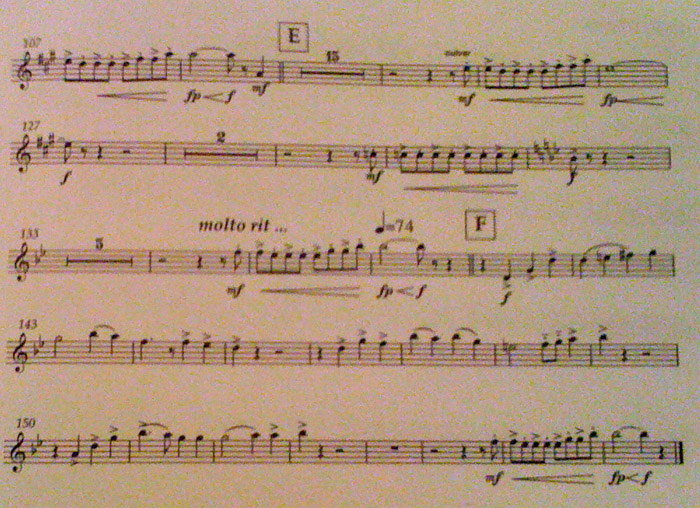
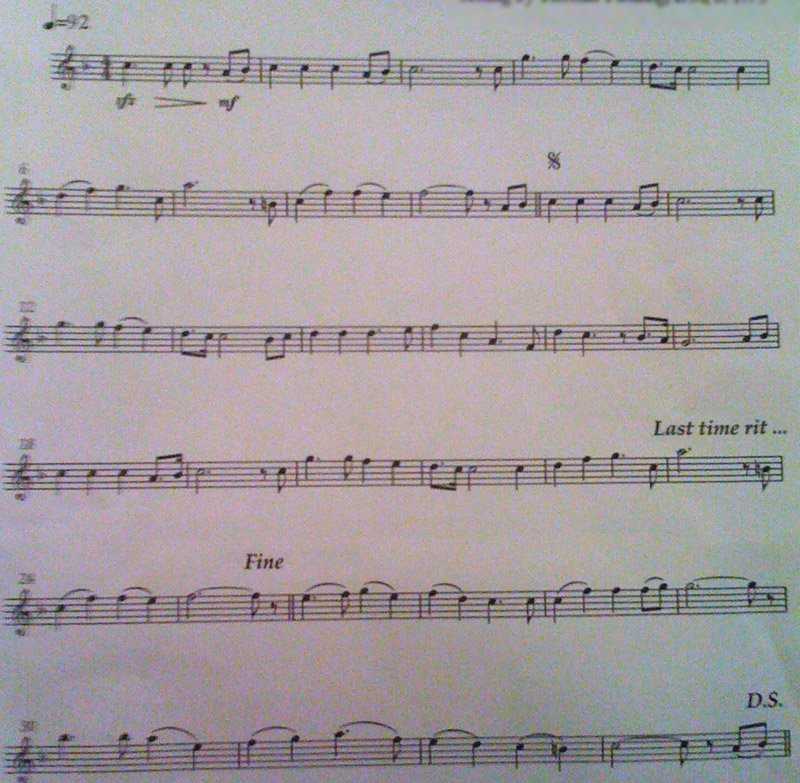
In a satirical look at a nightmare headline posted last May, the Halloween Photoshop spectres imagine a doomsday headline that would be any musician’s worst Halloween nightmare.

The Audience Thought You Were Nervous

About this time of year I always find some students are getting rather stiff in the chops, which leads to a discussion of how to avoid and manage this stiffness. But sometimes you have to play on with stiff chops and it may be easy to hear in the audience that you are stiff. What does the audience think?

monkey-bananasI was recently at a performance that did not go as well as it should have that involved a brass soloist which will serve as a good example. What it was exactly I am not going to say, it is not relevant to the point of this post, but rest assured it was a very fine brass player and they were having fairly serious response issues. I totally could feel it listening, their chops were just stiff. As brass players we all know that feeling. But non-brass players don’t. One of the other audience members commented to me that the player sounded really nervous.

I don’t think the performer was nervous at all other than maybe the sort of deep dread of knowing that your chops feel terrible. Again, we know this already as we know how the chops feel and sound when stiff but this audience member, who has a background in music but not brass instruments, needed a bit of gentle education on the topic. Not that we want to just put a bunch of excuses out there, but it is important for people in music in general to know that nerves are not the only reason why brass players miss notes.

As to how to manage, it is a combination of what your playing days look like and how you warm-up and warm-down. As to the playing days, pace yourself! Try not to play too far into the stiff zone. You are safest thinking of having three main playing sessions, with the heaviest practice being on the days when your other playing commitments are the lightest. I do suggest warming down and also inserting things that resemble warm-down exercises in your warm-up if you feel stiff.

And consider taking a day off sometime. This is a topic that I had a post about in my original HTML blog that has not come forward to Horn Matters yet. In a post titled “Is it OK to take a day off?” dated 7/27/06 I wrote,

This is a question that seems to come up quite a bit. Over the years I have had a number of conversations with students on this topic and over the summer it came up yet again more than once.

Normally my standard answer is no, you want to play at least a little every day, your chops will be better off with a light day than with a day of no playing. When I don’t play at all, especially several days off, there is a good chance that I will fight stiffness as I get fully back in shape. At least I must buzz a little.

But actually, I just took two days totally off with only light playing yesterday and today. The days off were a “reward” for [recent] hard playing ….

The way the topic often comes up though is there are teachers that specifically tell students to take a day off. In pondering this recently I realized at least part of why this is–some horn students (and professionals) really need to take a day off as they can get just a bit too intense about horn playing (and everything else).

There are a lot of angles to all of this but the big picture is you do want to avoid if possible getting too stiff. Again, audiences will tend to not think it is your chops being stiff, they will think it to be more about you being nervous.

Stiffness normally will pass but if you ignore your chops and overplay for too long you can run yourself into chop problems. For a few more thoughts on this topic see this article.

4 Tips on Orchestration and Horns

In “Composers who Can’t Write for the Horn” John Ericson made some very good points for composers to pay attention to.

At a number of the church-related gigs I do, music arrangements are purchased or done on-the-fly for the occasion. More often than not, the horn parts are not very idiomatic to the instrument. This holds true for both the traditional and contemporary services.

At one time I studied both composition and orchestration at Eastman. While this does not make me an expert, I have written a few original works and arrangements; this — in combination with performing experience — does offer some insight.

Echoing John’s suggestion:

 The coda of a 4-page chart. While there are some rests, this doubled both 1st trumpet and clarinet.
Ay Dios mio!
  • Writing horn parts that are too high.
    The French horn is not a trumpet. Just because the orchestration book says that the horn (or any wind instrument for that matter) has a certain range, it does mean that players can sustain high notes ad infinitum. In a recent job, most of the charts I played from doubled first trumpet or first clarinet. (Ouch!)In the example at right, I ended up taking most of this page — the coda of a 4-page chart — down one octave. This part would have worked better as a 3rd trumpet part.

For arrangers, I would add:

A hymn with a D.S. for 5 verses. Sacre bleu!

  • Writing horn parts that have no rests.
    Even with a horn part that is written in a moderate range, over time this can wear out a player’s endurance and stamina – possibly for the rest of the performance. The example at right presented a few small challenges. However with five repeats for five verses it was virtually unplayable. I had to tacet a few phrases. Meanwhile, the music director gave concerned looks — I see notes for the horn here in my score, why aren’t you playing?!
  • Overusing the “rip.”
    I enjoy a ripping good time as a much as any horn player, but musically speaking the upward harmonic/glissando effect might be better thought of as a spice rather than as the main entrée.Besides, as with high notes, rips can be very tiring on the lips.
  • Heavy orchestration in solo passages.
    A solo horn does not have the same ability to cut through thick orchestration as a trumpet or saxophone. In a physical environment too, where the horn section might be situated in front of a choir — which can absorb most of the sound — a horn solo can get lost. Take a lesson from Gustav Mahler. Even a robust solo will have a fairly light orchestration under it.Keep the orchestration as light as possible during horn solos. If this is not possible, consider making the solo a soli, and double the melody with two or more horns.
  • Bad page turns
    Horn playing involves the use of both hands at all times. Quick page turns that might be possible on the keyboard do not translate to the French horn. If the music continues from the front of a page to the back, allow time for a page turn or rearrange the layout to remove the page turn entirely.Writing “V.S.” or “turn the page quickly!!” is not a good solution.

I’m in Music Education – Why Do I Need to Know Transposition?

10
Uh horns? That E-flat you have there? ...uhm wait... do re fa sol la ti ... the F? No wait... is it a C?

The sentiment behind the question presented in the title is that only performance majors pursuing a career in orchestral playing need to worry about transposition. Orchestral repertoire demands the ability to transpose at sight virtually anything that is put on the stand.

For music education majors who will be teaching school children this skill is not needed, right?

Wrong!

Music teachers instruct classes from conductor scores that include a wide variety of instrumentation and transpositions. Many instruments — like the French horn — do not read in concert pitch.  Only rarely will a conductor score be written in concert pitch.

Children are smarter than you might presume

Worth mentioning too is that school children are very adept at detecting when a teacher fumbles for an answer to questions about notes and pitches. A lack of knowledge in this area can undermine a teacher’s authority in a classroom.

For the education major in college, what better way is there to learn transposition than on their instrument of proficiency?

For French horn players the skills of basic horn transposition correlate to score transpositions.

Horn in E-flat for example, requires a transposition of one whole step downwards. When reading a full score, the instruments in B-flat require a similar transposition method to figure out their corresponding concert pitches. This includes trumpets, clarinets and tenor saxes.

Conductors need to know transposition

A conductor absolutely needs to have keen transposition skills. In deciphering wrong notes, where they are coming from and how to fix them, a conductor uses transposition skills on a regular basis.

Occasionally in the professional performance arena, it is perplexing when a conductor cannot transpose. Very much like with school children, orchestra musicians — and French horn players especially — can detect when a conductor is fumbling with score details.

In some work environments an oversight like this can be a catalyst.

Learn your transpositions!

The Pencil Exercise – Trick or Treat?

Click the image to view the related video/
Click the image to view the related video.

One thing that I like about trumpet forums is their open-mindedness when it comes to trying out new things. Whereas some in the French horn world are ensconced in tradition, trumpets players always seem be looking for a new way to improve playing.

On the flip side, this open-mindedness does allow for occasional quackery and bad advice.

One controversial exercise technique that I had once discarded long ago is getting a second look – the so-called pencil exercise. After talking about it with several trumpet-playing colleagues, I am becoming more convinced that there may be something to it.

In a nutshell, it involves holding the eraser end of a pencil with the lips only. It is basically an isometric exercise that works the embouchure muscles in a held, static position.

I am told that the technique may have evolved from musicians enlisted in the military looking for a way to keep their chops in shape during basic training. From the trombone.org site, an article on Dr. Donald S. Reinhardt describes it as follows:

The Pencil Trick Routine has been recommended by many brass teachers since Reinhardt first wrote of it in 1942. Using a standard, unsharpened wooden pencil, form your embouchure as if to buzz while saturated with saliva.

Place the tip of either end of the pencil just between your compressed lips at the point of where your embouchure aperture forms during normal playing, never between your teeth. Using the compression of the lips alone, hold the pencil straight out for as long as possible without strain, usually only a few seconds at first. Gradually extend the amount of time you can hold the pencil straight out before dropping.

Some players will even add weights to the end of their pencils or use weighted metal bars for additional strength training.

Other tricks and treats

Within a regimen of exercises away from the horn –breathing, lip buzzing and mouthpiece buzzing — I am trying this out. Not that I am looking for “screamer” chops, but I found Bruce’s Screamer Club Exercises interesting.

For some students I have used the yoga lion pose as both an ice breaker and as a way to relieve stress.

Have you had any experience with the pencil exercise or other facial muscle exercises that are done away from the horn? Please share your comments and observations below.

The Rosetti Horn Concertos

5

A good question you can ask a “horn expert” if you want to totally stump them is “how many horn concertos did Rosetti write?”

This coming weekend I will be performing one of the Rosetti horn concertos on my faculty recital at Arizona State. A native of Bohemia who adopted an Italianized form of his name, Antonio Rosetti lived from ca. 1750-1792 and was known both as a composer and as a double bass player. And he wrote a lot of music for the horn.

There are two of his solo concertos that are performed with some regularity in the United States, one in D minor (the only minor key Classical horn concerto that I know of) and one that has been published as his Concerto No. 2 in E-flat. These have both been recorded a few times. Digging around on Amazon, tracks 7-9 of this disc are the D-minor concerto, and tracks 4-6 of this disc are the concerto in E-flat that I will be performing. It dates to 1779 and is a very charming work. Click on the links to find sample tracks of both.

I still did not answer the question of how many horn concertos Rosetti composed, and the answer will surprise you. According to Groves he wrote twelve horn concertos, but according to Thomas Hiebert in The Cambridge Companion to Brass Instruments, Rosetti

…wrote at least 21 horn concerti, six of them for two horns. A number of Rosetti’s double concerti are dedicated to Josef Nagel (c. 1750-1802) and Franz Zwierzina (1750-1825), first and second hornists at Wallerstein starting in 1780. Other concerti for low horn are dedicated to Carl Thürrschmidt (1753-97). Thürrschmidt teamed up with the specialist in playing the high horn Johann Palsa (1752-92) to create on of the most celebrated and well traveled of the horn duo teams.

21 concertos! Wow! [UPDATE: See also comment #4, below] I certainly don’t know all of these works of Rosetti but the ones I know I really like. If you are looking for more Classical horn repertoire, I heartily recommend looking into the Rosetti concertos. I wish they were better known in the horn-playing world for as a group they are fine compositions, and I will make it a project of my own to learn more of these, there must be several more gems among those 21 works.

Musicians Make Better Listeners

A recent broadcast at National Public Radio features an interesting study presented at Neuroscience 2009, the annual meeting of the Society for Neuroscience.

Operating on the theory that musician’s brains are more finely tuned to process sound, the study tested classically trained violinists and pianists.

While musician’s hearing may not be necessarily better than average non-musicians, they have better auditory concentration. The researchers found that the musician’s brains were much better adapted to discern subtle pitch and tonal differences in sound.

Applying this knowledge to language development, another study presented at the same conference suggested that musical training might help children struggling with language skills.

Researcher Dana Strait, a doctoral candidate and former oboist…

… asked musicians and nonmusicians to take a simple test.

“They were asked to click a button every time they heard a specific sound,” she says, “but not click a button to other sounds that they might hear.”

Musicians not only responded faster and more accurately; they were able to stay focused longer, Strait says.

In contrast, many children with dyslexia and other language problems do poorly on tests like this. Musical training could offer a way to improve their performance, Strait says.

“Musical experience can change how our brain interacts with sounds,” she says. “It’s almost like the brain is better able to pay attention to sound and [to] better extract meaning from sound.”

To musical therapists these findings are probably old news, but it is nice to hear it get some verification from neuroscience research.

Listen to the entire NPR story:
[dewplayer:/wp-content/uploads/2009/10/20091019_atc_15.mp3]

Videos from BlackJack Mouthpieces, and the Ultimate Mellophone Mouthpiece

One great series of videos on YouTube are Trumpet Tips from Jeffrey Curnow, Associate Principal Trumpet of the Philadelphia Orchestra. A good introduction generally to the series is this one, in which he lays out a number of models of the BlackJack Spartacus series mouthpieces, including the Magnum, Super Magnum, Super Duper Magnum, Eight Ball, Left Hook, and “their most popular model” the HitMan. And in this video we learn of the Micro Airbag Supplied HitMan, extremely useful on contemporary German compositions.

Watching these videos you can tell the trumpet world certainly has a different culture than the horn world. The video below is another of my favorites in the series, and while it is on Pops playing there is also a scoop, that the BlackJack HitMan mouthpiece is for real! Life imitates art or, as they say in the video, “Change your mouthpiece, change your life.”

Going over to the Curry site, I see that the BlackJack HitMan blank is available as a custom option for any Curry trumpet mouthpiece. Thus this means you could get the Curry 1HTF which is popular on the marching mellophone and have it made as a BlackJack HitMan Curry 1HTF. Would this be the ultimate mellophone mouthpiece?

The whole series of videos is really well done and very entertaining. This video on auditions is another favorite of mine. Check out the whole series.

More Debunking the F Horn for Beginners

patent-hornOccasionally I like to peruse Google Patent Search, looking for cool and far-out concepts in horn design. A complete article last year uncovered some interesting designs.

A recent find is Patent 6207884 from the year 2000 – a single B-flat French horn designed with an adjustable valve lever cluster. I like this sentiment of this patent very much and hope that it might be realized someday.

The basic idea is an adjustable horn that can fit both child and adult hands. Support elements associated with the left hand — the entire valve lever section, pinky hook and “duck’s foot” — are all adjustable. A beginning student could feasibly use an instrument like this from primary school through to high school.

Endorsing the single B-flat horn for beginners

Worth noting too is that this design is a single B-flat horn and not a single F horn. (Gasp!) In the old-school tradition, students are typically expected to begin on F horns.

I am a strong advocate of abandoning the F horn teaching model in favor of a more practical method. Getting a student excited with easier and more accurate playing is infinitely more conducive towards long term retention than maintaining an outdated teaching tradition.

Some might have us believe that the F horn method is one to separate the wheat from the chaff; that if you cannot master the F horn as a beginner you are not worthy of this noble and time-honored tradition.

The F horn tradition for beginners is like showing someone how to use a computer by starting them on a mechanical typewriter.

Yes, as mature horn players we strive for an ideal tone quality based upon this tradition. Myself, I do F horn studies on a regular basis as a part of a daily regime. F horn study has great value.

Yet, enforcing the single F horn with an iron hand on the average beginner is putting the cart before the horse. In American public schools especially, it is a method that needs to be re-examined.

A field example

A few years ago I taught band at an elementary school where all the horn students had single B-flat instruments. Even though they had been playing for only a few short months, they were technically adept and perhaps more importantly, excited about playing the instrument.

Children in public school music programs absolutely need short term rewards in order to maintain a strong interest in music. Only a minority of the most patient and adept learners excel on the F horn. For the rest, it is a path riddled with potholes and frustration.

Most beginning F horn students that I encounter are very inaccurate and as a result, unexcited by music in general. There is a direct cause and effect between the F horn method and long-term retention in music.

Any efforts to make beginning horn playing easier — a smaller mouthpiece, a compromised hand position, a B-flat horn, a Pip stick device, or this new Patent 6207884 — are to be applauded.

These ideas are not so much crutches as they are tools, leading students from broad, general principles towards those more specific and fine-tuned.

signatureBRUCE

A Look at the Original Kopprasch Etudes

Perhaps the oldest of the “old standard” horn etudes are the Kopprasch etudes. Back in 1997 my article on the history of the Kopprasch etudes was published in The Horn Call, and a version of it was online in Horn Articles Online for many years.

The basics

As quick background, I feel certain that Georg Kopprasch was an early adopter of the valved horn — although, if you read through the longer article below it is not 100% clear. It is clear, however, that these etudes were first published in 1832 or 33 in versions for high and low horn, and the version we most commonly use today is a heavily edited version of the low horn etudes from 1935, which is itself a reworking of an edition from the 1880s.

With the persistent popularity of these etudes, readers will be interested to know that the original version from 1832/33 is available as a download in the IMSLP / Petrucci Music Library! The Op. 5 high horn etudes are not nearly as well known today as the Op. 6 low horn etudes. I first saw these reprinted in the 1990 D.M.A. treatise by Robert Merrill Culbertson “The Kopprasch Etudes for Horn” and supplied a copy from this dissertation to David Thompson, who in turn published a nice clean version of the Op. 5 etudes at Thompson Edition.

You would not want to take the original version into a lesson with your teacher, but this an interesting edition to look over; it shows if nothing else just how heavily edited the modern version is. The page with the Kopprasch downloads is here.

The remainder of this article is based on materials published in The Horn Call 27, No. 2 (February, 1997), which were also for many years posted in the Horn Articles Online website. Headings have been added for better readability, and there have been minor edits. This is only a portion of a longer article which also looks at more recent editions of Kopprasch. 

The Kopprasch etudes. Practically every serious student of the horn today has studied these etudes, but who exactly was Kopprasch and when were his etudes first published? In spite of their popularity, until the recent research of Dr. Robert Merrill Culbertson, Jr. (completed in 1990) very little information was available about the original publication of these etudes or their composer.

Introducing Georg Kopprasch

Of all the hornists that worked in Berlin during the period that Heinrich Stölzel (1777-1844) was there actively promoting his invention of the valve, one name stands out today: Georg Kopprasch. Kopprasch was the son of bassoonist and composer Wilhelm Kopprasch (ca. 1750-after 1832), who was a member of the orchestra of the Prince of Dessau [Culbertson, 2]. Georg Kopprasch first came to notice as a hornist in the band of the Prussian regiment, and was a member of the orchestra of the Royal Theater in Berlin in the 1820s. Kopprasch is listed as being second hornist in an 1824 roster [Pizka, 25]. By 1832 Kopprasch had returned to his family home of Dessau as second horn in the court orchestra, as is noted on the title page of the original edition of his etudes, where he likely spent the remainder of his career. A conservative estimate as to his dates would place Georg Kopprasch living from just before 1800 until sometime after 1833.

Georg Kopprasch wrote and published a number of works for the horn. Belgian musicologist F. J. Fétis (1784-1871) in Biograhpie Universelle des Musiciens reported the following:

We have of his compositions: 1) Six short and easy quartets for four horns, Leipzig, Kollmann. 2) Twelve short duos for two horns, Leipzig, Kollmann. 3) Three grand duos, idem., ibid. 4) Six sonatas for two horns, two trumpets and three trombones, Leipzig, Peters. 5) Sixty etudes for cor alto (premier cor), op. 5, ibid. 6) Sixty etudes for cor basse (second cor), ibid [trans. in Culbertson, 3-4].

The etudes for Cor basse, Op. 6, are particularly important; they have been studied by generations of brass players and are in widespread use today.

His changing musical world

The etudes were first published in 1832 or 33 by Breitkopf and Härtel in Leipzig [Culbertson, 47-48]. While it is not known if any specific event inspired Kopprasch to write these etudes, it is possible that they were written for use at the Musical Institute in Dessau, which had been founded in 1829 by Friedrich Schneider (1786-1853), Kapellmeister to the Duke of Dessau [Gehring, vol. 4, 269]. Notably, Schneider had written one of the first reviews of the valved horn earlier in his career from Leipzig. This review, which appeared in Allgemeine musikalische Zeitung in 1817, gives some insights into the musical world that Kopprasch worked in, and vividly explains how Schneider felt music would benefit from the valve.

Because of its full and strong, yet soft and attractive tone, the Waldhorn is an extremely beautiful instrument; but, as is well known, it has until now been far behind almost all other wind instruments in its development, being very restricted to its natural notes ….

Herr Stölzel of Breslau has now completely removed these shortcomings …. He has simply provided his horn with two airtight valves, which are depressed with little effort by two fingers of the right hand, like the keys of the pianoforte, and restored to their previous position by the same two fingers with the help of attached springs; with these it is not only possible but also easy to produce a pure and completely chromatic scale from the lowest to the highest notes with a perfectly even tone. On this horn, therefore, there is no need to change from one key to another, and the same passage can be repeated immediately in a different key; even passages which previously were absolutely impossible to play on the normal horn can now be performed without difficulty.

How solo horn-playing will benefit from this invention is easy to imagine: one only has to think of the eternal monotony of passages played on the horn in concert music up to the present.

Now it is particularly striking and effective to hear low notes with the full, even strength of the horn’s tone.

It is to be hoped that Herr Stölzel receives numerous orders to compensate him for his efforts and expense; and indeed every musical administration, every concert society and theatrical institution, every good society of military music and every orchestra should acquire a pair of such horns, thereby enjoying the advantages for their art that can be obtained from such a significant improvement and enhancing considerably the enjoyment of all attentive listeners [trans. in Janetzky & Bruchle, 74-75].

High and low horn etudes?

Returning to Kopprasch, there are a total of 120 etudes; Op. 5 contains 60 etudes for Cor alto and Op. 6 contains 60 etudes for Cor basse. As Fétis noted, Kopprasch adopted the terms for the two types of horn from those advocated by Louis-Françios Dauprat (1787-1868) in his Méthode de Cor alto et Cor basse of 1824. Horn players of the time felt that the four octave range of the horn could not be mastered by one player, which resulted in specialization by range. Dauprat’s comments on this subject are most relevant in considering the distinct division between high and low horn players at this time.

Since the range of the horn encompasses four octaves … it is not possible to cover its full extent without using two mouthpieces of different diameter. Therefore, as it is likewise impossible for one person to adjust from the one to the other, or to use them in alteration, it is really necessary to have two instruments, or at least, two players, one of whom covers the middle and high notes, the upper part, and who for this reason is called the first horn; the other, who covers the middle and low notes, the lower part, and is called the second horn.

These somewhat vague titles have always carried an ambiguity which has been to the detriment of the “second horn,” making people believe that this last title, rather than designating a particular “genre,” implies a degree of inferiority in the player’s talent. This idea could have been given even more standing because of certain “first horn” players, who, through self-interest, vanity, or even both motives, have often promoted themselves to the detriment of their colleagues. …

It is to correct this error, but above all to better define better the two “genres” of horn, that we have substituted the terms cor alto and cor basse for the old titles of “first” and “second” horn.

Thus, following this model, the differences in terms of range between the high and low horn etudes of Kopprasch are quite distinct.

The Op. 5 etudes are for the Cor alto and cover a written range from b to f”’, with a general tessitura in the range from written c’ to c”’. These high horn etudes are especially virtuosic, but within the parameters of what was considered possible for the high horn players of the period. The work contains a mixture of technical and lyrical studies; the following are examples of both.

Example 1. Kopprasch, Etudes, Op. 5, etude no. 11, mm. 1-10.

Example 2. Kopprasch, Etudes, Op. 5, etude no. 32, mm. 1-8.

The Op. 6 etudes for the Cor basse cover a written range from F-sharp to c”’, with a general tessitura in a range from written c to a”. While this was within the normal range of the Cor basse of the period, the even distribution of pitches in the low range was quite new. Composers of low horn etudes before Kopprasch generally centered their low range pitches around the open tones of the natural horn, while Kopprasch wrote for a completely diatonic/chromatic low range. This is obvious right from the first etude.

Example 3. Kopprasch, Etudes, Op. 6, etude no. 1, mm. 1-16.

A number of the etudes in both volumes expanded on thematic ideas from exercises found in the methods of Dauprat and Heinrich Domnich (1767-1844) [Culbertson, 60]. The following examples show the common thematic materials and how Kopprasch transformed them into a cohesive binary form. (Kopprasch Op. 5, etude no. 8 is based on the same material as well. Culbertson gives other examples of transformations of this type in his dissertation on pages 63-66.)

Example 4. Domnich, Méthode, p. 72, no. 61.

Example 5. Dauprat, Méthode, pt. 2, p. 69, no. 12.

Example 6. Kopprasch, Etudes, Op. 6, etude no. 10.

Finally, Kopprasch used what is known today as “new” notation for the bass clef writing, as had Domnich in his Méthode de Premier et de Second Cor (1808). The following etude is an example of this. An accompanying footnote explained the notation.

Example 7. Kopprasch, Etudes, Op. 6, etude no. 29, mm. 1-18.

Range requirements, transpositions, etc.

Kopprasch presents many technical challenges to the hornist through these etudes, especially in the approach to the extreme ranges of the instrument. While many of the Op. 5 etudes would certainly lie better in terms of range in a lower key, there are no indications to transpose or use a lower crook. In fact, there are no technical indications of any sort with regard to the use of crooks, fingerings, hand stopping, or transposition in any of the Kopprasch etudes as originally published. The complete lack of these markings raises a difficult question: did Kopprasch write these etudes for the valved horn or for the natural horn?

The title pages give no clues, therefore we turn to the music itself. While the overall character of these etudes does not rule out natural horn writing on a virtuoso level, the approach to the low range shown in example 3 would point very strongly to the use of the valved horn.

The central issue is the low horn writing. Since Kopprasch adopted the terms Cor alto and Cor basse from Dauprat, his Méthode is a very appropriate source which may be used in a comparison with Kopprasch’s horn writing. In comparing the pitch content of large sections of both works containing the same general technical requirements, for example the Cor basse etudes found in Kopprasch, Op. 6, book I, and the Cor basse exercises found in the Dauprat Méthode, part 2, one finds the same overall gamut of pitches used rather differently. By making a chart of the frequency of the appearance of all the pitches one notices distinct clusters around the open tones of the natural horn in Dauprat, while in Kopprasch one finds a much more even distribution of pitches. While this could indicate nothing more than a difference of compositional styles (or even just bad natural horn writing on the part of Kopprasch), this even distribution of pitches does tend to lend even more support to the theory that these etudes were written for the valved horn.

After examining the evidence in his study of Kopprasch’s etudes, Culbertson concluded “It is quite plausible . . . that Kopprasch saw a developing need for studies which, while playable on the hand horn (with a good deal of difficulty, in some studies), gave the valve horn player a good workout as well” [Culbertson, 101-102]. This may well be the case. It is, however, equally possible that the etudes were actually written for the valved horn, and were published without this designation in order to avoid affecting the marketability of the publication among natural horn players. The low range writing in particular is very well suited to performance on the valved horn and extremely difficult and even uncharacteristic for the natural horn. Kopprasch certainly knew Heinrich Stölzel and other performers actively performing on the valved horn in Berlin. Additionally, hornist and composer Georg Abraham Schneider (1770-1839), the composer of one of the very first works for the valved horn, was Kapellmeister in the first years that Kopprasch performed in Berlin. These facts, combined with the already noted favorable attitude toward the valved horn of Dessau Kapellmeister Friedrich Schneider, points to the probability of these works being for the valved horn. Kopprasch was at the very least familiar with the valved horn and, as a second hornist himself, he could hardly have escaped noticing its advantages in the lower range.

Unfortunately, there is not enough evidence to definitively state that Georg Kopprasch even played the valved horn. It is to be hoped that further research will shed light on this significant question. But whatever instrument he played, we can say for certain that his etudes opened new technical challenges for hornists, and that his etudes have secured for Kopprasch a certain immortal fame among brass players far beyond anything he could have ever dreamed.

SOURCES

Robert Merrill Culbertson, “The Kopprasch Etudes for Horn,” D.M.A. treatise, University of Texas at Austin, 1990.

Louis-François Dauprat, Method for Cor Alto and Cor Basse, trans. ed. Viola Roth (Bloomington: Birdalone Music, 1994), part 1, 6-7 [14-15].

Heinrich Domnich, Méthode de Premier et de Second Cor, French, German and English ed., English trans. Darryl G. Poulsen (Kirchheim: Hans Pizka Edition, 1985).

F. J. Fétis, Biographie Universelle des Musiciens, 2nd ed. (Paris: 1874; reprint Bruxelles: Culture et Civilisation, 1963), vol. 5, 85.

Franz Gehring, “Schneider, Johann Christian Friedrich,” Grove’s Dictionary of Music and Musicians, J. A. Fuller Maitland, ed. (New York: Macmillan, 1909), vol. 4, 269.

G. Kopprasch, Soixante Etudes, Op. 5, 2 vols (Leipsic: Breitkopf & Härtel, [1832/33]).

________, Soixante Etudes, Op. 6, 2 vols (Leipsic: Breitkopf & Härtel, [1832/33]).

Hans Pizka, Hornisten Lexikon (Kirchheim: Hans Pizka Edition, 1986).

Friedrich Schneider, “Wichtige Verbesserung des Waldhorns,” Allgemeine musikalische Zeitung 19 (November 26, 1817), col. 814-816, trans. in Kurt Janetzky and Bernhard Brüchle, The Horn, trans. James Chater (Portland, OR: Amadeus Press, 1988), 74-75.