Home Blog Page 120

A Few Things Not French Horn

It is amazing how many things take on the name French horn that are not actually musical instruments. For example:

  • The French Horn Cocktail
    * 1 oz. vodka
    * 3/4 ozs. raspberry liqueur
    * 1/2 oz. lemon juice
    * Cocktail cherry
    * Lemon slice
    * Orange slice
    * Coarse sea salt
    * Saucer
    * Cocktail shaker
    * Toothpick
    * Stirrer straw
    * Cocktail glass
  • French Horn Inn
    This historic pub in Alton, Hampshire has been around since 1829. It is just one of many pubs, cafes and inns that adopt the French horn moniker.  It seems to be a popular name especially in the U.K.
  • French horn organ stop
    On electronic organs (and synthesizers) at least, the fractured “brr-uuu brrrr-uuu” blatty attack is a bit annoying.

Copyright and the PDF Maxime-Alphonse Etudes

4

Looking over the search terms coming in to Horn Matters I know the word is out that there is a place you can find the Maxime-Alphonse etudes online. You know who you are; you want to save a few dimes as these are expensive etudes that horn teachers really like to use. They are in fact online in the IMSLP / Petrucci Music Library. But before any links, let’s take a minute and look at the topic of copyright.

From my perspective publishing my own books at of Horn Notes Edition I say copyright is a good thing. The issue in relation to Maxime-Alphonse is when does a publication becomes part of the Public Domain, i.e., not protected by copyright. In his recent book (2009) The Savvy Musician David Cutler has this concise discussion of the topic in relation to the law in the United States.

For works no longer protected by copyright, there are no restrictions or payments required. This includes all music composed before 1923. Since then, the length of copyright has been expanded drastically. For example, works written after 1977 are protected for the life of the composer plus 70 years. If unsure whether a piece is PD, search Public Domain Info (www.pdinfo.com). Please note: It is possible to copyright a new arrangement of a PD work.

Also, note that copyright law varies from country to country. As they note at pdinfo.com,

Countries other than the US may offer copyright protection for 70 years or more after the death of the author. There is no such thing as an “international copyright”. You must research and comply with the copyright laws of each separate country where you use music or lyrics.

The central thing is that what is currently online as the IMSLP / Petrucci Music Library is all in the Public Domain in Canada where the site is hosted. The editions are no longer under copyright there. The IMSLP / Petrucci Music Library is online at http://imslp.org/wiki/ and the page of Maxime-Alphonse etudes for download is here. Not every volume of Maxime-Alphonse is in the Public Domain currently in the United States, as they clearly note. Specifically volumes 4-6 are in the Public Domain but volumes 1-3 are not.

So what should you do? Buy the real etudes; it is still the right thing to do. But it is hardly a news flash that these are coming out of copyright very soon, and I expect that someone out there is already planning to publish all the Maxime-Alphonse etudes in an inexpensive, modern version.

Review: E-Brass Whisper System

0
mute1
Small and lightweight

This past weekend a colleague in the Arizona Opera orchestra showed me a new horn product. At first glance I honestly thought it was a coffee travel cup. It’s aluminum exterior and shape was almost identical to my coffee thermos.

After seeing him put it inside his bell, I realized my mistake – this was some new kind of new practice mute!

The E-Brass Sound Transformer is designed by Shinji Hamanaga who I am told used to work for Yahama and has since branched out onto his own with a company called Best Brass. Mr. Hamanaga was involved in designing the original Yahama Silent Brass system and has since improved it under his new brand name.

I tried this mute and was pleasantly surprised. Compared to the Silent Brass mute it is very lightweight — weighing a least half as a much. It blows much more freely that the Silent Brass in all ranges. Open slots in the material that grips the mute in the bell seem to play a factor in this.

mute12
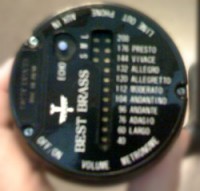
A bit blurry, but a shot of the end of the mute showing its features.

The nicest feature of this mute is its small size and the built-in power unit. No bulky external unit is required in order to attach earphones. It requires only 2 AAA batteries and the entire mute can fit into the horn – even in the horn case.

As an added bonus it has a built-in metronome. While it squawks an unattractive sounding beep, it is a nice feature.

The only other shortcoming I found was that the upper register intonation sounded a bit flat – not terrible, but noticeable. Compensating for this flaw with the lip could, over time, be detrimental. A regular user of this mute would need to grow accustomed to the high range sounding lower than usual and not adjusting for it.

As with any practice mute too, there is a danger in over-blowing due to the sound dampening effect of the mute. The manufacturer recommends using the earphones at all times to counterbalance that temptation.

For the first time when using e-Brass, because of the sound deadening effect, you may blow louder than usual. As a result, the sound that comes out of e-Brass wouldn’t be deadened effectively, and you would be hard to blow. To avoid that problem, using the headphones is recommended when you play the instrument with e- Brass.

Having experienced first-hand “practice-mute chops” this message is a warning to be heeded — all fractured English from the inventor aside.

The price – $250 – may be a bit prohibitive for some, but for its built in technology, compact size and free blowing feel, it is worth the price.

Poulenc Thinks Horn Players Might Drag

This coming weekend I am performing the Poulenc Sextet on a faculty recital at Arizona State, the recital of oboe colleague Martin Schuring. This is a great chamber work that I have not before had the opportunity to perform. Working on it I see one rather interesting marking.

Consider this musical example to be Exhibit A. It is from the opening section of the Finale movement; note the markings sans ralentir.

Poulenc Sextet, Movement 3

The tempo marking is Prestissimo, half note at 116. Basically for a lot of horn players this is right around their maximum single tongue speed at volume. A likely scenario is that on some very early rehearsal of the manuscript the horn player drug these passages, so Poulenc marked them sans ralentir. Which in this case really means “hey horn player, don’t drag this passage.” [There are a number of very similar markings, for the same reason, in the orchestral works of Strauss and Mahler. They don’t want the horns to drag.]

On YouTube one performance of this movement that caught my attention is this one from Venezuela in 2008. Hornist Rainer Ossot does not drag! Enjoy.

Marketing Blunder: The Holton VD Mouthpiece

2

This post could also be subtitled “How Not to Market a Mouthpiece.” With the information I have at hand I can’t pin down the date but at some point in I would guess the 1960s Holton had Farkas expand beyond what became the MC mouthpiece (which was based on the original Schilke FARKAS MODEL) to produce a full line of mouthpieces. By the time I was buying mouthpieces and starting to save literature on the horn in the late 1970s the line had six distinct models; SC (shallow cup), MC (medium cup), MDC (medium deep cup), DC (deep cup), VDC (very deep cup), and XDC (extra deep cup). These are all available to this day, with the MC and MDC being I am sure good steady sellers for Holton for many years.

mouthpieces 003But the mouthpieces produced in this expanded line were introduced with slightly different model designations than those used today. For example the largest two models were the VD and XD models, illustrated here. The lettering is a little hard to see in the photo, but the VD mouthpieces are on the right. I have a pair of each.

Farkas had some experience in marketing so it is really curious in particular that they ever marketed a VD mouthpiece. When I show these to students they often get a chuckle. For those reading this who are not native speakers of English, this link will give you the reason why selling a VD mouthpiece was especially odd. The change to the VDC was a great move.

These two models in the classic and modern versions I find actually work pretty well on natural horn. But on modern horn I don’t know of any player who actually is a fan of these particular models. They are based on very deep designs similar to nineteenth century and Viennese designs, and are really off at an extreme end in a size range few players use today. But they make a great “poor man’s” authentic natural horn mouthpiece and, in the case of the VD mouthpiece, a conversation piece.

Why do we have Old Notation Bass Clef?

1

One of the reasons I love working on the Neuling low horn etudes with advanced horn students is they will not only work your low range like nothing else but also after about half a dozen you will never have trouble reading old notation bass clef ever again.

In horn writing there are two systems for bass clef. Composers as late as Shostakovich used what we commonly refer to today as old notation bass clef. In this system bass clef notes are written one octave lower than the octave we play it in. The first time I saw this I recall being very confused, I thought maybe it was notated in C? But no, it was just notated an octave lower than I was to play in the same key as the horn part (horn in F, horn in D, etc.).

New notation has the part written out in the correct octave; you play it as written. Examples of this are quite uncommon before the 20th century.

But … why?

Recently a reader wrote in and asked why this system? It is a very common question without a clear answer. I believe it mostly had to do initially with easily notating two horn parts together on one line of a score from the days of before Mozart for the few notes that needed to shift over to bass clef on the natural horn. And then, after a time, it just became the tradition. For example, this excerpt of the score of Beethoven 7 is a good example. With the bass clef notes an octave too low they visually look low still on the staff and, if Beethoven had wanted the first horn notes to be even higher than one octave above the second there is plenty of room to notate it on the same stave.

Beethoven 7, movement 1

It is worth noting as well that this type of notation is not confined to horn parts; Classical trumpet parts also have many examples of old notation bass clef writing.

If in doubt if it is old or new notation bass clef it is usually clear in the context of the lower parts in the section; if the notes are lower than any horn player can play, it is old notation.

One final note, working with people on the low range I always use the Neuling books at some point. But with that said I have taught a number of advanced students who came in from other schools and were completely unfamiliar with these etudes. They are great! I have more on Hermann Neuling here, check these etudes out.

What Makes a Performance Great?

ArtCraft Listening to music, looking at fine art or in appreciating a great meal, what is it that makes the experience great, memorable and worthy of praise and adoration?

This question leads to the topic of artistry versus virtuosity. It is one of endless fascination to me.

Is it the overlap between artistry and virtuosity that defines a work of art as being great?

For myself, overly-technical and spotlessly clean music performances — while impressive — fall a bit flat after the “wow” factor wears off.

Wildly interpretative performances on the other hand are both exciting and confusing. A handful of overly demonstrative concert soloists make me wince a little. Possibly a byproduct of my mercurial nature, but I am tempted to mock overly-demonstrative gestures — flying hands, flailing hair and stomping feet.

Perhaps what defines this common ground of greatness is a personal thing – a matter of personal taste.

A recent article on web design — “The Difference Between Art and Design” — delves into this topic head-on. The main points set off fireworks in my head.

Interpolating this article specifically to music, some interesting questions began to surface:

  • Artistic interpretations inspire, technical virtuosity motivates.

An technically-minded performer isn’t inventing something new but is rather conveying a message that already exists — with a driven purpose. An artistically sensitive musician strives to make a strong connection between themselves and their audience – they want to inspire.

Ever listen to a performance where afterward you wanted to go practice?

  • Good art is a talent, good technique is a skill.

Some famous musicians seem to be born and blessed with a great artistic ability. However, you do not have to be a great artist with a huge personality from birth to be a good musician. Sometimes you just need to achieve the goals of the performance.

  • Good art is interpreted, good technique is understood.

With auditions in particular, solid technique is a must. Missed notes and “clams” are not allowed. On the other hand, conveying some personality can add the extra spice that wins the position.

This being said:

  • Good art sends a different message to everyone, good technique sends the same message to everyone.

Check out the complete article and share what you think below. It certainly got me thinking.

Review: A Soft Stand for your Horn

9

I was recently contacted by the maker of Soft Stands to try their horn stand. Looking at their site, it looked like an interesting product. What horn stands I had seen in the past were either sort of variations on a guitar stand or seemed to be more for display purposes than actual daily use by horn players. The Soft Stand looked to be well suited for daily use in my situation as a studio horn teacher. [See UPDATE at end for availability.]

Their product description begins,

We are offering a radical new approach to French Horn stands. Most other designs are simply variations of the “display plate” approach, where the horn is placed on three points of contact, with the majority of the weight being distributed on the two lower points. The total area of support is very small; on many models well under ½ square inch. “Soft Stands” gently cradle your horn with a support area of over 25 square inches of soft polar fleece fabric…. If properly used, it is impossible to dent your horn with a Soft Stand.

Soft Stand for hornThe photo shows the stand and how I have it placed in my office, between my chair and a magazine rack that I use for music that is frequently used in lessons. As advertised, the horn sits securely in the Soft Stand in for me an ideal, convenient location.

One other selling point of the Soft Stand is that it can be assembled and disassembled easily and packs up in a compact carrying case. The stand itself is held together with bungee cords.  This leaves the frame slightly flexible which is I think generally a positive thing but some might perceive to be a negative. If you desire the frame to be completely solid it would not be difficult to glue it into a fixed position. In any case the stand is stable and would take effort to knock over.

Besides daily use in a home practice room or teaching studio I can also see this product being very handy for the player who often plays shows or opera and for some orchestral works. In a situation where there are many rests it keeps the horn right there handy next to the chair ready to go. For this same reason, it would also be handy in a work such as Bruckner 8 where you have to make quick changes from horn to Wagner tuba.

In short, if you are looking for a horn stand this is a solid product worth looking into. It is priced at $75 (shipping included) and comes in two sizes, double horn and triple horn. My stand is double horn size but actually my Paxman triple fits it just fine as well.

There is more information to be found in their site along with ordering information. Also note that this product is also available sized for Euphonium, which I believe would also have applications in an orchestral situation where horn and Wagner tuba doubling is required.

Finally, a disclaimer: I was given this stand by the maker, under the understanding that I was not obligated to review it. I posted the review because I do feel that it is an interesting product worth looking into.

UPDATE 2015: These are no longer available, as noted in the comments as well. Someone handy enough could make something similar just from the photo. I LOVE the soft stand I have, it is wonderful in my office, it is to be hoped a similar product makes it to market again.

UPDATE 2016: And they are back on the market! The link above still works, and I still love this product. Everyone needs one!

Stopped Horn: Up or Down? Does it Matter?

In a past tongue-in-cheek article — “How to Provoke a Horn Geek” — I poked a little fun a some hot button issues in the horn world. One of those is the ongoing debate of stopped horn and whether the pitch actually raises or lowers upon closing the bell with the hand.

Archived discussions at the HornPlayer.net site illustrate this debate and its dogma:

An article at the Music Animation website reprints some information from an August 1976 issue of the Journal of the Acoustical Society of America. Author and acoustical expert John Backus offers logical explanations for either theory.

Smoke and mirrors

All acoustical and theoretical discussion aside, stopped fingerings are generally the easiest to figure out and play on the F-side of the double horn. Simply finger the stopped note down one-half step below the written pitch.

This is not to say that B-flat fingerings will not work for stopped horn. It is just that they might take some experimenting to figure out what works best. B-flat stopped fingerings generally do not fit into a neat pattern like those on the F-horn.

Stop mutes

When it came to stopped horn, “flesh is best” was the advice from a former teacher of mine. Yet, not everyone has the hand size to stop the bell in order to get the proper effect. In these cases, a stop mute can be a big help.

Bruce Richards has [or UPDATE had, site no longer online] an excellent series on stopped horn on his blog “Thoughts on Playing the Horn Pretty Well.” He recommended the use of the wood stop mutes, expressing a preference for its sound over brass mutes. He makes (made) a convincing argument.

The Balu stop mute is another very unique design.

Another interesting product that I have never tried is the non-transposing stop mute. In the best of both worlds, I would love to own all three types.

A makeshift solution

A simple solution that I am experimenting with resembles a product invented by Pip Eastop, the “EaseStop.” (The last time I checked the pictures were missing from his site.)

A large gum eraser — held as pictured below — might help individuals with smaller hands achieve a better stopped effect. A few of my students have had good luck with this makeshift solution.

eraser1 eraser2

Little Boy Blue, Come Blow Your Horn

thomas_gainsborough_blue-boy2The Blue Boy (c. 1770) is the most famous work by English portrait artist Thomas Gainsborough (1727-1788).

Though not related, it is often mistaken as being associated with the nursery rhyme Little Boy Blue. This particular rendition may only compound that confusion.

[Click the image for the complete view.]