Home Blog Page 146

A Fingering Chart for Single F, Double, and Single B-flat Horns

0

I know from the site stats that people are looking for fingering charts for the horn!

Typically horn fingering charts are somewhat confusing as they combine fingerings for F and B-flat horns without presenting clearly a preferred set for the double horn. In response to this need I have posted a PDF (extracted from my publication Introducing the Horn) of my horn fingering chart, which clearly presents the fingerings for the three most popular types of horns for beginners.

What type of horn do I have?

Related, if you need a fingering chart, you may also be wondering what type of horn you have?

Going back to the late 19th century as a starting point, there were no double horns! Players back then used either single F or single Bb horns. The double horn became popular in the early 20th century and combines both pitch lengths, as you will see with the double set of valve slides. Photos below should clear up what you have.

Single F (nearly always has 3 valves.) [Note that the valve slides are longer on the F horn than the Bb horn below.]

Single Bb (may have 3 or 4 valves — the “extra” valve is a stopping valve.) [And note: the pitch is thought of as being “in F.” This horn just has a different set of fingerings than a single F, and plays at the same pitch level.]

Double horn (will have most typically 4 “two-story” valves, with the 4th valve placed either before or after the main 3 valves.)

A Blind Test of Horns at IHS Denver, the Results

1

A post on the Pope Instrument Repair site/blog points to the results of the blind test of horns done at the 2008 IHS Denver Symposium. The results are here, worth checking out if you are an advanced hornist.

UPDATE-2011: The results are gone now! But, relying on memory, the gist of it was three (four) horns were tested. One was a custom Geyer horn of some sort, one was probably a Conn 8D, one was a Reynolds Pottag Model, and the other was a “mystery horn.” Read more about the Reynolds Pottag Model here; you will want to after reading the results.

The gist of the results was that when listeners knew they were hearing the Reynolds they did not like it but Pope tricked the audience! For the Reynolds was also the “mystery horn,” and when people rated the mystery horn it often came in as the best sounding horn! Says something about our ears versus bias against certain models and types of horn.

The following September the following short article was posted as well, and it seems like one to combine with this one for a bit more complete article.

Inspired by the report of the blind horn tests done at IHS Denver, in our first studio class of the semester I did something similar. The three horns used in the test were three quite different horns, a big Paxman 25AND horn (the one I recorded my solo CDs on), a Holton single B-flat, and a Conn single F. Students were told that these were the three horns but they were not told which horn was which. I played a C major scale on all three horns and they had to guess which one I played first, second, and third.

The majority of the studio did in fact get it right; it was not extremely hard to do as these three horns are quite different. Still, it was pretty interesting as the difference was much smaller than they thought it might be given the vastly different nature and quality of the instruments in the test. Something to ponder.

Transposition Tricks: Old vs. New Notation

A detailed description of bass clef notation for French horn.

Since posting a blog on concert-pitch bass clef transposition, I have been getting a lot of Google hits on the topic of “old” and “new” bass clef notation. This style of notation – not related to transposing concert-pitch bass clef music – is distinct to the French horn and causes loads of confusion for both players and conductors.

Ever since the French horn was introduced into the orchestra until about the mid-20th century, composers have utilized a unique standard for notating bass clef notes. This style of notation – known as “old notation” – was the practice of transposing bass clef notes in octaves below concert pitch rather than above.

The rationale for this compositional practice is not completely known, but it is a standard that modern-day horn-players must compensate for nonetheless.

The Composer’s Perspective

The exact interval for this down-transposition practice depended on what key the composer decided to pitch the horn in. Remember that prior to circa 1850, most horns used in the professional arena were valveless, using detachable crooks to change keys and right-hand techniques to fill in harmonic series gaps.

For a horn crooked in F (the key that modern horns read and play in), the composer would transpose bass clef notes down a perfect 4th (rather than today’s standard of up a perfect 5th). So for example:

Example 1a:

Another example, for Horn in A illustrates the same principle. Instead of writing Horn in A from concert pitch up a minor 3rd, a composer would write it down a major 6th:

Example 1b:

The Hornist’s Perspective

To compensate for this practice, a modern day horn-player must always play old notation by reading the notes up one octave from where they are written.

If a transposition (other than Horn in F) is involved some forethought to decipher exactly what notes to play may be necessary.

*Example 1c:

[*The notes in red are the pitches to actually be played for a Horn in F.]

As illustrated above, for a transposition other than Horn in F, you must apply the “octave up” rule plus the normal transposition. For the Horn in A example above, the “octave up” rule applies plus the transposition for Horn in A (up a major third).

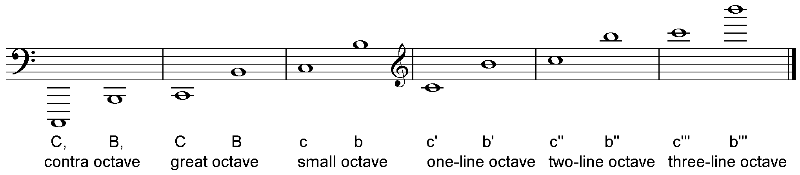
Fortunately with Classical and early Romantic era compositions, the number of old notation notes is primarily limited to the lowest 3 or 4 notes of the harmonic series. The example 1c above illustrates this – the written* bass clef notes in Classical and early Romantic are primarily C, e, g and c’ (see octave registration chart).

[*Please do not confuse this statement with actual sounding or transposed pitches.]

In late Romantic and early 20th century era however, as valved horns came into vogue, composers produced much more complex old notation parts.

Beyond the Natural Horn

Example 2:

As illustrated in the excerpt above from Strauss’ Ein Heldenleben, the old notation standard continued into the late Romantic period, but the writing became much more complex. No longer was old notation bass isolated to 3 or 4 notes.

Example 2 aside, take a look at the famous opening call to Till Eulenspiegel.

Example 3:

The three bass clef notes in this well-known excerpt are written in old notation. Because the passage is written for Horn in F, there is no additional transposition required other than the “octave up” rule. The horn player plays c’, g and C. (see octave registration chart).

However, in the same composition Strauss utilizes “Horn in D” old notation passages in the third horn part.

Example 4a:

The complete transposition then, is “octave up” (compensating for old notation) plus down a major third (compensating for Horn in D).

The passage at 29 in Example 4a, written out for Horn in F, would like like this:

Example 4b:

When to Zig, When to Zag

In the period from the late 19th to early 20th century, old notation began to fall from common usage. In this transitional period, some composers stayed with old notation while others adopted new notation.

Example 5a: Excerpt from Mahler: Symphony No. 1 (old notation)

Example 5b: Excerpt from Mussorgsky/Ravel: Pictures at an Exhibition (new notation)

The rule of thumb

There is then, no hard-and-fast rule to determine what is “old” and what is “new” bass clef notation. However –

  • …if the composition was written prior to 1920 and,
  • …if the bass clef note is well below the staff

– chances are that it is old notation.

A quote from Eldon Matlick at hornplayer.net sums it up nicely:

Even 20thc composers (even those active today) are not universal in the type of bass clef notation. Thus, there are a few ways you might be able to hazard a guess:

The first rule of thumb is that if the bass clef part has any ledger lines below the staff, especially below E, it probably is in old notation. However, don’t be fooled as the low E in the Shostakovitch 5th Symphony is the real thing!

So, the best thing you can do is to look at the score to see the voicing of the orchestration. This might give you a clue, especially if there are horns in octaves written in bass clef. If this is common piece of music, get a recording and listen to it with your part and score.

If this is a band work, it “probably” is written in new notation. I’m not trying to side step the issue, but this is a problem we as hornists must deal with.

Fingerings and Notations for the Single B-flat Horn

Exactly how to think of fingerings and notations for the single B-flat horn is a point of confusion for many music educators. I believe this is a topic not covered well typically in a methods class.

A horn player reads from F horn music only, no matter what type of horn they play. If a person, perhaps a beginner, has a single B-flat horn really all this means is that they use B-flat horn fingerings but they still read from music in F like every one else. The fingerings for a single B-flat horn are exactly the same as the thumb down fingerings on a F/B-flat double horn. The fingerings for a single F horn are exactly the same as the thumb up fingerings on a F/B-flat double horn.

The important point to grasp is that horn players don’t look at B-flat horn fingerings like those of a trumpet or baritone–we think of them as being the B-flat side of a double horn fingerings. Pitches are still conceived of as being in F.

The confusion noted earlier is related to wondering the question can a player on a single B-flat horn read F horn music or do they need a different part? The answer is there is absolutely no problem with B-flat horn in relation to music in F. Most beginner methods present B-flat horn and F horn fingerings right there in the book and give both sets in the fingering chart. From the perspective of the students in a section where some players have single F and others single B-flat horns they just have different types of horns and they use somewhat different fingerings but they read from the same music and play at the same pitch level.

In terms of comparing the two types of single horns, the example I like to give my students is to just play them back to back, single F and single B-flat. The main thing to notice hearing the two is that the single B-flat horn sounds considerably better. If you were to play them back-to-back you would note that the single B-flat is easier to play also.

In short, there is no specific problem with fingerings or notations to overcome for the single B-flat horn. The player just uses the line of single B-flat horn fingerings, such as presented in my publication Introducing the Horn and pretty much every other introductory method out there for horn players.

One other footnote: notations and fingerings are the same for the B-flat marching horn. Parts should be notated in F and the fingerings are those of the B-flat side of a double horn, as described above.

Oddities: What a Pisser!

Building a better mousetrap?

I first found this picture at Ilkka Talvi’s schmaltzuberalles.blogspot.com.

It also can be found at many other web sites. I found no copyright information but nevertheless under the guise of “fair use,” I am posting it here.

Talavi maintains a very good blog with excellent and varied content. It does have one very unfortunate design flaw: one very long scrolling page showing all posts on one single page. This makes linking to a specific post impossible.

Nit-picking aside Mr. Talvi, as a Finnish ex-patriot, writes with a fresh perspective on a variety of topics. His July 13th post included this picture of what I believe to be a tenor horn – not a Wagner tuba – converted into a urinal in a public bathroom. (!)

In my twisted imagination I see this as a very unique opportunity to connect to symphony patrons. Imagine adding fixtures like these to a concert hall bathroom! Any brass instrument would be fair game of course, and with a little creativity, the larger woodwinds and strings could also play a role.

The conversation at intermission might go like this:

HUSBAND:

“Oh my dear, you should see the cute little tenor horn urinal in the Men’s bathroom. It’s amazing!”

WIFE:

“That’s nothing compared to the contrabassoon in the Women’s bathroom!”

Or better yet…

Bathroom facilities like these could be installed in failed orchestra management offices (!) where frustrated administrators (maybe like those in … Columbus, Ohio?) could figuratively and literally take a crap on their musicians.

The Kozinn Effect: A New York Times Music Critic and His Dislike for the French Horn

“The good critic is he who relates the adventures of his soul among masterpieces.” –Anatole France

As the word spreads on the New York Times article “The French Horn – That Wild Card of the Orchestra” in which the French horn and the New York Philharmonic horn section are much maligned, more people are chiming in.

In addition to sources quoted in “Wild Card Critic,” here is more of the latest, including an email found on a forum from the critic himself:

  • International Horn Society President Jeffrey Snedeker has posted a message at IHS Online. His stance assumes the high ground between responsible reporting and realistic expectations of live performances. This is similar to a response made in “Chasing Rainbows.”
  • A discussion at the TrumpetHerald.com includes an email reply from Mr. Kozinn where he defends his position and clarifies his stance.

    The reaction to this piece has been extremely interesting. I’ve had something more than 200 emails. Roughly 10% were from irate hornists and their colleagues [EDIT]. Among the other 90% were a surprisingly high number from hornists, both professional and part time, who said, basically, “it’s true, we offer too many excuses, and we should be held to account.” Many of the others, from both professional musicians and “civilian” readers alike, listed performances that had been ruined for them by substandard horn playing — some going back decades: those performances weren’t just ruined, they were ruined so spectacularly that people haven’t forgotten them. That, I think, is what horn players should be worrying about instead of whether or not they’re called on it in the New York Times.

  • At the Pillage Idiot blog, blogger “Attila” paints sports metaphors, and astutely points out that “clams” are more often the by-product of the harmonic series and not due to errant condensation, as Mr. Kozinn has written.

Other related items of interest:

  • An old post at “The Short Road to Nirvana,” discusses an article by Kozinn in which David Jolley is sharply critiqued. It offers a composer’s perspective.
  • Check out Mr. Kozinn’s biography on Wikipedia. Reading between the lines, one would surmise that his musical background is in the pop genre – guitar and keyboards, maybe?
  • See an old post at Greg Sandow’s blog where he asks, WTF dude?

You Say Marcato, I Say Staccato

The final bars of Stravinsky’s Firebird.

When it came to international copyrights composer Igor Stravinsky had to be a shrewd businessman. At the time he composed his famous Ballet Russe scores, copyright protection had a very limited scope and offered little protection.

After a score’s copyright expired, any publisher could pick it up and replicate it without any revenue going back to the composer. In the event of a force majeure (say, like the Russian Revolution!) a composer could lose all rights and hence, royalty payments.

With his famous ballet scores Stravinsky circumvented this loophole by regularly publishing alternate and revised versions of his scores.

In the 1964 1965 video featured below, Stravinsky conducts the last two sections of his Firebird Suite. The horn solo occurs at about the 4:15 mark – Alan Civil performs (on a single B-flat horn.)

I greatly admire Stravinsky’s interpretation with the unison chords near the end of the piece, which are executed as dry staccatos – as clearly indicated in his score. While his conducting style is very metronomic (many times composers do not make the most expressive conductors), this particular detail works very well in context. In modern performances today this effect is typically ignored; the chords are performed as long, marcato notes.

Take a look at a 1961 performance with the New Zealand National Orchestra – Stravinsky is again at the podium. What is most interesting about this video is that it also includes a modern performance of the same excerpt. The contrast further illustrates the staccato vs. marcato issue I address.

This interpretation by the composer himself beckons the question – why do today’s conductors elongate these staccatos?

While the longer chords are what we have grown to expect – giving conductors an opportunity to dramatically flail their arms – the dry staccatos to my ear are much more terse and interesting. The final few measures then, are even more glorious and final.

It is reminiscent of one of my favorite symphonies, the Sibelius’ 5th. In the coda after a long build-up, it concludes with loud, broadly-spaced staccato chords.

The effect is distinctive and very powerful.

Photo credit:
Hood detail, 1977 Pontiac Firebird


flickr.com/photos/loveandhaight/13382671/sizes/s/


Thoughts on Choosing a School for Advanced Horn Study

0

The topic of choosing a school for horn study is a large topic. Any talented horn player will find themselves with several good choices as to schools, but underlying the topic at all is a larger question. Is college level horn study a good idea? I may be biased but I would still say yes. But read on, there are many things to consider.

Undergraduate

First, an observation; undergrads are in general not as good at researching horn programs as are graduate students. If you are reading this post as a high school senior you are to be commended as being ahead of the game.

The most important thing to research is the horn teacher. E-mail them; meet them; take a lesson or even a couple lessons if possible. It is a big commitment. If you can’t get a reply from them by E-mail this could be a bad sign. A part of my job as a horn professor at ASU is to meet with and recruit prospective students. If a teacher doesn’t have time for you now they may not have time later either. Don’t be afraid to try to contact horn teachers directly. I know I appreciate direct contact via clearly written E-mails. But note: I am sure occasionally I miss messages! Realize that sometimes they land in the junk mail by accident or sometimes they may have been sent to an incorrect address (at one point there was also a John Erickson at ASU!). So be sure to give the professor a second chance as to an E-mail reply, you may have just caught a bit of Internet bad luck.

In general I recommend schools at the undergraduate level that have full time horn teachers. My feeling is that you will have more interaction with the teacher and it will be the best overall experience. Every program is a bit different, check out a number of schools to see what you are comfortable with. Imagine what it would be like to spend the next four years at this place while you are there.

In general I also strongly recommend going to a school where you won’t run up a large debt. I went through undergrad at a small college and at the end had no debt at all! It made an expensive grad school much more possible to attend.

As you are looking at teachers I have found there is one resource that is right at your fingertips but is underutilized. Take the time to read the biography of the horn teacher as posted in the website of the school. It is interesting, you can tell a lot about someone by what they say about themselves. And if the school website is disorganized and hard to navigate this may also be taken as a bad sign.

There are a couple of “traps” to avoid when looking at teachers. One is the “famous teacher” trap, which is that while it is cool to work with someone everyone has heard of at a famous school, not all famous teachers are actually teachers that you would work with well. Teaching styles vary widely. Closely related is the “my way or the highway” trap. Some teachers have a style that is closely oriented around just one way of playing. Which is fine if it works for you but if it does not you may find that you have made a big mistake in choosing that teacher. Better to research it out first. Some teachers, such as myself, are very comfortable working in different styles. My goal is not to make every student a parrot of me but to instead help them to sound as good as possible in relation to the range of possible styles of horn playing.

Visit the campus but keep in mind as you visit yet another mistake I see. Some students will pick schools instead of teachers and programs. Your experience at the school will be very much influenced by your experience with the teacher and the overall music program. Don’t just pick a great campus even if you have many people pushing you to attend, make it your first priority to pick a teacher and program.

Performance can be a good undergraduate degree program but you have to be ready to give your best to reach a very high level on the horn and you can’t be too far behind going in. Gear up for the audition, for sure take some lessons on the music with a qualified horn teacher. If your audition is not together you won’t get in. There really are not a lot of performance jobs out there after you graduate, which is why we must be very selective with performance applicants. In terms of getting a playing job at the end of your degree the trick is to be the best applicant. To make that level you have to be pretty ready to go by the end of an undergraduate degree, at the least playing at a level that you can polish everything up very well during MM study later.

Music education is a great option. For students considering this program I have one standard thing I tell them; the reason to be a music education major is because you would like to be a music educator. Typically the performance requirement in terms of entrance level it is somewhat lower than in a performance program. Many students audition for me for the performance degree that play on a level acceptable for music education but not for performance. But realize that if you don’t show that you have a good ear and some potential you will also be rejected for music education. It is not enough to love band and want to be a director, you have to individually show that you have made the effort to reach the highest level you can as a player.

Note also, not all schools require marching band for music education students. ASU in 2012 dropped this requirement.

I also very much enjoy working with music therapy students from time to time at ASU. This is actually a great program, one I would highly recommend if this is an interest of yours. The BA program is also a good fit for some students. Speaking generally, however, it can be an unfocused program and would not be my first choice for a student. Music business can be another good option.

As you look at audition requirements remember that really it is much more how you play than what you play. Play music that you are comfortable with and represents the best that you can play. Be ready to play scales (they should not sound like a surprise!) and to sight read. It is OK to mess up some things, as in the end we are listening for and estimating your potential. But with one foot note; be sure you have some contrast of style in what you play as your solo selections. Two different movements of Mozart are a poor choice.

Graduate:

When the time comes that you are nearing the end of an undergraduate program it is time to think about grad school. Grad applicants are much more aware, speaking generally, of what they are getting into than the average undergrad, and are in general I find looking to polish up their playing to a higher level to take auditions for performing positions.

First, read all of what I say above about finding an undergraduate program and do the same homework with respect to looking for a graduate program. Contact potential teachers, take lessons with them, visit websites and schools, etc. Check it all out well; grad school is a big commitment. Also check the audition requirements. They may be less flexible than in undergraduate auditions. If coming in you are too far behind on excerpts and solo study the MM may not be an option. Also be aware that we are looking at your undergraduate grades and the recommendation letters in your file. If you had lots of trouble in theory classes in particular this is viewed by many teachers as a red flag.

For many the MM is a degree that is seen as the last and best chance to go after the dream of performing on the horn. It is a time to really knuckle down and work, and it is especially important at this point to work with a teacher that knows and teaches excerpts.

Historically many of my MM students at ASU have had undergraduate degrees in music education, and it actually makes a lot of sense for them to consider the MM performance program as in many states a Masters degree is required of music educators to obtain permanent certification.

In the MM performance program I am pretty focused on development of skills needed for orchestral playing and auditions. As a part of your audition you need to show me that you have a foundation laid and that you are at a point where you can make the kind of additional progress required.

The terminal graduate degree in horn is the Doctorate, in most cases the DMA (Doctor of Musical Arts, although I have a DM). While traditionally this program was for students that wanted to teach at the college level, increasingly I find that a percentage of DMA students are basically players who are working toward winning a performance job. Still, I see the DMA as ideally a degree for someone who wants to build a career that includes playing and teaching at the college level. Many schools require the Doctorate for tenure track faculty. In terms of how I teach a DMA student, this study is an extension of MM study but with more thought given to building a broader resume and experience.

Unless you went to a very prestigious school for your undergrad you should probably be thinking about a larger school for your advanced degrees. Ideally for someone wanting to teach college you should attend a variety of schools; I attended a small college (BM-Emporia State), a conservatory (MM and PC, Eastman), and a large university (DM-Indiana) for my degrees. Plus I built up a resume with solid performing experiences (including Third Horn in the Nashville Symphony) and publications.

Finally, in conclusion, consider ASU among your options. We have a very strong program at all levels, one that should be considered by any serious student of the horn.

Behave Yourself in Rehearsal

Reminders for the new school year.

Not enough can be said about keeping your cool while working with others; no matter how badly you want to scream at the top of your lungs with bitter angst and pained anguish it is always a better strategy to suck it up and play nice.

Professional behavior and demeanor in the freelance realm can make the difference between getting jobs and waiting at home for the phone to ring. In the academic world, good behavior can make the difference between a productive educational experience and one plagued with unnecessary drama and stumbling blocks.

I have previously blogged a top-ten list (“Who’s the New Guy?”) which highlights some of the most common rookie mistakes I have either seen or committed while on the job. By virtue of their artistic sensibilities, musicians tend to be a temperamental bunch and left unchecked, this temperament can turn into unnecessary temper tantrums.

In American popular media, bad behavior is often rewarded; being naughty gleans attention and the spotlight. A vast majority of so-called “reality” television for example, is comprised of clashing personalities strategically chosen and pushed into conflict by the show’s producers. The resulting messy conflict draws higher ratings and from a marketing viewpoint, this works to keep the show from being canceled. Television viewers like to watch this kind of drivel in the same way that drivers like to slow down and “rubber-neck” car accidents.

Beware – this is only an illusion and television is not reality. Unless you are a million-dollar heiress to an exclusive hotel brand, selfish and inappropriate behavior can have dire consequences.

Acting like a brat in the music world will get you shunned and ostracized. Of course, I am not alone in having posted cautionary warnings like this. Here are a few others:

Photo credit: www.flickr.com/photos/nickulas/449802607/sizes/s/

Wild Card Critic Allan Kozinn Rails on the NY Phil Horns

Reaction around the Internet.

I have been tracking the response to Allan Kozinn’s New York Times article “The French Horn – That Wild Card of the Orchestra.” As of August 15th, this article was the #2 most e-mailed Times arts-related story and #17 in the overall rankings.

Beside my own commentary, here is a post of some other blog and forum reactions.

  • Kenneth Woods on his blog “View from the Podium” points out from the conductor and teacher perspective that ordering players to DO NOT MISS!!, can provoke more mistakes in “Why I Subscribe to the New York Times.”
  • While the Yahoo Horn Group has been relatively subdued on the topic, the forum discussion at TrumpetHerald.com has been quite animated.
  • At “Brass and Ivory” blog a funny story of a horn player stomping music and throwing his horn is told.
  • John Ericson’s “On Defensive Hornists and Accuracy.”
  • A brief response at the “College Confidential” forum.
  • Greg Sabo has posted a blog with the provocative title “The Worst Instrument in the World.” Apparently his experience was nothing but frustration.
  • ArtsJournal.com which normally picks up everything arts-related in the media either missed this one completely, or made a conscious decision to pass on it (!?)

As an aside to add some perspective, I also found “Eavesdropping on a Horn God” an interesting read – notes taken at a Phil Myers masterclass on taking auditions. An old CNN article is also worth a look.